



Plant Modernization, Stricter Safety Standards and Digital, Corrosion-Resistant Technologies Drive Petrochemical Pump Demand
Petrochemical Pumps Market
Dublin, Aug. 14, 2026 (GLOBE NEWSWIRE) — The “Petrochemical Pumps Market Opportunity, Growth Drivers, Industry Trend Analysis, and Forecast 2026-2035” has been added to ResearchAndMarkets.com’s offering.
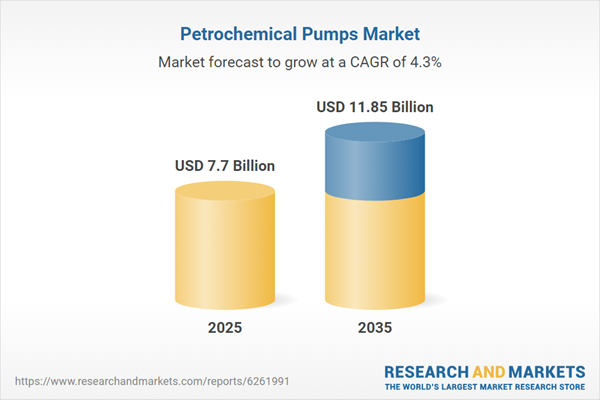

The global petrochemical pumps market was valued at USD 7.7 billion in 2025 and is estimated to grow at a CAGR of 4.3% to reach USD 11.85 billion by 2035.
Market expansion is supported by the rising consumption of petrochemical products across multiple industrial sectors, increasing investments in modern processing infrastructure, and continuous advancements in pump technologies that improve efficiency and operational reliability. Growing industrialization and expanding production capacities are driving the need for durable pumping systems capable of handling demanding petrochemical applications while maintaining high performance under challenging operating conditions. In addition, stricter environmental and industrial safety requirements are encouraging manufacturers and plant operators to adopt high-quality pumping equipment that supports regulatory compliance, minimizes leakage, and improves operational safety. Ongoing modernization of processing facilities is creating sustained demand for advanced pump solutions that enhance production efficiency, reduce maintenance requirements, and optimize lifecycle costs. At the same time, the long-term expansion of global petrochemical production capacity is expected to provide consistent growth opportunities for both equipment manufacturers and aftermarket service providers, reinforcing positive market momentum throughout the forecast period.
The centrifugal pumps segment is expected to generate USD 5 billion in 2025. The segment maintains its dominant position because of its broad application across petrochemical processing operations and its ability to deliver reliable performance under a wide range of operating conditions. Its extensive industry acceptance is supported by established engineering standards, widespread manufacturing availability, operational versatility, and a favorable total cost of ownership compared with other pump technologies. These advantages continue to strengthen its adoption across existing facilities and newly commissioned petrochemical plants.
The stainless steel segment is projected to grow at a CAGR of 4.6% through 2035. Increasing adoption of stainless steel pumps is being driven by their superior corrosion resistance, extended operational lifespan, and ability to meet increasingly stringent environmental, safety, and operational standards. These performance benefits are encouraging greater deployment across demanding petrochemical processing environments where equipment reliability and durability remain critical priorities.
The United States petrochemical pumps market accounted for a 77% share in 2025, generating USD 1.8 billion. The country’s leading position is supported by a well-established petrochemical manufacturing base, ongoing investments in facility modernization, and strong demand for reliable industrial equipment. Regulatory frameworks focused on workplace safety, emissions control, and operational reliability continue to encourage investment in advanced pump technologies capable of supporting safe and efficient plant operations. These factors are expected to sustain steady demand for high-performance petrochemical pumps throughout the forecast period.
Major companies operating in the global petrochemical pumps market include Flowserve Corporation, Sulzer Ltd., Baker Hughes, ITT Inc., KSB SE & Co. KGaA, Ebara Corporation, Kirloskar Brothers Ltd., Nikkiso Co., Ltd., Ruhrpumpen GmbH, Sundyne LLC, LEWA GmbH, Trillium Flow Technologies, SEEPEX GmbH, Torishima Pump Mfg. Co., Ltd., PumpWorks LLC, Dickow Pumpen GmbH & Co. KG, KAIQUAN Pump Group, Jiangsu Haishi Pump Manufacturing Co., Ltd., OPTIMEX Pumps, FB Bombas, and United Pumps Australia. Companies operating in the petrochemical pumps market are strengthening their market positions through continuous investment in product innovation, digital monitoring capabilities, and high-efficiency pump technologies. Manufacturers are expanding their portfolios with corrosion-resistant materials, energy-efficient designs, and predictive maintenance solutions that improve equipment reliability and reduce operating costs. Strategic collaborations with engineering contractors, petrochemical producers, and industrial distributors are helping companies broaden their customer reach and secure long-term supply agreements. Businesses are also increasing investments in manufacturing capacity, aftermarket services, and regional service networks to improve customer support and lifecycle value.
Comprehensive Market Analysis and Forecast
Industry trends, key growth drivers, challenges, future opportunities, and regulatory landscape
Competitive landscape with Porter’s Five Forces and PESTEL analysis
Market size, segmentation, and regional forecasts
In-depth company profiles, business strategies, financial insights, and SWOT analysis
Key Attributes:
| Report Attribute | Details |
| No. of Pages | 250 |
| Forecast Period | 2025 – 2035 |
| Estimated Market Value (USD) in 2025 | $7.7 Billion |
| Forecasted Market Value (USD) by 2035 | $11.85 Billion |
| Compound Annual Growth Rate | 4.3% |
| Regions Covered | Global |
Key Topics Covered:
Chapter 1 Methodology and Scope
1.1 Market scope and definition
1.2 Research design
1.2.1 Research approach
1.2.2 Data collection methods
1.3 Data mining sources
1.3.1 Global
1.3.2 Regional/Country
1.4 Base estimates and calculations
1.4.1 Base year calculation
1.4.2 Key trends for market estimation
1.5 Primary research and validation
1.5.1 Primary sources
1.6 Forecast model
1.7 Research assumptions and limitations
Chapter 2 Executive Summary
2.1 Industry 360 synopsis
2.2 Key market trends
2.2.1 Regional
2.2.2 Type
2.2.3 Material
2.2.4 Application
2.2.5 End Use
2.2.6 Distribution Channel
Chapter 3 Industry Insights
3.1 Industry ecosystem analysis
3.1.1 Supplier landscape
3.1.2 Profit margin
3.1.3 Value addition at each stage
3.1.4 Factor affecting the value chain
3.2 Industry impact forces
3.2.1 Growth drivers
3.2.2 Industry pitfalls & challenges
3.2.3 Opportunities
3.3 Growth potential analysis
3.3.1 Price volatility and market unpredictability
3.3.2 Quality assurance and equipment reliability concerns
3.4 Future market trends
3.5 Technology and innovation landscape
3.5.1 Current technological trends
3.5.2 Emerging technologies
3.6 Pricing Analysis (Driven by Primary Research)
3.6.1 Historical Price Trend Analysis (Driven by Primary Research)
3.6.2 Pricing Strategy by Player Type (Premium/Value/Cost-plus) (Driven by Primary Research)
3.6.3 Average Selling Price by Product Type & Capacity
3.7 Regulatory landscape
3.7.1 Standards and compliance requirements
3.7.2 Regional regulatory frameworks
3.7.3 Certification standards
3.8 Porter’s analysis
3.9 PESTEL analysis
3.10 Trade Data Analysis (Driven by Primary Research)
3.10.1 Import/Export Volume & Value Trends by Region (HS Code Level) (Driven by Primary Research)
3.10.2 Key Trade Corridors (China-North America, China-Europe) & Tariff Impact (Driven by Primary Research)
3.11 Impact of AI & Generative AI on the Petrochemical Pumps Market
3.11.1 AI-Driven Disruption of Existing Business Models
3.11.2 GenAI Use Cases & Adoption Roadmap by Segment
3.11.3 Risks, Limitations & Regulatory Considerations
3.12 Capacity and Production Landscape – Asia-Pacific (Driven by Primary Research)
3.12.1 Installed Capacity by Country and Key Producer – Asia-Pacific (Driven by Primary Research)
3.12.2 Capacity Utilization Rates and Expansion Pipelines (Driven by Primary Research)
Chapter 4 Competitive Landscape, 2025
4.1 Introduction
4.2 Company market share analysis
4.2.1 by region
4.2.1.1 North America
4.2.1.2 Europe
4.2.1.3 Asia-Pacific
4.2.1.4 Latin America
4.2.1.5 Middle East and Africa
4.3 Company matrix analysis
4.4 Competitive analysis of major market players
4.5 Competitive positioning matrix
4.6 Key developments
4.6.1 Mergers & acquisitions
4.6.2 Partnerships & collaborations
4.6.3 New product launches
4.6.4 Expansion plans
Chapter 5 Market Estimates & Forecast, by Type, 2022-2035, (USD Billion) (Thousand Units)
5.1 Key trends
5.2 Centrifugal pumps
5.3 Positive displacement pumps
5.4 Rotary pumps
Chapter 6 Market Estimates & Forecast, by Material, 2022-2035, (USD Billion) (Thousand Units)
6.1 Key trends
6.2 Stainless steel
6.3 Carbon steel
6.4 Alloy steel
6.5 Others (e.g., nickel alloys)
Chapter 7 Market Estimates & Forecast, by Application, 2022-2035, (USD Billion) (Thousand Units)
7.1 Key trends
7.2 Upstream
7.2.1 Exploration pumps
7.2.2 Production pumps (e.g., artificial lift)
7.2.3 Injection pumps
7.2.4 Transfer pumps
7.3 Midstream
7.3.1 Pipeline pumps
7.3.2 Storage pumps
7.3.3 Loading/unloading pumps
7.4 Downstream
7.4.1 Refinery pumps
7.4.2 Petrochemical plant pumps
7.4.3 Distribution pumps
Chapter 8 Market Estimates & Forecast, by End Use, 2022-2035, (USD Billion) (Thousand Units)
8.1 Key trends
8.2 Oil & gas
8.3 Chemical
8.4 Power generation
8.5 Others (e.g., water treatment)
Chapter 9 Market Estimates & Forecast, by Distribution Channel, 2022-2035, (USD Billion) (Thousand Units)
9.1 Key trends
9.2 Direct sales
9.3 Indirect sales
Chapter 10 Market Estimates and Forecast, by Region, 2022-2035 (USD Billion) (Thousand Units)
10.1 Key trends
10.2 North America
10.2.1 U.S.
10.2.2 Canada
10.3 Europe
10.3.1 Germany
10.3.2 UK
10.3.3 France
10.3.4 Italy
10.3.5 Spain
10.4 Asia-Pacific
10.4.1 China
10.4.2 Japan
10.4.3 India
10.4.4 Australia
10.4.5 South Korea
10.5 Latin America
10.5.1 Brazil
10.5.2 Mexico
10.5.3 Argentina
10.6 Middle East and Africa
10.6.1 South Africa
10.6.2 Saudi Arabia
10.6.3 UAE
Chapter 11 Company Profiles
11.1 Top Global Player
11.1.1 Flowserve Corporation
11.1.2 Sulzer Ltd.
11.1.3 KSB SE & Co. KGaA
11.1.4 Ebara Corporation
11.1.5 ITT Inc.
11.1.6 Baker Hughes
11.1.7 Ruhrpumpen GmbH
11.1.8 LEWA GmbH
11.1.9 Nikkiso Co., Ltd.
11.1.10 Sundyne LLC
11.2 Regional Player
11.2.1 Kirloskar Brothers Ltd.
11.2.2 Torishima Pump Mfg. Co., Ltd.
11.2.3 KAIQUAN Pump Group
11.2.4 Trillium Flow Technologies
11.2.5 Dickow Pumpen GmbH & Co. KG
11.2.6 SEEPEX GmbH
11.2.7 FB Bombas
11.3 Emerging Players
11.3.1 Jiangsu Haishi Pump Manufacturing Co., Ltd.
11.3.2 PumpWorks LLC
11.3.3 OPTIMEX Pumps
11.3.4 United Pumps Australia
For more information about this report visit https://www.researchandmarkets.com/r/zgndgr
About ResearchAndMarkets.com
ResearchAndMarkets.com is the world’s leading source for international market research reports and market data. We provide you with the latest data on international and regional markets, key industries, the top companies, new products and the latest trends.
Attachment
- Petrochemical Pumps Market
CONTACT:
CONTACT: ResearchAndMarkets.com
         Laura Wood,Senior Press Manager
         press@researchandmarkets.com
         For E.S.T Office Hours Call 1-917-300-0470
         For U.S./ CAN Toll Free Call 1-800-526-8630
         For GMT Office Hours Call +353-1-416-8900


