



Accelerating corporate net-zero commitments and tightening regulations on conventional chemical emissions highlighted by Invista’s ISCC PLUS mass-balance certification, Ascend Performance Materials’ low-carbon manufacturing expansions, Genomatica’s microbial fermentation process licensing, and strategic momentum across Asahi Kasei Corporation and Radici Group are driving rapid transition toward bio-based chemical intermediates. This comprehensive study delivers an in-depth analysis of production technologies (microbial fermentation, chemo-catalytic conversion), end-use verticals (bio-Nylon 6,6, automotive engineering plastics, textiles, polyurethane foams), and regional growth projections through 2035.
Bio-Adipic Acid Market
Dublin, Aug. 14, 2026 (GLOBE NEWSWIRE) — The “Bio-Adipic Acid Market Opportunity, Growth Drivers, Industry Trend Analysis, and Forecast 2026-2035” has been added to ResearchAndMarkets.com’s offering.
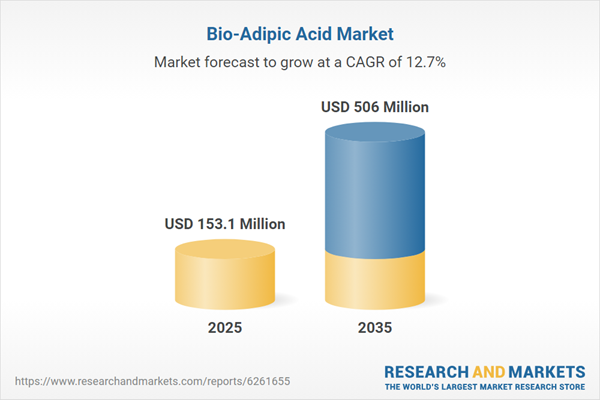

The global bio-adipic acid market was valued at USD 153.1 million in 2025 and is estimated to grow at a CAGR of 12.7% to reach USD 506 million by 2035.
The global bio-adipic acid market continues to gain momentum as manufacturers accelerate the transition toward renewable raw materials and lower-carbon chemical production processes. Advancements in microbial fermentation, bio-based feedstock conversion technologies, and integrated biorefinery operations are improving production efficiency while narrowing the cost gap between bio-based and conventional alternatives. Increasing regulatory emphasis on reducing industrial greenhouse gas emissions is creating favorable conditions for wider adoption of bio-adipic acid across multiple end-use industries. At the same time, growing corporate sustainability commitments and stronger demand for environmentally responsible materials continue to encourage greater use of bio-based chemical intermediates throughout global supply chains. Manufacturers are also responding to evolving procurement requirements by expanding sustainable production capabilities and improving process scalability. Continued investment in renewable chemical technologies, combined with rising demand for low-emission manufacturing solutions, is expected to support long-term market expansion and strengthen the commercial outlook for the global bio-adipic acid market throughout the forecast period.
Microbial fermentation accounted for a 68% share in 2025 and is expected to grow at a CAGR of 12.3% through 2035. The segment maintains its leading position because of its compatibility with a broad range of renewable feedstocks and its ability to support scalable bio-based production processes. Ongoing technological advancements in industrial fermentation, strain optimization, metabolic engineering, and process efficiency continue to improve production performance while supporting wider commercial adoption. Growing investments in sustainable manufacturing technologies further reinforce the dominance of microbial fermentation within the global bio-adipic acid market.
The nylon 6,6 production segment held a 58% share in 2025 and is projected to grow at a CAGR of 11.6% through 2035. Demand remains strong because bio-adipic acid serves as a direct substitute for conventional adipic acid in existing nylon 6,6 manufacturing processes without requiring significant production modifications. Increasing preference for sustainable polymer production, combined with rising demand for environmentally responsible engineering materials, continues to support market growth across this application segment. Expanding adoption of bio-based raw materials throughout industrial manufacturing further strengthens long-term demand for bio-adipic acid in nylon 6,6 production.
The North American bio-adipic acid market accounted for a 32% share in 2025 and is forecast to grow at a CAGR of 12.1% through 2035. The United States represented 85.1% of regional revenue, maintaining its position as the largest contributor to market growth across North America. Continued regulatory emphasis on reducing greenhouse gas emissions, growing investment in renewable chemical production, and increasing support for sustainable industrial manufacturing continue to strengthen regional demand. Ongoing advancements in bio-based technologies and expanding commercialization of renewable chemicals are expected to reinforce North America’s leading role in the global bio-adipic acid market during the forecast period.
Major companies operating in the global bio-adipic acid market include Ascend Performance Materials, Asahi Kasei Corporation, Invista, Genomatica Inc., and Radici Group. Market participants focus on technological innovation, production capacity expansion, and sustainability initiatives to strengthen their competitive positions. Manufacturers continue to invest in research and development to improve microbial fermentation efficiency, optimize bio-based feedstock utilization, and reduce production costs. Many companies are also expanding manufacturing capabilities and strengthening vertically integrated production models to improve supply chain efficiency and meet growing commercial demand. Strategic partnerships, joint development programs, and long-term customer agreements help accelerate product commercialization and broaden market reach. Businesses further differentiate themselves by emphasizing renewable production processes, regulatory compliance, and high-quality bio-based materials aligned with evolving sustainability goals.
Comprehensive Market Analysis and Forecast
Industry trends, key growth drivers, challenges, future opportunities, and regulatory landscape
Competitive landscape with Porter’s Five Forces and PESTEL analysis
Market size, segmentation, and regional forecasts
In-depth company profiles, business strategies, financial insights, and SWOT analysis
Key Attributes:
| Report Attribute | Details |
| No. of Pages | 195 |
| Forecast Period | 2025 – 2035 |
| Estimated Market Value (USD) in 2025 | $153.1 Million |
| Forecasted Market Value (USD) by 2035 | $506 Million |
| Compound Annual Growth Rate | 12.7% |
| Regions Covered | Global |
Key Topics Covered:
Chapter 1 Methodology & Scope
1.1 Research approach
1.2 Quality Commitments
1.2.1 GMI AI policy & data integrity commitment
1.2.1.1 Source consistency protocol
1.3 Research Trail & Confidence Scoring
1.3.1 Research Trail Components
1.3.2 Scoring Components
1.4 Data Collection
1.4.1 Partial list of primary sources
1.5 Data mining sources
1.5.1 Paid sources
1.5.1.1 Sources, by region
1.6 Base estimates and calculations
1.6.1 Base year calculation for any one approach
1.7 Forecast model
1.7.1 Quantified market impact analysis
1.7.1.1 Mathematical impact of growth parameters on forecast
1.8 Research transparency addendum
1.8.1 Source attribution framework
1.8.2 Quality assurance metrics
1.8.3 Our commitment to trust
Chapter 2 Executive Summary
2.1 Industry 360 synopsis
2.2 Key market trends
2.2.1 Regional
2.2.2 by Production Technology
2.2.3 by Application
2.2.4 by Grade
2.2.5 by End Use
2.3 TAM Analysis, 2026-2035
2.4 CXO perspectives: Strategic imperatives
Chapter 3 Industry Insights
3.1 Industry ecosystem analysis
3.1.1 Supplier landscape
3.1.2 Profit margin
3.1.3 Value addition at each stage
3.1.4 Factor affecting the value chain
3.1.5 Disruptions
3.2 Industry impact forces
3.2.1 Growth drivers
3.2.2 Industry pitfalls and challenges
3.2.3 Market opportunities
3.3 Growth potential analysis
3.4 Regulatory landscape
3.4.1 North America
3.4.2 Europe
3.4.3 Asia-Pacific
3.4.4 Latin America
3.4.5 Middle East & Africa
3.5 Porter’s analysis
3.6 PESTEL analysis
3.7 Price trends
3.7.1 by region
3.7.2 by Production Technology
3.8 Future market trends
3.9 Technology and Innovation landscape
3.9.1 Current technological trends
3.9.2 Emerging technologies
3.10 Patent Landscape
3.11 Trade statistics (HS code)
3.11.1 Major importing countries
3.11.2 Major exporting countries
3.12 Sustainability and environmental aspects
3.12.1 Sustainable practices
3.12.2 Waste reduction strategies
3.12.3 Energy efficiency in production
3.12.4 Eco friendly initiatives
Chapter 4 Competitive Landscape, 2025
4.1 Introduction
4.2 Company market share analysis
4.2.1 by region
4.2.1.1 North America
4.2.1.2 Europe
4.2.1.3 Asia-Pacific
4.2.1.4 LATAM
4.2.1.5 MEA
4.3 Company matrix analysis
4.4 Competitive analysis of major market players
4.5 Competitive positioning matrix
4.6 Key developments
4.6.1 Mergers & acquisitions
4.6.2 Partnerships & collaborations
4.6.3 New Product Launches
4.6.4 Expansion Plans
Chapter 5 Market Estimates and Forecast, by Production Technology, 2022 to 2035 (USD Million) (Tons)
5.1 Key trends
5.2 Microbial Fermentation
5.2.1 Glucose / Sugar-Based Fermentation
5.2.2 Lignocellulosic Biomass Fermentation
5.2.3 Fatty Acid / Vegetable Oil-Based Fermentation
5.3 Catalytic Conversion
5.3.1 Chemo-Catalytic Conversion
5.3.2 Biocatalytic / Enzymatic Conversion
5.4 Semi-Biosynthetic (Hybrid)
Chapter 6 Market Estimates and Forecast, by Application, 2022 to 2035 (USD Million) (Tons)
6.1 Key trends
6.2 Nylon 6,6 Production
6.2.1 Nylon 6,6 Fiber
6.2.2 Nylon 6,6 Resin
6.3 Polyurethanes
6.3.1 Flexible Polyurethane Foam
6.3.2 Rigid Polyurethane Foam
6.3.3 Polyurethane Elastomers & Adhesives
6.4 Adipate Esters (Plasticizers)
6.4.1 Dioctyl Adipate (DOA)
6.4.2 Diisodecyl Adipate (DIDA) & Others
6.5 Lubricants
6.5.1 Synthetic Base Oils
6.5.2 Low-Temperature Lubricants
6.6 Coatings & Paints
6.6.1 Polyamide-Based Coatings
6.6.2 Polyester-Based Coatings
6.7 Food Additives
6.7.1 Acidulants & pH Buffers
6.7.2 Leavening Agents
6.8 Others
Chapter 7 Market Estimates and Forecast, by Grade, 2022 to 2035 (USD Million) (Tons)
7.1 Key trends
7.2 Industrial Grade
7.3 Food Grade
Chapter 8 Market Estimates and Forecast, by End Use, 2022 to 2035 (USD Million) (Tons)
8.1 Key trends
8.2 Automotive
8.2.1 Under-Hood & Structural Components
8.2.2 Interior Applications
8.2.3 EV-Specific Applications
8.3 Textiles & Fibers
8.3.1 Apparel & Hosiery
8.3.2 Industrial Textiles
8.3.3 Carpets & Home Furnishings
8.4 Electrical & Electronics
8.4.1 Connectors, Switches & Housings
8.4.2 Cable & Wire Insulation
8.5 Construction
8.5.1 Polyurethane Insulation Foams
8.5.2 Sealants, Adhesives & Coatings
8.6 Food & Beverage
8.6.1 Beverages & Dairy
8.6.2 Processed & Baked Foods
8.7 Others (Packaging, Pharma, Cosmetics)
Chapter 9 Market Estimates and Forecast, by Region, 2022 to 2035 (USD Million) (Tons)
9.1 Key trends
9.2 North America
9.2.1 U.S.
9.2.2 Canada
9.3 Europe
9.3.1 Germany
9.3.2 UK
9.3.3 France
9.3.4 Spain
9.3.5 Italy
9.3.6 Rest of Europe
9.4 Asia-Pacific
9.4.1 China
9.4.2 India
9.4.3 Japan
9.4.4 Australia
9.4.5 South Korea
9.4.6 Rest of Asia-Pacific
9.5 Latin America
9.5.1 Brazil
9.5.2 Mexico
9.5.3 Argentina
9.5.4 Rest of Latin America
9.6 Middle East and Africa
9.6.1 Saudi Arabia
9.6.2 South Africa
9.6.3 UAE
9.6.4 Rest of Middle East and Africa
Chapter 10 Company Profiles
10.1 Invista
10.2 Ascend Performance Materials
10.3 Genomatica Inc.
10.4 Radici Group
10.5 Asahi Kasei Corporation
10.6 OzoneBio Inc.
10.7 BASF SE
10.8 twig.bio
10.9 Sumatra Biorenewables
For more information about this report visit https://www.researchandmarkets.com/r/ajbmg4
About ResearchAndMarkets.com
ResearchAndMarkets.com is the world’s leading source for international market research reports and market data. We provide you with the latest data on international and regional markets, key industries, the top companies, new products and the latest trends.
Attachment
- Bio-Adipic Acid Market
CONTACT:
CONTACT: ResearchAndMarkets.com
         Laura Wood,Senior Press Manager
         press@researchandmarkets.com
         For E.S.T Office Hours Call 1-917-300-0470
         For U.S./ CAN Toll Free Call 1-800-526-8630
         For GMT Office Hours Call +353-1-416-8900


