



High-Power EV Charging Expansion Drives Demand for Thermally Conductive Potting Compounds, Led by Epoxy and Thermal-Cured Solutions
Electronic Potting Compound For EV Charger Market
Dublin, Aug. 14, 2026 (GLOBE NEWSWIRE) — The “Electronic Potting Compound For EV Charger Market Opportunity, Growth Drivers, Industry Trend Analysis, and Forecast 2026-2035” has been added to ResearchAndMarkets.com’s offering.
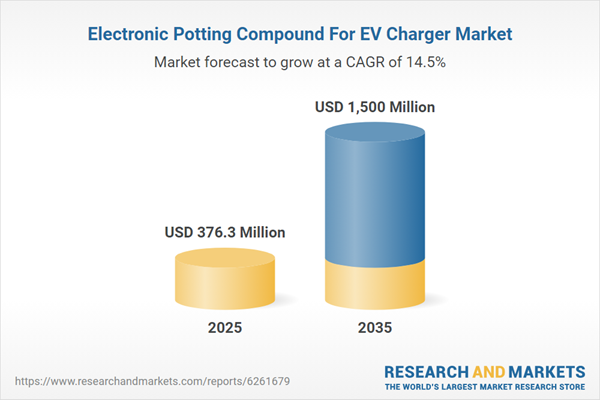

The global electronic potting compound for EV charger market was valued at USD 376.3 million in 2025 and is estimated to grow at a CAGR of 14.5% to reach USD 1.5 billion by 2035.
The market is experiencing strong growth as EV infrastructure continues to expand globally and demand for safer, more efficient charging systems increases. Governments, charging station developers, and EV equipment manufacturers are increasingly prioritizing advanced encapsulation and protection materials to improve system reliability and operational safety. The rapid rollout of high-power and connected charging networks is significantly boosting the need for advanced potting compounds that protect electronic components from thermal stress, vibration, moisture exposure, dust ingress, and electrical hazards. As EV chargers become more compact and power-intensive, thermal management and insulation performance have become critical design requirements. This is driving innovation in material science, particularly in formulations that enhance heat dissipation, extend component lifespans, and support high-voltage applications. Continuous advancements in charging speed, infrastructure density, and system miniaturization are further reinforcing the importance of high-performance potting compounds across next-generation EV charging ecosystems.
The epoxy segment accounted for a 37.2% share in 2025. This segment continues to lead due to its excellent adhesion, high structural strength, and strong resistance to chemical exposure. Epoxy-based potting materials are widely used in EV charging systems to insulate and protect critical components such as power modules, connectors, transformers, and control systems. Their ability to withstand vibration, corrosion, and electrical stress makes them highly suitable for demanding high-voltage charging environments and industrial-grade applications.
The thermal-cured segment held a 46.3% share in 2025 and is projected to grow at a CAGR of 13.8% from 2026 to 2035. This segment dominates due to its superior thermal stability, strong mechanical integrity, and enhanced resistance to chemical degradation. Thermal-curing technologies are widely used in fast- and ultra-fast-charging infrastructure, where components operate under high electrical loads and elevated temperatures. These materials provide reliable encapsulation, efficient heat management, and long-term protection for sensitive electronic systems, ensuring consistent performance in high-power EV charging applications.
China’s electronic potting compound for EV charger market accounted for a 78.8% share in 2025, generating USD 123.6 million. The country maintains a leading position due to its large-scale EV adoption, rapidly expanding charging infrastructure, and highly developed electronics manufacturing ecosystem. The widespread deployment of charging stations across urban, residential, and highway networks is significantly increasing demand for advanced potting solutions used for thermal regulation, insulation, and environmental protection. Strong policy support for electric mobility, combined with infrastructure expansion initiatives and stringent safety standards, continues to drive the adoption of high-performance encapsulation materials across the country.
Major players operating in the global electronic potting compound for EV charger market include Henkel, Dow, 3M, Huntsman, Wacker Chemie, Elantas, and Momentive. Companies are focusing on strengthening their market positions through continuous innovation in high-performance material formulations that enhance thermal conductivity, electrical insulation, and mechanical durability. Leading players are investing heavily in research and development to create next-generation compounds that support fast- and ultra-fast EV charging systems. Strategic collaborations with EV charger manufacturers and infrastructure developers are enabling better product integration and customized solutions. Companies are also expanding production capacities and optimizing supply chains to meet rising global demand. Emphasis on sustainability and low-emission material development is increasing as manufacturers align with environmental regulations.
Comprehensive Market Analysis and Forecast
. Industry trends, key growth drivers, challenges, future opportunities, and regulatory landscape
. Competitive landscape with Porter’s Five Forces and PESTEL analysis
. Market size, segmentation, and regional forecasts
. In-depth company profiles, business strategies, financial insights, and SWOT analysis
Key Attributes:
| Report Attribute | Details |
| No. of Pages | 255 |
| Forecast Period | 2025 – 2035 |
| Estimated Market Value (USD) in 2025 | $376.3 Million |
| Forecasted Market Value (USD) by 2035 | $1500 Million |
| Compound Annual Growth Rate | 14.5% |
| Regions Covered | Global |
Key Topics Covered:
Chapter 1 Research Methodology
1.1 Research approach
1.2 Quality Commitments
1.2.1 GMI AI policy & data integrity commitment
1.2.1.1 Source consistency protocol
1.3 Research Trail & Confidence Scoring
1.3.1 Research Trail Components
1.3.2 Scoring Components
1.4 Data Collection
1.4.1 Partial list of primary sources
1.5 Data mining sources
1.5.1 Paid sources
1.5.1.1 Sources, by region
1.6 Base estimates and calculations
1.6.1 Base year calculation for any one approach
1.7 Forecast model
1.7.1 Quantified Market impact analysis
1.7.1.1 Mathematical impact of growth parameters on forecast
1.8 Research transparency addendum
1.8.1 Source attribution framework
1.8.2 Quality assurance metrics
1.8.3 Our commitment to trust
Chapter 2 Executive Summary
2.1 Industry 360 synopsis, 2022-2035
2.2 Key Market trends
2.2.1 Regional
2.2.2 Material
2.2.3 Curing technology
2.2.4 Charger type
2.2.5 End Use
2.2.6 Application
2.3 TAM Analysis, 2026-2035
2.4 CXO perspectives: Strategic imperatives
Chapter 3 Industry Insights
3.1 Industry ecosystem analysis
3.1.1 Supplier landscape
3.1.2 Profit margin analysis
3.1.3 Cost structure
3.1.4 Value addition at each stage
3.1.5 Factor affecting the value chain
3.1.6 Disruptions
3.2 Industry impact forces
3.2.1 Growth drivers
3.2.1.1 Rising Deployment of Fast-Charging Infrastructure
3.2.1.2 Increasing Adoption of Electric Vehicles
3.2.1.3 Growing Demand for High-Voltage Insulation Materials
3.2.1.4 Expansion of Outdoor EV Charging Installations
3.2.2 Industry pitfalls and challenges
3.2.2.1 Complex Thermal Management Requirements
3.2.2.2 Stringent Environmental and Chemical Regulations
3.2.3 Market opportunities
3.2.3.1 Advancements in Thermally Conductive and Lightweight Materials
3.2.3.2 Increasing Integration of Power Electronics in Compact Charger Designs
3.3 Technology and innovation landscape
3.3.1 Current technological trends
3.3.1.1 Silicone-based potting compounds
3.3.1.2 Epoxy potting systems
3.3.1.3 Polyurethane encapsulation materials
3.3.1.4 Thermally conductive gels and resins
3.3.2 Emerging technologies
3.3.2.1 Dual-cure (UV + thermal) potting systems
3.3.2.2 Nanomaterial-enhanced thermal compounds
3.3.2.3 Low-VOC and bio-based potting materials
3.3.2.4 Advanced potting for SiC and GaN power electronics
3.4 Growth potential analysis
3.5 Pricing Analysis (Driven by primary research)
3.5.1 Historical Price Trend Analysis
3.5.2 Pricing Strategy by Player Type
3.6 Regulatory landscape
3.6.1 North America
3.6.1.1 U.S Environmental Protection Agency
3.6.1.2 National Highway Traffic Safety Administration
3.6.1.3 Underwriters Laboratories
3.6.2 Europe
3.6.2.1 European Chemicals Agency
3.6.2.2 European Commission
3.6.2.3 Federal Motor Transport Authority
3.6.2.4 Agency for Ecological Transition
3.6.3 Asia-Pacific
3.6.3.1 Ministry of Industry and Information Technology
3.6.3.2 Ministry of Ecology and Environment
3.6.3.3 Ministry of Economy, Trade and Industry
3.6.4 Latin America
3.6.4.1 National Institute of Metrology, Quality and Technology
3.6.4.2 National Traffic Department
3.6.4.3 Secretariat of Infrastructure, Communications and Transport
3.6.5 Middle East & Africa
3.6.5.1 Ministry of Energy and Infrastructure
3.6.5.2 Emirates Authority for Standardization and Metrology
3.6.5.3 Saudi Standards, Metrology and Quality Organization
3.7 Porter’s analysis
3.8 PESTEL analysis
3.9 Patent analysis (Driven by primary research)
3.10 Cost breakdown analysis
3.11 Capacity & production landscape (Driven by Primary Research)
3.11.1 Installed capacity by region & key producer
3.11.2 Capacity utilization rates & expansion pipelines
3.12 Trade data analysis (Driven by Paid Research)
3.12.1 Import/export volume & value trends
3.12.2 Key trade corridors & tariff impact
3.13 Impact of AI and Generative AI on the Market
3.13.1 AI Driven Disruption of Existing Business Models
3.13.2 GenAI Use Cases and Adoption Roadmap by Segment
3.13.3 Risks Limitations and Regulatory Considerations
3.14 Sustainability and environmental aspects
3.14.1 Sustainable practices
3.14.2 Waste reduction strategies
3.14.3 Energy efficiency in production
3.14.4 Eco-friendly Initiatives
3.14.5 Carbon footprint considerations
3.15 Forecast assumptions & scenario analysis (Driven by Primary Research)
3.15.1 Base Case- Key Macro & Industry Variables Driving CAGR
3.15.2 Optimistic Scenarios- Favorable macro and industry tailwinds
3.15.3 Pessimistic Scenario – Macroeconomic slowdown or industry headwinds
Chapter 4 Competitive Landscape, 2025
4.1 Introduction
4.2 Company Market share analysis
4.2.1 North America
4.2.2 Europe
4.2.3 Asia-Pacific
4.2.4 LATAM
4.2.5 MEA
4.3 Competitive analysis of major market players
4.4 Competitive positioning matrix
4.5 Key developments
4.5.1 Mergers & acquisitions
4.5.2 Partnerships & collaborations
4.5.3 New Product Launches
4.5.4 Expansion Plans and funding
4.6 Company tier benchmarking
4.6.1 Tier classification criteria & qualifying thresholds
4.6.2 Tier positioning matrix by revenue, geography & innovation
Chapter 5 Market Estimates & Forecast, by Material, 2022-2035 (USD Mn, Metric Tons)
5.1 Key trends
5.2 Polyurethane
5.3 Silicone
5.4 Epoxy
Chapter 6 Market Estimates & Forecast, by Curing Technology, 2022-2035 (USD Mn, Metric Tons)
6.1 Key trends
6.2 Room Temperature Cured
6.3 Thermal Cured
6.4 UV Cured
Chapter 7 Market Estimates & Forecast, by Charger type, 2022-2035 (USD Mn, Metric Tons)
7.1 Key trends
7.2 AC Charger
7.3 DC Fast Charger
Chapter 8 Market Estimates & Forecast, by End Use, 2022-2035 (USD Mn, Metric Tons)
8.1 Key trends
8.2 Residential Charging
8.3 Commercial Charging
8.4 Public Charging Infrastructure
8.5 Fleet Charging Depots
Chapter 9 Market Estimates & Forecast, by Application, 2022-2035 (USD Mn, Metric Tons)
9.1 Key trends
9.2 Power Electronics
9.3 HV Components, Busbars & Sensor Relays
9.4 PCB & Control Modules
9.5 Connector & Cable IP Protection Zones
9.6 Charging Gun
9.7 Others
Chapter 10 Market Estimates & Forecast, by Region, 2022-2035 (USD Mn, Metric Tons)
10.1 Key trends
10.2 North America
10.2.1 US
10.2.2 Canada
10.3 Europe
10.3.1 Germany
10.3.2 UK
10.3.3 France
10.3.4 Italy
10.3.5 Spain
10.3.6 Russia
10.3.7 Norway
10.3.8 Netherlands
10.3.9 Sweden
10.4 Asia-Pacific
10.4.1 China
10.4.2 India
10.4.3 Japan
10.4.4 Australia
10.4.5 South Korea
10.4.6 Singapore
10.4.7 Thailand
10.4.8 Indonesia
10.4.9 Vietnam
10.5 Latin America
10.5.1 Brazil
10.5.2 Mexico
10.5.3 Argentina
10.6 MEA
10.6.1 South Africa
10.6.2 Saudi Arabia
10.6.3 UAE
10.6.4 Turkey
Chapter 11 Company Profiles
11.1 Global Players
11.1.1 Henkel
11.1.2 Dow
11.1.3 Wacker Chemie
11.1.4 Elantas
11.1.5 Momentive Performance Materials
11.1.6 3M Company
11.1.7 Shin-Etsu Chemical
11.2 Regional Players
11.2.1 Electrolube
11.2.2 Master Bond
11.2.3 Dymax
11.2.4 MG Chemicals
11.2.5 ResinLab
11.2.6 Nagase ChemteX
11.2.7 ACC Silicones
11.2.8 Epic Resins
11.3 Emerging Players
11.3.1 WEVO-CHEMIE
11.3.2 Elkem
11.3.3 Chase
11.3.4 Engineered Materials Systems
11.3.5 RAMPF
For more information about this report visit https://www.researchandmarkets.com/r/c4o0cb
About ResearchAndMarkets.com
ResearchAndMarkets.com is the world’s leading source for international market research reports and market data. We provide you with the latest data on international and regional markets, key industries, the top companies, new products and the latest trends.
Attachment
- Electronic Potting Compound For EV Charger Market
CONTACT:
CONTACT: ResearchAndMarkets.com
         Laura Wood,Senior Press Manager
         press@researchandmarkets.com
         For E.S.T Office Hours Call 1-917-300-0470
         For U.S./ CAN Toll Free Call 1-800-526-8630
         For GMT Office Hours Call +353-1-416-8900


