For most of the last two decades, purchasing was treated as back-office work. Someone found a supplier, agreed a price, placed the order, and the business moved on. Then came a stretch of disruption no planning cycle had accounted for: pandemic shortages, shipping bottlenecks, sharp swings in energy and material costs, currency volatility, and trade policy that can change the economics of a cross-border supply relationship with little warning. Suddenly, where a company buys from, on what terms, and with what backup plan became a question for the executive team, which is why more mid-sized and large companies are investing in procurement software such as APSentra to see and control their spending in real time.
Procurement has moved from the back office to the boardroom. Here’s what’s driving the change, and what organizations are actually doing about it.
Why Purchasing Became a Leadership Issue
Three pressures converged.
Costs stopped being predictable. Input prices that once moved gradually now shift quickly. A supplier contract signed on last year’s assumptions can look very different twelve months later, especially for businesses importing materials or equipment.
Supply reliability became a boardroom risk. Companies learned the hard way that a single sole-source supplier, or a supply chain concentrated in one region, can halt production or empty shelves. Resilience moved from a nice-to-have to a governance requirement.
Margins tightened. With wage costs, borrowing costs and operating expenses rising, many businesses can no longer absorb inefficient buying. Because savings on purchases go straight to the bottom line, procurement became one of the fastest ways to protect profit without cutting jobs.
The problem is that in many companies, purchasing is still managed the way it was when it was considered routine: spreadsheets, email approvals, and supplier relationships living in individual employees’ inboxes. That’s a weak foundation for decisions that now reach the board.
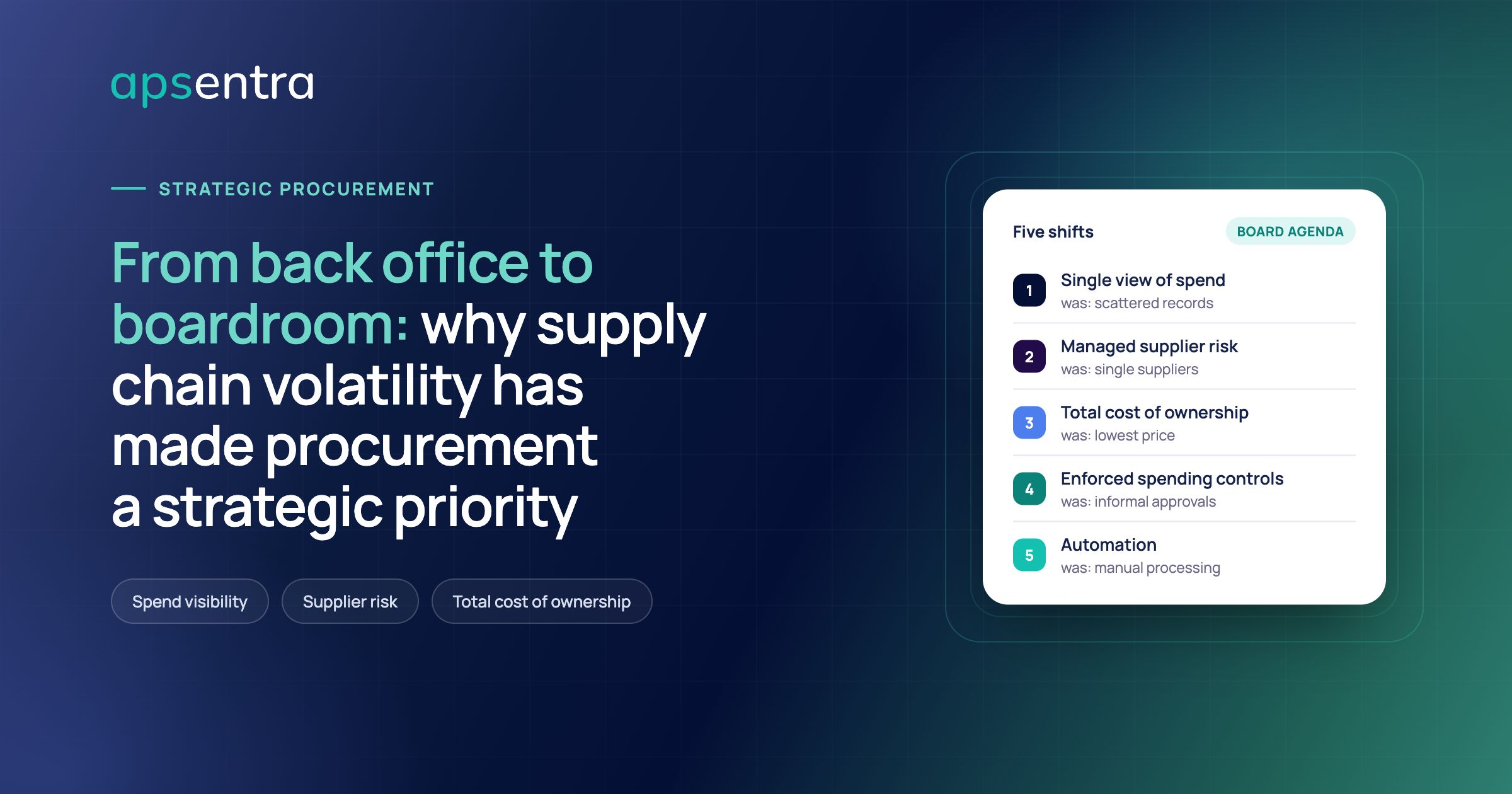
Five Shifts Companies Are Making
1. From scattered records to a single view of spend
The first question a board asks is the hardest for many companies to answer: how much do we actually spend, with whom, and on what?
When purchasing data sits in different spreadsheets, departments, locations and legal entities, nobody can see the whole picture. That hides duplicate suppliers, price differences between sites, and categories where the company is spending enough to negotiate far better terms.
Organizations are consolidating all purchasing into one system so the answer takes minutes, not weeks.
2. From single suppliers to managed supplier risk
Companies are mapping their dependencies: which materials come from one supplier only, which suppliers are concentrated in a single region, and how quickly an alternative could be qualified. Critical suppliers are being monitored on delivery reliability, quality, financial stability, and compliance rather than reviewed only when something goes wrong.
The goal isn’t to abandon long-standing partners. It’s to know where the vulnerabilities are before a disruption finds them.
3. From lowest price to total cost of ownership
A cheaper quote can be the more expensive option once you count delivery, installation, energy use, maintenance, downtime, quality problems, inventory costs and payment terms. Procurement teams are increasingly evaluating offers on total cost over the asset or contract’s life, and comparing payment schedules on a present-value basis so that “cheaper” actually means cheaper.
4. From informal approvals to enforced spending controls
Rising costs have made uncontrolled purchasing harder to tolerate. Companies are putting structured approval workflows in place so that every request is checked against budgets and policy before an order is placed, rather than reconciled after invoices land. This also closes the door on off-contract buying, where negotiated discounts quietly go unused.
5. From manual processing to automation
Finally, organizations are automating the repetitive work: capturing invoice data, matching invoices against orders and deliveries, routing approvals, and producing spend reports. This reduces duplicate payments and billing errors, speeds up purchasing, and frees procurement and finance staff for negotiation and supplier management, which is where savings are actually created.
What This Looks Like in Practice
Consider a manufacturer operating three plants. Before modernizing, each site bought independently: different suppliers, different prices, separate spreadsheets, approvals by email. Nobody could say what the group spent on packaging in a year, and invoices were entered by hand.
After centralizing purchasing in one platform, the company can see combined demand across all sites, negotiate as one customer rather than three, check budgets before orders are placed, run competitive tenders for major categories, and catch mismatched invoices before payment. The savings don’t come from one dramatic negotiation; they accumulate from dozens of small corrections that were previously invisible.
That pattern repeats across industries: food and agriculture, retail chains, construction, logistics, utilities, financial services, and healthcare distribution.
Where Technology Fits: APSentra
APSentra is an AI-driven source-to-pay procurement platform built for company-wide spend control. It replaces spreadsheets, email approval chains and disconnected tools with a single system covering the full purchasing cycle, and it’s designed for complex, multi-site, multi-entity organizations.
What the platform covers:
- Spend visibility and analytics: real-time dashboards by category, supplier, site and legal entity, with predictive and prescriptive KPIs and an AI assistant that analyzes spending and highlights opportunities.
- Budget planning and control: requests validated against budgets before money is committed, with commitment tracking and separate governance for operating and capital expenditure.
- Intelligent intake and approvals: guided buying towards approved suppliers and contracted prices, consolidated demand, and configurable approval routing by amount, category, department, site or entity.
- Strategic sourcing: digital tenders, RFPs and online auctions with multi-criteria evaluation covering price, quality, delivery terms and total cost of ownership.
- Contract lifecycle management: AI-assisted extraction of key terms, contract monitoring, and prevention of value leakage.
- Procure-to-pay automation: AI-powered OCR invoice processing and 3-way matching of purchase orders, goods receipts and invoices.
- Supplier management and risk control: onboarding, performance tracking, and ESG and third-party risk visibility.
Built for multi-entity groups. APSentra’s digital twin mirrors an organization’s real structure and purchasing logic, so every site and company follows the right rules whether procurement is centralized, local, or a hybrid of both.
Compatible with existing systems. APSentra is ERP-agnostic and integrates with SAP, SAP Business One, Oracle, Microsoft Dynamics 365 Business Central and Dynamics NAV, NetSuite, QuickBooks, Odoo, Microsoft Power BI, Slack, Amazon Business, single sign-on, custom APIs and databases.
Governance built in. Automated policy enforcement, complete audit trails, role-based access control and real-time compliance dashboards are standard, supported by an anti-corruption and security architecture and independent security testing.
Track record
APSentra is trusted by more than 130 enterprise clients across agriculture, manufacturing, retail and FMCG, construction, financial services, and telecom and utilities.
| Metric | Result |
|---|---|
| Procurement requests processed | 2,050,000+ |
| Purchase orders executed | 443,560 |
| Tenders conducted | 386,400 |
| Active contracts managed | 126,200 |
| Suppliers connected | 120,000+ |
| Procurement volume managed | ≈ $129 billion |
| Verified savings generated | ≈ $16 billion |
| Customer satisfaction | 94% |
According to APSentra, organizations using the platform typically achieve up to 25% cost savings, up to 80% faster procurement processes, and full transparency over purchasing. Its customer cases include Bunge, which aligned more than 200 procurement and operations users across regions, a restaurant chain with over 100 locations, a fashion retail group, a pharmaceutical distributor, and an agribusiness that has run all of its procurement through the platform for more than a decade.
Implementation
APSentra’s standard rollout takes about eight weeks: one week of consulting to assess processes and define KPIs, three weeks of configuration and workflow launch, three weeks of integration with ERP and accounting systems, and one week of training, followed by ongoing optimization. The company also provides procurement audits, consulting, benchmarking and change management support.
A Practical Starting Point for Executives
For leadership teams wanting to act without launching a year-long project:
- Establish the baseline. Total external spend, top 20 suppliers, spend by category and site.
- Map critical dependencies. Which inputs have only one supplier, and how long would qualifying an alternative take?
- Test the process. How long does an approval take? Can an order be placed without one? Can an invoice be paid without a matching order?
- Quantify the leakage. Look for duplicate payments, off-contract purchases and price variance between locations.
- Fix the biggest gap first, then expand. Approvals and budget control usually deliver the quickest return.
- Report it to the board. Track savings, cycle times, contract compliance and supplier risk as standing metrics.
Final Thoughts
Volatility hasn’t ended, and few executives expect a return to predictable input costs and frictionless supply chains. What has changed is the recognition that purchasing decisions carry strategic weight: they shape margins, cash flow, resilience and compliance.
Companies that still manage that function through spreadsheets and email are making consequential decisions without visibility. Those that have centralized purchasing can see their spending as it happens, compare suppliers properly, prevent overspending before it occurs, and respond to disruption with data rather than guesswork.
APSentra provides that capability in a single AI-driven platform, typically live in about eight weeks and integrated with existing business systems. Organizations evaluating their options can request a demo or use the savings calculator on the company’s website.
Frequently Asked Questions
What is procurement software?
It’s a system that manages company purchasing end to end: requests, approvals, budgets, supplier selection, tenders, contracts, orders, invoices and analytics, replacing spreadsheets and email-based processes.
How is it different from accounting software?
Accounting software records transactions after they occur. Procurement software governs purchases before money is committed, then passes approved data to finance systems.
Is it only relevant for large corporations?
No. The determining factor is complexity rather than size. Businesses with multiple sites, many suppliers or several approvers typically see the clearest benefit.
Do companies need to replace their ERP system?
Not with an ERP-agnostic platform. APSentra integrates with systems including SAP, Oracle, Microsoft Dynamics, NetSuite, QuickBooks and Odoo.
What kind of savings are realistic?
Results vary by sector and starting point. APSentra reports that its customers typically achieve up to 25% cost savings, and the platform has generated roughly $16 billion in verified savings across about $129 billion in managed procurement volume.
How long does implementation take?
APSentra’s standard implementation runs about eight weeks, covering consulting, configuration, integration and training.