



- With U.S. grid interconnection timelines stretching three to seven years, data centers are losing billions in delayed capacity. The 2.5MWh Power Hub is engineered for rapid deployment, delivering megawatt-scale power within days of arrival.
- Scaling from 1.2 MWh to 4 MWh, the 2.5MWh Power Hub series serves AI data centers, industrial build-outs, and mission-critical facilities, replacing years of infrastructure planning with a single factory-integrated unit that plugs in and powers on.
- Built on the same architecture behind more than 250 MWh of Xos energy storage already operating in commercial service across North America, the Power Hub is a productized platform with a proven track record, not a launch promise.
LOS ANGELES, June 02, 2026 (GLOBE NEWSWIRE) — Xos, Inc. (NASDAQ: XOS) (“Xos” or the “Company”), a leader in electric commercial vehicles and mobile charging solutions, today announced the launch of its 2.5MWh Power Hub series, a family of fully integrated, behind-the-meter energy storage and hybrid power systems engineered to deliver megawatt-scale power where the U.S. grid cannot. Built on the same proven architecture as the Xos Hub™ mobile EV charging platform, the Power Hub series scales from 1.2 MWh to 4 MWh and ships inside a standard intermodal container, energizing industrial sites, data centers, and mission-critical facilities within days, not the three to seven years that grid interconnection now routinely demands.
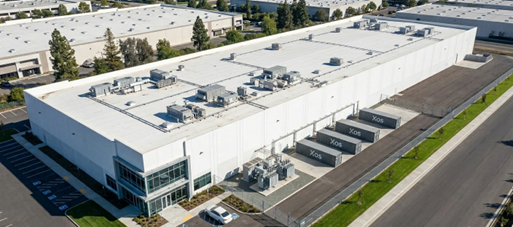
The Xos Hub production facility in Tennessee where the new 2.5MWh Xos Hub will be manufactured.
The IEA projects global data center electricity consumption will roughly double by 2030, with AI as the primary driver, yet the transformers, switchgear, and grid connections required to serve that demand carry lead times of up to five years. Behind-the-meter power has shifted from contingency to strategic necessity, and the 2.5MWh Power Hub was engineered to meet that moment.
A New Category of Industrial Power Infrastructure
- Industrial sites and data centers face multi-year grid bottlenecks: Grid bottlenecks driven by data center demand cost PJM-region consumers $14.7 billion in a single capacity auction in 2025, up from $2.2 billion just two years earlier. The IEA projects global data center electricity consumption will roughly double by 2030 with AI as the primary driver, yet for industrial operators who cannot wait years for a grid connection, behind-the-meter generation has become the only viable path forward.
- Generators need storage to perform: Natural gas reciprocating engines are the fastest-available power source for new industrial loads, but GPU-driven and transient-heavy workloads force gensets to run inefficiently at partial load. The 2.5MWh Power Hub pairs with these generators, absorbing load swings and allowing continuous operation at peak efficiency, meaningfully reducing fuel consumption and emissions per megawatt-hour delivered.
- The 2.5MWh Power Hub eliminates the integration tax: Conventional BESS deployments require separately procured DC battery blocks, power conversion systems, and microgrid controllers, adding months of project timeline and hundreds of thousands of dollars in integration costs. The 2.5MWh Power Hub ships as a single, factory-integrated unit with power conversion, plant controls, and generator dispatch logic all included and standard 480V three-phase output. No proprietary interfaces. No separate controllers. No multi-vendor specification process.
- The 2.5 MWh flagship configuration is engineered for rapid deployment: The 2.5MWh Power Hub 2500 ships in a standard intermodal container, so a unit that boards a truck today can be energizing a site within days, compressing time-to-power by an order of magnitude versus traditional infrastructure buildout.
- Scales to any load, from single site to multi-megawatt campus: All configurations can be combined through an external power combiner to create multi-megawatt-hour, multi-megawatt power plants from standardized factory-built blocks, without the multi-year engineering and commissioning cycle of conventional utility-scale projects.
Built on Proven, In-Field Energy Storage at Scale
The 2.5MWh Power Hub is built on the same battery, power electronics, and controls architecture powering more than 1,400 Xos assets and over 250 MWh of deployed energy storage across North America today. This is not a new platform built for this launch; it is a proven one, scaled into a new form factor.
That installed base operates in some of the most demanding duty cycles on the continent, including fleet charging for autonomous vehicle operators, utility-fleet equipment, and emergency-response applications where fast-cycle endurance and continuous availability are non-negotiable. The 2.5MWh Power Hub takes that track record and puts it to work for industrial power delivery.
“In order to win in today’s competitive landscape, it is important for any company to make every dollar count. For our business, one of the major costs we are constantly analyzing is power consumption, as we operate six industrial-sized paint booths continuously. Xos has been a great partner in helping us control those costs and bring those savings directly to the bottom line.” said Robert Fitzgerald, Founder and CEO, Fitzgerald Collision and Repair.
“The single biggest constraint in US industry right now is the inability to deliver power where it’s needed, when it’s needed. We engineered this product to do three things that conventional energy storage systems cannot: arrive on a standard truck, energize without a microgrid controller, and make every kilowatt-hour of fuel-fired generation cleaner and more efficient. This is not a battery. It is a deployable power plant.” said Dakota Semler, Chief Executive Officer, Xos
Product Configurations
The 2.5MWh Power Hub series will be offered in three core configurations:
| Configuration | Capacity | Output | Best for |
| 1.2MWh Power Hub | 1.2 MWh | 0.6 MW continuous | Hybrid operation with optional genset (scalable to match any application) |
| 2.5MWh Power Hub | 2.5 MWh | 1.2 MW continuous | Hybrid operation with optional 500 kWe dual-fuel genset, intermodal-ready |
| 4.0MWh Power Hub | 4 MWh | Max stored energy per sq ft | Applications requiring maximum stored energy per square foot |
Every configuration is designed to scale: units can be combined through an external power combiner to create multi-megawatt-hour, multi-megawatt power plants from standardized factory-built blocks, without the multi-year engineering and commissioning cycle of conventional utility-scale projects.
The 2.5MWh Power Hub incorporates integrated power conversion, controls, and packaging that conventional containerized BESS solutions sell as separate systems. A comparable utility-scale deployment combining a 2.5 MWh DC battery block, a 1.2 MW power conversion system, a microgrid controller, and balance-of-system engineering typically requires additional equipment plus several hundred thousand dollars of incremental site engineering, integration, and commissioning costs, with project timelines measured in quarters rather than days. The Xos Power Hub ships as a single, factory-integrated unit, eliminating the multi-vendor integration burden and compressing time-to-power by an order of magnitude.
Target Applications
The 2.5MWh Power Hub series addresses markets where power cannot wait for the grid:
- AI data centers and industrial build-outs facing multi-year grid delays, requiring bridge power or permanent behind-the-meter generation to keep projects on schedule
- Commercial and industrial sites expanding ahead of grid upgrades, where a conventional interconnection timeline would stall construction by years
- Utility-scale deployments where multiple units operate in series to create multi-megawatt power plants without the engineering and commissioning burden of traditional BESS projects
- Defense, government, and mission-critical installations requiring rapid-deploy, fuel-flexible, grid-independent power where reliability is non-negotiable
- Mobile and event power through short-term rental and leasing channels, serving temporary but high-demand applications

Rendering of multiple 2.5MWh Power Hub units deployed at an AI data center facility, delivering grid-independent megawatt-scale power without waiting years for grid interconnection.
“Our customers are committing hundreds of millions of dollars to projects that cannot afford to wait. They do not buy promises, they buy proof. Xos has put over 250 megawatt-hours of energy storage to work in the most demanding industrial environments in North America, and those systems are running right now, every day, in conditions where failure is not an option. The Power Hub is that same proven platform, built for the scale this market demands,” said Dakota Semler, Chief Executive Officer, Xos.
The Power Hub series marks the next chapter in Xos’s energy storage journey, scaling the same proven architecture behind the Xos Hub mobile charging platform into a stationary, industrial-grade power system built for the demands of the modern grid crisis. As U.S. industry races to secure power ahead of multi-year grid constraints, Xos is expanding its network of rental, leasing, and deployment partners to put Power Hub units where demand is greatest, with initial partner announcements expected in the coming quarters.
About Xos
Xos, Inc. (NASDAQ: XOS) is a Los Angeles-based clean energy and commercial vehicle technology company specializing in mobile energy storage, EV charging infrastructure, and battery-electric commercial vehicles. Founded in 2016 and publicly traded since 2021, Xos has emerged as one of North America’s leading deployers of behind-the-meter mobile energy storage systems, with over 250 megawatt-hours of deployed energy storage capacity across utility, fleet, government, and industrial customers.
Xos designs, engineers, and manufactures its energy storage and charging platforms in-house with proprietary electric architecture and proprietary energy management software. Products are designed in California and manufactured in Tennessee and available through federal procurement vehicles including the GSA Schedule, Sourcewell, and OMNIA Partners. For more information, visit www.xostrucks.com.
Forward-Looking Statements
This press release contains forward-looking statements within the meaning of Section 27A of the Securities Act of 1933, as amended, and Section 21E of the Securities Exchange Act of 1934, as amended. Forward-looking statements generally are identified by the words “believe,” “project,” “expect,” “anticipate,” “estimate,” “intend,” “strategy,” “future,” “opportunity,” “plan,” “may,” “should,” “will,” “would,” “will be,” “will continue,” “will likely result,” and similar expressions. These statements are based on the current expectations and beliefs of Xos management and are subject to uncertainty and changes in circumstances. Actual results may differ materially from those expressed or implied by these forward-looking statements due to risks and uncertainties, including market demand, competitive conditions, manufacturing capabilities, supply chain constraints, tariff impacts, regulatory changes, product specification finalization, pricing, customer adoption, partner availability, and other factors described in Xos’s filings with the Securities and Exchange Commission, including its Annual Report on Form 10-K and Quarterly Reports on Form 10-Q. Xos undertakes no obligation to update these forward-looking statements.
Media Contact:
Diana Carvajal
Marketing, Communications, and Public Relations
press@xostrucks.com
Investor Contact:
Xos Investor Relations
ir@xostrucks.com
Photos accompanying this announcement are available at
https://www.globenewswire.com/NewsRoom/AttachmentNg/0c93b086-6527-4b6c-af25-4c59af866c54
https://www.globenewswire.com/NewsRoom/AttachmentNg/ee499875-1cb5-4d69-ab8d-55fb7dad45cf


