






Infrastructure Modernization and Modular Construction Drive Global Precast Concrete Adoption as Automation and Low-Carbon Solutions Gain Momentum
Precast Concrete Market
Dublin, Aug. 14, 2026 (GLOBE NEWSWIRE) — The “Precast Concrete Market Opportunity, Growth Drivers, Industry Trend Analysis, and Forecast 2026-2035” has been added to ResearchAndMarkets.com’s offering.
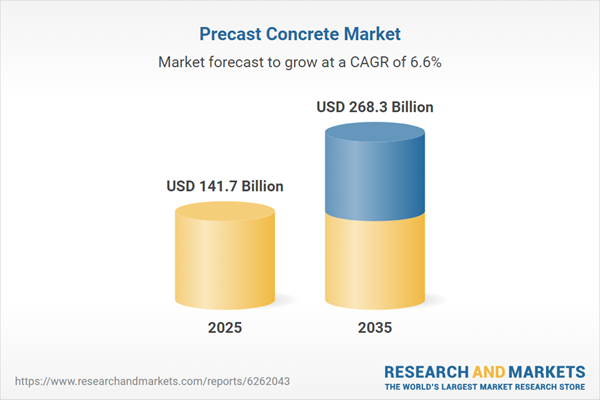

The global precast concrete market was valued at USD 141.7 billion in 2025 and is estimated to grow at a CAGR of 6.6% to reach USD 268.3 billion by 2035.
Market growth is driven by continuous investments in infrastructure modernization, residential construction, and industrial development across developed and emerging economies. Increasing preference for faster project execution, improved construction efficiency, and reduced on-site labor requirements is accelerating the adoption of precast concrete solutions worldwide. Off-site manufacturing allows structural components to be produced while site preparation progresses, significantly shortening overall project completion timelines compared with conventional construction methods. The growing shift toward modular construction techniques is further strengthening demand as developers seek cost-effective, high-quality, and standardized building solutions. In addition, expanding investments in public infrastructure, utility networks, and commercial developments continue to support the widespread use of precast concrete products. Factory-controlled manufacturing processes provide greater product consistency, enhanced quality control, and improved durability, making precast solutions increasingly attractive across multiple construction applications. As governments and private developers continue to prioritize efficient construction practices, the long-term outlook for the global precast concrete market remains highly favorable throughout the forecast period.
The conventional precast concrete segment generated USD 79.9 billion in 2025 and is expected to grow at a CAGR of 6.1% through 2035. This segment represents the foundation of the global precast concrete market due to its broad use across residential, commercial, industrial, transportation, and utility construction projects. Conventional precast products continue to experience consistent demand because they offer proven structural performance, standardized manufacturing processes, and reliable quality. Their widespread application across multiple end-use sectors helps maintain stable demand across regional markets and varying economic conditions.
The building and construction segment accounted for a 42.4% share in 2025 and is projected to register a CAGR of 7% through 2035. Market leadership is supported by the growing adoption of precast concrete solutions across residential, commercial, institutional, and industrial construction activities. Increasing demand for efficient structural systems, architectural components, flooring solutions, wall systems, and other prefabricated construction elements continues to strengthen the position of this application segment as developers prioritize faster project delivery and improved construction productivity.
The United States precast concrete market generated USD 30.2 billion in 2025, representing a 93.5% share. The country’s dominant position is supported by its extensive precast manufacturing network and ongoing investments in transportation, utility, and public infrastructure projects. Rising public construction expenditure and continued development of transportation, water management, and utility infrastructure continue to create strong demand for precast concrete components. Sustained investment across federal, state, and municipal construction programs is expected to reinforce market growth throughout the forecast period.
Major companies operating in the global precast concrete market include Spancrete, Gate Precast Company, Oldcastle Infrastructure (CRH plc), Fabcon Precast, Jensen Precast, Wells Concrete, Knife River Corporation, Northeast Precast, Forterra, Inc., Hannibal Industries, and Tindall Corporation. Companies operating in the precast concrete market are strengthening their positions through capacity expansion, manufacturing modernization, and continuous product innovation. Many producers are investing in automated production facilities to improve efficiency, maintain product quality, and increase output while reducing manufacturing costs. Strategic acquisitions, regional expansion, and partnerships with construction firms are helping companies broaden their customer bases and strengthen distribution networks. Businesses are also developing customized precast solutions that support modular construction and faster project execution. Investments in sustainable manufacturing practices, low-carbon concrete technologies, and resource-efficient production methods are becoming increasingly important as environmental regulations evolve.
Comprehensive Market Analysis and Forecast
Industry trends, key growth drivers, challenges, future opportunities, and regulatory landscape
Competitive landscape with Porter’s Five Forces and PESTEL analysis
Market size, segmentation, and regional forecasts
In-depth company profiles, business strategies, financial insights, and SWOT analysis
Key Attributes:
| Report Attribute | Details |
| No. of Pages | 180 |
| Forecast Period | 2025 – 2035 |
| Estimated Market Value (USD) in 2025 | $141.7 Billion |
| Forecasted Market Value (USD) by 2035 | $268.3 Billion |
| Compound Annual Growth Rate | 6.6% |
| Regions Covered | Global |
Key Topics Covered:
Chapter 1 Methodology & Scope
1.1 Market scope and definition
1.2 Research design
1.2.1 Research approach
1.2.2 Data collection methods
1.3 Data mining sources
1.3.1 Global
1.3.2 Regional/Country
1.4 Base estimates and calculations
1.4.1 Base year calculation
1.4.2 Key trends for market estimation
1.5 Primary research and validation
1.5.1 Primary sources
1.6 Forecast model
1.7 Research assumptions and limitations
Chapter 2 Executive Summary
2.1 Industry 360 synopsis
2.2 Key market trends
2.2.1 Regional
2.2.2 Product type
2.2.3 Material type
2.2.4 Application
Chapter 3 Industry Insights
3.1 Industry ecosystem analysis
3.1.1 Supplier landscape
3.1.2 Profit margin
3.1.3 Value addition at each stage
3.1.4 Factor affecting the value chain
3.2 Industry impact forces
3.2.1 Growth drivers
3.2.1.1 Growing demand for fast-track construction
3.2.1.2 Increasing adoption of modular construction
3.2.1.3 Advancements in materials and design
3.2.2 Industry pitfalls & challenges
3.2.2.1 Transportation and logistics constraints
3.2.2.2 Skilled workforce gaps in specialized areas
3.2.2.3 Interest rate sensitivity & residential cyclicality
3.2.3 Opportunities
3.2.3.1 Expansion of infrastructure modernization projects
3.2.3.2 Rising demand for data centers and warehousing
3.2.3.3 Advancements in high-performance materials
3.3 Growth potential analysis
3.4 Future market trends
3.5 Technology and innovation landscape
3.5.1 Current technological trends
3.5.2 Emerging technologies
3.6 Regulatory landscape
3.6.1 Standards and compliance requirements
3.6.2 Regional regulatory frameworks
3.6.3 Certification standards
3.7 Trade data analysis (HS Code 681091)
3.7.1 Import/export volume & value trends
3.7.2 Key trade corridors & tariff impact
3.8 Pricing analysis
3.8.1 Historical price trend analysis (driven by primary research)
3.8.2 Pricing strategy by player type (premium / value / mass market)
3.9 Impact of AI & generative AI on the market
3.9.1 AI-driven disruption of existing business models
3.9.2 GenAI use cases & adoption roadmap by segment
3.9.3 Risks, limitations & regulatory considerations
3.10 Porter’s analysis
3.11 PESTEL analysis
Chapter 4 Competitive Landscape, 2025
4.1 Introduction
4.2 Company market share analysis
4.2.1 by Region
4.2.1.1 North America
4.2.1.2 Europe
4.2.1.3 Asia-Pacific
4.2.1.4 Latin America
4.2.1.5 Middle East & Africa
4.3 Company matrix analysis
4.4 Competitive analysis of major market players
4.5 Competitive positioning matrix
4.6 Key developments
4.6.1 Mergers & acquisitions
4.6.2 Partnerships & collaborations
4.6.3 New product launches
4.6.4 Expansion plans
Chapter 5 Market Estimates & Forecast, by Product Type, 2022-2035, (USD Billion) (Million Units)
5.1 Key trends
5.2 Wall panels & facades
5.2.1 Architectural wall panels
5.2.2 Structural wall panels
5.3 Beams & columns
5.4 Floors & roofs
5.4.1 Double tee slabs
5.4.2 Hollow core slabs
5.4.3 Inverted tee beams
5.5 Staircases & landings
5.6 Bridge girders & elements
5.7 Pipes, manholes & drainage products
5.8 Piles & foundation elements
5.9 Others (retaining walls, barriers, utility vaults)
Chapter 6 Market Estimates & Forecast, by Material Type, 2022-2035, (USD Billion) (Million Units)
6.1 Key trends
6.2 Conventional precast concrete
6.3 Prestressed precast concrete
6.4 Fiber-reinforced precast concrete
6.5 Ultra-high-performance concrete (UHPC)
Chapter 7 Market Estimates & Forecast, by Application, 2022-2035, (USD Billion) (Million Units)
7.1 Key trends
7.2 Building & construction
7.2.1 Residential
7.2.1.1 Single-family housing
7.2.1.2 Multi-family & apartment buildings
7.2.2 Commercial
7.2.2.1 Office buildings & corporate campuses
7.2.2.2 Retail & mixed-use developments
7.2.2.3 Hospitality & entertainment venues
7.2.3 Industrial
7.2.3.1 Warehouses & logistics facilities
7.2.3.2 Manufacturing plants & facilities
7.3 Infrastructure
7.3.1 Bridges & overpasses
7.3.2 Roads & highways
7.3.3 Tunnels & underground structures
7.3.4 Railways & transit infrastructure
7.4 Water & wastewater
7.4.1 Water treatment facilities
7.4.2 Stormwater management systems
7.4.3 Sewage & wastewater infrastructure
7.5 Agricultural & rural infrastructure
7.6 Others
Chapter 8 Market Estimates & Forecast, by Region, 2022-2035, (USD Billion) (Million Units)
8.1 Key trends
8.2 North America
8.2.1 U.S.
8.2.2 Canada
8.3 Europe
8.3.1 Germany
8.3.2 UK
8.3.3 France
8.3.4 Italy
8.3.5 Spain
8.4 Asia-Pacific
8.4.1 China
8.4.2 India
8.4.3 Japan
8.4.4 South Korea
8.4.5 Australia
8.4.6 Indonesia
8.4.7 Malaysia
8.5 Latin America
8.5.1 Brazil
8.5.2 Mexico
8.5.3 Argentina
8.6 MEA
8.6.1 Saudi Arabia
8.6.2 UAE
8.6.3 South Africa
Chapter 9 Company Profiles
9.1 Global Leaders
9.1.1 Oldcastle Infrastructure (CRH plc)
9.1.2 Forterra, Inc.
9.1.3 Jensen Precast
9.1.4 Gate Precast Company
9.1.5 Tindall Corporation
9.2 Regional Champions
9.2.1 Wells Concrete
9.2.2 Spancrete
9.2.3 Knife River Corporation
9.2.4 Hannibal Industries
9.2.5 Fabcon Precast
9.3 Emerging Players
9.3.1 Northeast Precast
9.3.2 High Concrete Group
9.3.3 Nitterhouse Concrete Products
9.3.4 Concrete Pipe & Precast LLC
9.3.5 Leesburg Concrete Company
For more information about this report visit https://www.researchandmarkets.com/r/9i5nue
About ResearchAndMarkets.com
ResearchAndMarkets.com is the world’s leading source for international market research reports and market data. We provide you with the latest data on international and regional markets, key industries, the top companies, new products and the latest trends.
Attachment
- Precast Concrete Market
CONTACT:
CONTACT: ResearchAndMarkets.com
         Laura Wood,Senior Press Manager
         press@researchandmarkets.com
         For E.S.T Office Hours Call 1-917-300-0470
         For U.S./ CAN Toll Free Call 1-800-526-8630
         For GMT Office Hours Call +353-1-416-8900


