



Presents the competitive landscape with Porter’s Five Forces and PESTEL analysis
PFAS-Free Food Packaging Market
Dublin, Aug. 24, 2026 (GLOBE NEWSWIRE) — The “PFAS-Free Food Packaging Market Opportunity, Growth Drivers, Industry Trend Analysis, and Forecast 2026-2035” has been added to ResearchAndMarkets.com’s offering.
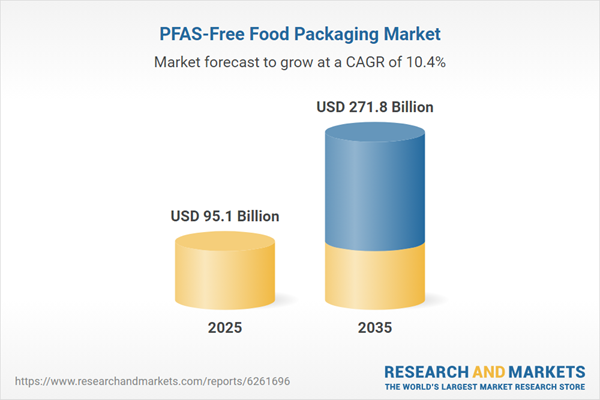
The global PFAS-free food packaging market was valued at USD 95.1 billion in 2025 and is estimated to grow at a CAGR of 10.4% to reach USD 271.8 billion by 2035.

The transition toward PFAS-free alternatives reflects the industry’s growing commitment to safer packaging materials that deliver comparable functional performance while eliminating substances known for their long-term environmental persistence. These packaging solutions support both sustainability initiatives and food safety objectives by reducing the potential for chemical migration into food while minimizing environmental impact.
Manufacturers are increasingly utilizing innovative barrier technologies and renewable material solutions that avoid fluorinated compounds while maintaining product protection and packaging performance. Growing awareness of the environmental and health concerns associated with persistent chemicals is encouraging businesses throughout the packaging value chain to adopt safer material choices. Rising consumer expectations, evolving sustainability commitments, and stronger regulatory focus continue to accelerate the adoption of PFAS-free food packaging across global food packaging applications.
The paper and paperboard segment accounted for USD 38 billion in 2025. Its leading position is supported by strong recyclability, broad compatibility with sustainable barrier technologies, and increasing demand for environmentally responsible packaging materials. Molded fiber and pulp-based packaging solutions continue to gain momentum because they provide dependable structural performance while supporting compostable packaging requirements. At the same time, bioplastics and bio-based polymers are becoming increasingly important as flexible packaging materials that offer effective moisture resistance and reliable sealing performance while supporting the industry’s transition toward renewable raw materials.
The packaged food and beverages segment reached USD 32.3 billion in 2025. Growing emphasis on food safety, stricter regulatory compliance, and corporate sustainability initiatives continue to drive the transition toward PFAS-free packaging materials across this segment. Manufacturers are increasingly adopting coated paper, fiber-based packaging, and bioplastic solutions to maintain product quality while supporting environmental objectives. Food service providers are also expanding the use of PFAS-free packaging materials as they align packaging strategies with changing regulatory requirements and increasing consumer demand for safer food-contact materials.
The North American PFAS-free food packaging market reached USD 28.5 billion in 2025. The region continues to witness rising adoption of PFAS-free packaging solutions as regulatory oversight becomes more rigorous and consumer awareness of sustainable packaging increases. Food retailers and food service companies are steadily transitioning toward packaging materials that support both regulatory compliance and long-term sustainability objectives. Continued policy developments and corporate sustainability commitments are further accelerating the adoption of fiber-based packaging materials and PFAS-free coating technologies across a broad range of food packaging applications.
Major companies operating in the global PFAS-free food packaging market include Huhtamaki Oyj, Stora Enso Oyj, Pactiv Evergreen Inc., Smurfit WestRock, Graphic Packaging International, Sealed Air Corporation, Berry Global Group (Amcor merger pending), Vegware Ltd., Sabert Corporation, Solenis LLC, Good Start Packaging, and Transcend Packaging.
Companies participating in the PFAS-free food packaging market are strengthening their competitive positions by expanding sustainable product portfolios and investing in advanced barrier technologies that eliminate PFAS while maintaining packaging performance. Manufacturers continue to increase research and development activities to introduce innovative materials that meet evolving food safety regulations and sustainability goals. Many companies are enhancing production capabilities, improving material sourcing strategies, and optimizing manufacturing efficiency to support rising global demand. Strategic partnerships across the packaging value chain help accelerate product development and expand market reach.
Comprehensive Market Analysis and Forecast
- Industry trends, key growth drivers, challenges, future opportunities, and regulatory landscape
- Competitive landscape with Porter’s Five Forces and PESTEL analysis
- Market size, segmentation, and regional forecasts
- In-depth company profiles, business strategies, financial insights, and SWOT analysis
Key Attributes
| Report Attribute | Details |
| No. of Pages | 123 |
| Forecast Period | 2025-2035 |
| Estimated Market Value (USD) in 2025 | $95.1 Billion |
| Forecasted Market Value (USD) by 2035 | $271.8 Billion |
| Compound Annual Growth Rate | 10.4% |
| Regions Covered | Global |
Key Topics Covered
Chapter 1 Methodology & Scope
1.1 Market scope and definition
1.2 Research design
1.2.1 Research approach
1.2.2 Data collection methods
1.3 Data mining sources
1.3.1 Global
1.3.2 Regional/Country
1.4 Base estimates and calculations
1.4.1 Base year calculation
1.4.2 Key trends for market estimation
1.5 Primary research and validation
1.5.1 Primary sources
1.6 Forecast model
1.7 Research assumptions and limitations
Chapter 2 Executive Summary
2.1 Industry 360 degree synopsis
2.2 Key market trends
2.2.1 Material type
2.2.2 Packaging type
2.2.3 End Use
2.2.4 Regional
2.3 TAM Analysis, 2026-2035
2.4 CXO perspectives: Strategic imperatives
2.5 Future outlook and strategic recommendations
Chapter 3 Industry Insights
3.1 Industry ecosystem analysis
3.1.1 Supplier landscape
3.1.2 Profit margin
3.1.3 Value addition at each stage
3.1.4 Factor affecting the value chain
3.1.5 Disruptions
3.2 Industry impact forces
3.2.1 Growth drivers
3.2.1.1 Rising demand for safer food packaging
3.2.1.2 Increasing regulatory restrictions on PFAS use
3.2.1.3 Growing consumer awareness on sustainability
3.2.2 Industry pitfalls and challenges
3.2.2.1 Development of biodegradable barrier coatings
3.2.2.2 Expansion in foodservice and retail applications
3.2.3 Market opportunities
3.2.3.1 Higher production costs compared alternatives
3.2.3.2 Performance limitations in grease resistance applications
3.3 Growth potential analysis
3.4 Regulatory landscape
3.4.1 North America
3.4.2 Europe
3.4.3 Asia-Pacific
3.4.4 Latin America
3.4.5 Middle East & Africa
3.5 Porter’s analysis
3.6 PESTEL analysis
3.7 Technology and innovation landscape
3.7.1 Current technological trends
3.7.2 Emerging technologies
3.8 Price trends
3.8.1 by region
3.8.2 by material type
3.9 Future market trends
3.10 Patent landscape
3.11 Trade statistics (HS code)
3.11.1 Major importing countries
3.11.2 Major exporting countries
3.12 Sustainability and environmental aspects
3.12.1 Sustainable practices
3.12.2 Waste reduction strategies
3.12.3 Energy efficiency in production
3.12.4 Eco-friendly initiatives
3.13 Carbon footprint consideration
Chapter 4 Competitive Landscape, 2025
4.1 Introduction
4.2 Company market share analysis
4.2.1 by region
4.2.1.1 North America
4.2.1.2 Europe
4.2.1.3 Asia-Pacific
4.2.1.4 LATAM
4.2.1.5 MEA
4.3 Company matrix analysis
4.4 Competitive analysis of major market players
4.5 Competitive positioning matrix
4.6 Key developments
4.6.1 Mergers & acquisitions
4.6.2 Partnerships & collaborations
4.6.3 New product launches
4.6.4 Expansion plans
Chapter 5 Market Estimates and Forecast, by Material type, 2022-2035 (USD Million) (Kilo Tons)
5.1 Key trends
5.2 Paper & paperboard
5.3 Molded fiber / pulp
5.4 Bioplastics & bio-derived polymers
5.5 Cellulose films
5.6 Aluminum & metal-based
5.7 Others
Chapter 6 Market Estimates and Forecast, by Packaging type, 2022-2035 (USD Million) (Kilo Tons)
6.1 Key trends
6.2 Wraps & liners
6.3 Clamshells & hinged containers
6.4 Plates, bowls & trays
6.5 Cups & lids
6.6 Bags & pouches
6.7 Others
Chapter 7 Market Estimates and Forecast, by End Use, 2022-2035 (USD Million) (Kilo Tons)
7.1 Key trends
7.2 Packaged food & beverages
7.3 QSR & fast food
7.4 Retail & convenience stores
7.5 Bakery & confectionery
7.6 Others
Chapter 8 Market Estimates and Forecast, by Region, 2022-2035 (USD Million) (Kilo Tons)
8.1 Key trends
8.2 North America
8.2.1 U.S.
8.2.2 Canada
8.3 Europe
8.3.1 Germany
8.3.2 UK
8.3.3 France
8.3.4 Spain
8.3.5 Italy
8.3.6 Rest of Europe
8.4 Asia-Pacific
8.4.1 China
8.4.2 India
8.4.3 Japan
8.4.4 Australia
8.4.5 South Korea
8.4.6 Rest of Asia-Pacific
8.5 Latin America
8.5.1 Brazil
8.5.2 Mexico
8.5.3 Argentina
8.5.4 Rest of Latin America
8.6 Middle East and Africa
8.6.1 Saudi Arabia
8.6.2 South Africa
8.6.3 UAE
8.6.4 Rest of Middle East and Africa
Chapter 9 Company Profiles
9.1 Huhtamaki Oyj
9.2 Stora Enso Oyj
9.3 Pactiv Evergreen Inc.
9.4 Smurfit WestRock
9.5 Graphic Packaging International
9.6 Sealed Air Corporation
9.7 Berry Global Group (Amcor merger pending)
9.8 Vegware Ltd.
9.9 Sabert Corporation
9.10 Solenis LLC
9.11 Good Start Packaging
9.12 Transcend Packaging
For more information about this report visit https://www.researchandmarkets.com/r/kpq5nu
About ResearchAndMarkets.com
ResearchAndMarkets.com is the world’s leading source for international market research reports and market data. We provide you with the latest data on international and regional markets, key industries, the top companies, new products and the latest trends.
Attachment
- PFAS-Free Food Packaging Market
CONTACT:
CONTACT: ResearchAndMarkets.com
         Laura Wood,Senior Press Manager
         press@researchandmarkets.com
         For E.S.T Office Hours Call 1-917-300-0470
         For U.S./ CAN Toll Free Call 1-800-526-8630
         For GMT Office Hours Call +353-1-416-8900