

This comprehensive study delivers an in-depth evaluation across label technologies (QR code-based labels holding 52% market share, NFC tags), primary application domains (product authentication and anti-counterfeiting accounting for 29.3% share, customer engagement, traceability), end-use sectors (apparel, pharmaceuticals, food & beverage, electronics), and key geographic markets led by North America (32% regional share).
NFC and QR-Enabled Consumer-Facing Smart Labels Market
Dublin, Aug. 14, 2026 (GLOBE NEWSWIRE) — The “NFC and QR-Enabled Consumer-Facing Smart Labels Market Opportunity, Growth Drivers, Industry Trend Analysis, and Forecast 2026-2035” has been added to ResearchAndMarkets.com’s offering.
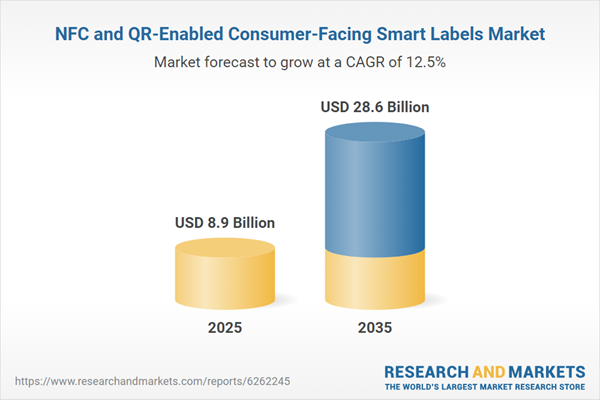

The global NFC & QR-enabled consumer-facing smart labels market was valued at USD 8.9 billion in 2025 and is estimated to grow at a CAGR of 12.5% to reach USD 28.6 billion by 2035.
Growth in the NFC & QR-enabled consumer-facing smart labels market is supported by the increasing implementation of product traceability frameworks, rising consumer preference for instant access to digital product information, and broader adoption of connected packaging by brand owners seeking stronger customer engagement. As deployment costs decline due to lower NFC chip prices and scalable cloud-based analytics platforms, manufacturers are finding smart label implementation more economically viable across high-volume production environments. Digital product information has become an essential expectation as transparency surrounding ingredients, sourcing, sustainability, and product details continues to influence purchasing behavior. QR-enabled smart labels allow brands to update digital content instantly while delivering multilingual and market-specific information without modifying printed packaging, making them an efficient solution for evolving compliance requirements and consumer communication.
The QR code-based labels segment represented a 52% share in 2025 and is anticipated to grow at a CAGR of 11.5% through 2035. The segment continues to maintain its leading position because QR codes can be digitally created and incorporated into existing printing processes at minimal additional cost. Their compatibility with conventional label production methods allows manufacturers to integrate digital functionality without requiring significant modifications to packaging equipment, making QR technology an attractive and scalable option for widespread commercial adoption.
The product authentication and anti-counterfeiting segment accounted for a 29.3% share in 2025 and is projected to grow at a CAGR of 12.8% through 2035. Market expansion is being driven by an increasing emphasis on product verification and secure identification solutions across global supply chains. Advanced NFC and QR-enabled authentication technologies equipped with secure encryption capabilities provide stronger protection against duplication than traditional identification methods, enabling manufacturers to improve product integrity, strengthen consumer confidence, and enhance supply chain visibility.
The North American NFC & QR-enabled consumer-facing smart labels market captured a 32% share in 2025. Regional growth is supported by expanding investments in digital packaging technologies, increasing adoption of connected labeling solutions, and the ongoing modernization of product traceability systems. Companies throughout the region continue to invest in machine-readable labeling infrastructure and consumer engagement platforms, supporting broader implementation of smart labels across packaging operations while improving product transparency, supply chain efficiency, and digital interaction with end users.
The NFC & QR-enabled consumer-facing smart labels market has a moderately consolidated competitive landscape, with the top five companies comprising Avery Dennison, Zebra Technologies, CCL Industries, Checkpoint Systems, and Smartrac (NXP Semiconductors). Companies operating in the market are strengthening their presence through continuous product innovation, strategic partnerships, technology integration, and the expansion of digital packaging capabilities. Market participants are investing in advanced NFC and QR-enabled labeling solutions with enhanced security, data analytics, and cloud connectivity to deliver greater value for brand owners. Many companies are expanding manufacturing capacity, improving production efficiency, and broadening their geographic reach to meet growing customer demand. Businesses are also focusing on research and development to enhance label functionality, increase durability, and improve compatibility with existing packaging operations.
Comprehensive Market Analysis and Forecast
Industry trends, key growth drivers, challenges, future opportunities, and regulatory landscape
Competitive landscape with Porter’s Five Forces and PESTEL analysis
Market size, segmentation, and regional forecasts
In-depth company profiles, business strategies, financial insights, and SWOT analysis
Key Attributes:
| Report Attribute | Details |
| No. of Pages | 222 |
| Forecast Period | 2025 – 2035 |
| Estimated Market Value (USD) in 2025 | $8.9 Billion |
| Forecasted Market Value (USD) by 2035 | $28.6 Billion |
| Compound Annual Growth Rate | 12.5% |
| Regions Covered | Global |
Key Topics Covered:
Chapter 1 Methodology & Scope
1.1 Market scope and definition
1.2 Research design
1.2.1 Research approach
1.2.2 Data collection methods
1.3 Data mining sources
1.3.1 Global
1.3.2 Regional/Country
1.4 Base estimates and calculations
1.4.1 Base year calculation
1.4.2 Key trends for market estimation
1.5 Primary research and validation
1.5.1 Primary sources
1.6 Forecast model
1.7 Research assumptions and limitations
Chapter 2 Executive Summary
2.1 Industry 360 synopsis
2.2 Key market trends
2.2.1 Regional
2.2.2 Technology Type
2.2.3 Application
2.2.4 Deployment Model
2.2.5 End-use
2.3 TAM Analysis, 2026-2035
2.4 CXO perspectives: Strategic imperatives
2.4.1 Executive decision points
Chapter 3 Industry Insights
3.1 Industry ecosystem analysis
3.1.1 Supplier landscape
3.1.2 Profit margin
3.1.3 Value addition at each stage
3.1.4 Factor affecting the value chain
3.1.5 Disruptions
3.2 Industry impact forces
3.2.1 Growth drivers
3.2.2 Industry pitfalls and challenges
3.2.3 Market opportunities
3.3 Growth potential analysis
3.4 Regulatory landscape
3.4.1 North America
3.4.2 Europe
3.4.3 Asia-Pacific
3.4.4 Latin America
3.4.5 Middle East & Africa
3.5 Porter’s analysis
3.6 PESTEL analysis
3.7 Price trends
3.7.1 by region
3.7.2 by type
3.8 Future market trends
3.9 Technology and Innovation landscape
3.9.1 Current technological trends
3.9.2 Emerging technologies
3.10 Patent Landscape
3.11 Trade statistics (HS code)
3.11.1 Major importing countries
3.11.2 Major exporting countries
3.12 Sustainability and environmental aspects
3.12.1 Sustainable practices
3.12.2 Waste reduction strategies
3.12.3 Energy efficiency in production
3.12.4 Eco-friendly initiatives
3.13 Carbon footprint consideration
Chapter 4 Competitive Landscape, 2025
4.1 Introduction
4.2 Company market share analysis
4.2.1 by region
4.2.1.1 North America
4.2.1.2 Europe
4.2.1.3 Asia-Pacific
4.2.1.4 LATAM
4.2.1.5 MEA
4.3 Company matrix analysis
4.4 Competitive analysis of major market players
4.5 Competitive positioning matrix
4.6 Key developments
4.6.1 Mergers & acquisitions
4.6.2 Partnerships & collaborations
4.6.3 New Product Launches
4.6.4 Expansion Plans
Chapter 5 Market Estimates and Forecast, by Technology Type, 2022-2035 (USD Billion)
5.1 Key trends
5.2 QR Code-Based Labels
5.3 NFC-Based Labels
5.4 Hybrid QR + NFC Labels
Chapter 6 Market Estimates and Forecast, by Application, 2022-2035 (USD Billion)
6.1 Key trends
6.2 Product Authentication & Anti-Counterfeiting
6.3 Consumer Engagement & Marketing
6.4 Supply Chain Traceability
6.5 Payment & Smart Transactions
6.6 Product Information & Transparency
Chapter 7 Market Estimates and Forecast, by Deployment Model, 2022-2035 (USD Billion)
7.1 Key trends
7.2 Cloud-Based Analytics Platforms
7.3 On-Premises / Integrated Systems
Chapter 8 Market Estimates and Forecast, by End-use, 2022-2035 (USD Billion)
8.1 Key trends
8.2 Pharmaceuticals
8.3 Food & Beverage (F&B)
8.4 Apparel & Fashion
8.5 Consumer Goods (FMCG)
8.6 Luxury Goods
8.7 Electronics
Chapter 9 Market Estimates and Forecast, by Region, 2022-2035 (USD Billion)
9.1 Key trends
9.2 North America
9.2.1 U.S.
9.2.2 Canada
9.3 Europe
9.3.1 Germany
9.3.2 UK
9.3.3 France
9.3.4 Spain
9.3.5 Italy
9.3.6 Rest of Europe
9.4 Asia-Pacific
9.4.1 China
9.4.2 India
9.4.3 Japan
9.4.4 Australia
9.4.5 South Korea
9.4.6 Rest of Asia-Pacific
9.5 Latin America
9.5.1 Brazil
9.5.2 Mexico
9.5.3 Argentina
9.5.4 Rest of Latin America
9.6 Middle East and Africa
9.6.1 Saudi Arabia
9.6.2 South Africa
9.6.3 UAE
9.6.4 Rest of Middle East and Africa
Chapter 10 Company Profiles
10.1 Avery Dennison
10.2 Zebra Technologies
10.3 CCL Industries
10.4 Checkpoint Systems
10.5 Smartrac (HID Global / NXP)
10.6 Alien Technology
10.7 Thinfilm Electronics
10.8 Identiv
10.9 SATO Holdings
10.10 Impinj
10.11 Tageos
10.12 Pragmatic Semiconductor
10.13 Scantrust
10.14 Digimarc
For more information about this report visit https://www.researchandmarkets.com/r/bnoh12
About ResearchAndMarkets.com
ResearchAndMarkets.com is the world’s leading source for international market research reports and market data. We provide you with the latest data on international and regional markets, key industries, the top companies, new products and the latest trends.
Attachment
- NFC and QR-Enabled Consumer-Facing Smart Labels Market
CONTACT:
CONTACT: ResearchAndMarkets.com
         Laura Wood,Senior Press Manager
         press@researchandmarkets.com
         For E.S.T Office Hours Call 1-917-300-0470
         For U.S./ CAN Toll Free Call 1-800-526-8630
         For GMT Office Hours Call +353-1-416-8900