Opportunities include advanced marine batteries, electric and hybrid propulsion, port charging and electrification, and energy management systems. Demand spans ferries, workboats, leisure craft and large ships, supported by decarbonization rules, incentives and industry partnerships.
Marine Electric Vehicle Market
Dublin, Aug. 25, 2026 (GLOBE NEWSWIRE) — The “Marine Electric Vehicle Market, Till 2035: Distribution by Type of Vehicle, Type of Technology, Type of Vessel Size, Type of Range, and Geographical Regions: Industry Trends and Global Forecasts” has been added to ResearchAndMarkets.com’s offering.
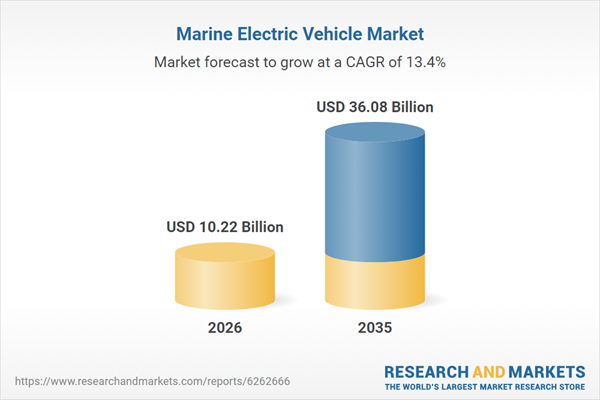

Marine Electric Vehicle Market Projected to Reach USD 36.08 Billion by 2035
Rising maritime decarbonization targets, battery innovation and port electrification are accelerating global adoption of electric and hybrid vessels.
The global marine electric vehicle market is projected to expand from USD 10.22 billion to USD 36.08 billion by 2035, representing a compound annual growth rate of 13.44% during the forecast period. Market growth is being driven by stricter maritime emission regulations, growing demand for sustainable transportation and continued investment in electric propulsion systems, marine batteries and charging infrastructure.
Maritime transport accounts for approximately 2% to 3% of global carbon emissions, according to the World Economic Forum. Pressure to reduce the sector’s environmental impact is encouraging commercial operators, shipbuilders, governments and technology providers to accelerate the transition toward fully electric and hybrid-electric vessels. The International Maritime Organization’s 2050 emission reduction objectives are also creating significant opportunities for marine electrification across passenger transportation, cargo operations, tourism, leisure, defense and industrial applications.
Market Growth Drivers
Government emission standards and sustainability initiatives remain central to marine electric vehicle market growth. Electric propulsion can help operators reduce greenhouse gas emissions, water pollution, fuel consumption and operating costs while improving energy efficiency. Demand is also rising as maritime stakeholders strengthen resilience and environmental performance in response to climate-related risks.
Advances in marine battery energy density, capacity, safety and charging performance are supporting longer operating ranges and broader vessel applications. At the same time, investment in shore-side charging, port electrification and integrated energy management systems is improving the commercial viability of electric fleets.
Competitive Landscape and Emerging Innovation
The competitive landscape includes multinational technology companies, regional manufacturers and specialized startups. ABB, Siemens, Corvus Energy and BAE Systems are among the prominent companies developing electric propulsion, hybrid-electric powertrains, battery systems and energy management technologies for marine vessels.
Established participants are using partnerships, collaborations, acquisitions and product development programs to strengthen their market positions. Emerging companies are contributing to market diversification by introducing electric propulsion solutions for recreational boats, passenger ferries and smaller commercial vessels.
Key marine electric mobility trends include the deployment of larger fully electric ships, growing adoption of hybrid-electric ferries and workboats, and closer collaboration among shipbuilders, battery manufacturers, ports and technology providers. Recent launch activity, including major fully electric vessels introduced in 2025, demonstrates the industry’s progress toward higher-capacity electric maritime operations.
Europe Leads the Marine Electric Vehicle Market
Europe holds the largest share of the global marine electric vehicle market, supported by stringent environmental regulations, the European Green Deal and national incentives for clean maritime technologies. Grants, subsidies and policy support are encouraging fleet operators and shipbuilders to invest in electric and hybrid propulsion systems.
The region also benefits from an established maritime technology ecosystem and the presence of leading industry participants. Increasing demand for sustainable public transportation and low-emission vessels is supporting the deployment of electric ferries, workboats and recreational craft across European markets.
Challenges Affecting Market Adoption
Despite strong growth prospects, the marine electric vehicle industry continues to face technical and commercial barriers. Current battery limitations can restrict the range and operating capacity of vessels used for long-distance or heavy-duty applications. High initial costs for batteries, propulsion systems, vessel integration and charging infrastructure may also delay fleet conversion decisions.
Additional challenges include limited charging availability at ports, extended charging times and inconsistent technical standards across regions. Harsh operating conditions involving saltwater, humidity and temperature fluctuations place further demands on battery durability, safety and maintenance. Battery recycling requirements and supply constraints affecting lithium, cobalt and nickel remain important considerations for long-term market development.
Marine Electric Vehicle Market Segmentation
- By vehicle type: Autonomous underwater vehicles, leisure and tourist surface ships, military vehicles and workboats
- By technology: Fully electric and hybrid
- By vessel size: Small electric boats, medium-sized electric boats and large electric ships
- By operating range: Less than 50 kilometers, 50-100 kilometers, 101-1,000 kilometers and more than 1,000 kilometers
- By region: North America, Europe, Asia, Latin America, the Middle East and North Africa, and the rest of the world
Report Coverage
The marine electric vehicle market report provides revenue forecasts and opportunity analysis across vehicle type, propulsion technology, vessel size, operating range and geography. It also evaluates the competitive landscape, company positioning, industry megatrends, patents, partnerships, funding activity and recent strategic developments.
Detailed company profiles assess product and technology portfolios, operating segments, geographic footprints, financial information, management teams and future growth strategies. The research also includes Porter’s Five Forces analysis and a SWOT assessment covering the principal strengths, weaknesses, opportunities and threats influencing the marine electric mobility industry.
Key Questions Addressed
- What is the current size of the marine electric vehicle market, and how will it develop through 2035?
- Which companies are leading the global marine electric vehicle industry?
- What regulatory, environmental and technological factors are driving market growth?
- How are partnerships, investments and funding trends shaping marine electrification?
- Which regions and market segments are expected to record the strongest growth?
- How will market opportunities be distributed across vehicle types, technologies, vessel sizes and operating ranges?
Strategic Value for Industry Stakeholders
The report is designed to support shipbuilders, fleet operators, battery manufacturers, propulsion technology providers, investors and policymakers evaluating opportunities in the global marine electric vehicle market. It combines market forecasts with competitive intelligence, expert insights and strategic frameworks to identify growth areas, emerging technologies and potential market gaps.
Additional benefits include dynamic Excel dashboards for analytical modules, complimentary content customization of up to 15%, an interactive walkthrough with the research team and updates for report editions older than six to 12 months.
Key Attributes:
| Report Attribute | Details |
| No. of Pages | 184 |
| Forecast Period | 2026 – 2035 |
| Estimated Market Value (USD) in 2026 | $10.22 Billion |
| Forecasted Market Value (USD) by 2035 | $36.08 Billion |
| Compound Annual Growth Rate | 13.4% |
| Regions Covered | Global |
Key Topics Covered:
SECTION I: REPORT OVERVIEW
1. PREFACE
1.1. Introduction
1.2. Market Share Insights
1.3. Key Market Insights
1.4. Report Coverage
1.5. Key Questions Answered
1.6. Chapter Outlines
2. RESEARCH METHODOLOGY
2.1. Chapter Overview
2.2. Research Assumptions
2.3. Database Building
2.3.1. Data Collection
2.3.2. Data Validation
2.3.3. Data Analysis
2.4. Project Methodology
2.4.1. Secondary Research
2.4.1.1. Annual Reports
2.4.1.2. Academic Research Papers
2.4.1.3. Company Websites
2.4.1.4. Investor Presentations
2.4.1.5. Regulatory Filings
2.4.1.6. White Papers
2.4.1.7. Industry Publications
2.4.1.8. Conferences and Seminars
2.4.1.9. Government Portals
2.4.1.10. Media and Press Releases
2.4.1.11. Newsletters
2.4.1.12. Industry Databases
2.4.1.13. Roots Proprietary Databases
2.4.1.14. Paid Databases and Sources
2.4.1.15. Social Media Portals
2.4.1.16. Other Secondary Sources
2.4.2. Primary Research
2.4.2.1. Introduction
2.4.2.2. Types
2.4.2.2.1. Qualitative
2.4.2.2.2. Quantitative
2.4.2.3. Advantages
2.4.2.4. Techniques
2.4.2.4.1. Interviews
2.4.2.4.2. Surveys
2.4.2.4.3. Focus Groups
2.4.2.4.4. Observational Research
2.4.2.4.5. Social Media Interactions
2.4.2.5. Stakeholders
2.4.2.5.1. Company Executives (CXOs)
2.4.2.5.2. Board of Directors
2.4.2.5.3. Company Presidents and Vice Presidents
2.4.2.5.4. Key Opinion Leaders
2.4.2.5.5. Research and Development Heads
2.4.2.5.6. Technical Experts
2.4.2.5.7. Subject Matter Experts
2.4.2.5.8. Scientists
2.4.2.5.9. Doctors and Other Healthcare Providers
2.4.2.6. Ethics and Integrity
2.4.2.6.1. Research Ethics
2.4.2.6.2. Data Integrity
2.4.3. Analytical Tools and Databases
3. MARKET DYNAMICS
3.1. Forecast Methodology
3.1.1. Top-Down Approach
3.1.2. Bottom-Up Approach
3.1.3. Hybrid Approach
3.2. Market Assessment Framework
3.2.1. Total Addressable Market (TAM)
3.2.2. Serviceable Addressable Market (SAM)
3.2.3. Serviceable Obtainable Market (SOM)
3.2.4. Currently Acquired Market (CAM)
3.3. Forecasting Tools and Techniques
3.3.1. Qualitative Forecasting
3.3.2. Correlation
3.3.3. Regression
3.3.4. Time Series Analysis
3.3.5. Extrapolation
3.3.6. Convergence
3.3.7. Forecast Error Analysis
3.3.8. Data Visualization
3.3.9. Scenario Planning
3.3.10. Sensitivity Analysis
3.4. Key Considerations
3.4.1. Demographics
3.4.2. Market Access
3.4.3. Reimbursement Scenarios
3.4.4. Industry Consolidation
3.5. Robust Quality Control
3.6. Key Market Segmentations
3.7. Limitations
4. MACRO-ECONOMIC INDICATORS
4.1. Chapter Overview
4.2. Market Dynamics
4.2.1. Time Period
4.2.1.1. Historical Trends
4.2.1.2. Current and Forecasted Estimates
4.2.2. Currency Coverage
4.2.2.1. Overview of Major Currencies Affecting the Market
4.2.2.2. Impact of Currency Fluctuations on the Industry
4.2.3. Foreign Exchange Impact
4.2.3.1. Evaluation of Foreign Exchange Rates and Their Impact on Market
4.2.3.2. Strategies for Mitigating Foreign Exchange Risk
4.2.4. Recession
4.2.4.1. Historical Analysis of Past Recessions and Lessons Learnt
4.2.4.2. Assessment of Current Economic Conditions and Potential Impact on the Market
4.2.5. Inflation
4.2.5.1. Measurement and Analysis of Inflationary Pressures in the Economy
4.2.5.2. Potential Impact of Inflation on the Market Evolution
4.2.6. Interest Rates
4.2.6.1. Overview of Interest Rates and Their Impact on the Market
4.2.6.2. Strategies for Managing Interest Rate Risk
4.2.7. Commodity Flow Analysis
4.2.7.1. Type of Commodity
4.2.7.2. Origins and Destinations
4.2.7.3. Values and Weights
4.2.7.4. Modes of Transportation
4.2.8. Global Trade Dynamics
4.2.8.1. Import Scenario
4.2.8.2. Export Scenario
4.2.9. War Impact Analysis
4.2.9.1. Russian-Ukraine War
4.2.9.2. Israel-Hamas War
4.2.10. COVID Impact / Related Factors
4.2.10.1. Global Economic Impact
4.2.10.2. Industry-specific Impact
4.2.10.3. Government Response and Stimulus Measures
4.2.10.4. Future Outlook and Adaptation Strategies
4.2.11. Other Indicators
4.2.11.1. Fiscal Policy
4.2.11.2. Consumer Spending
4.2.11.3. Gross Domestic Product (GDP)
4.2.11.4. Employment
4.2.11.5. Taxes
4.2.11.6. R&D Innovation
4.2.11.7. Stock Market Performance
4.2.11.8. Supply Chain
4.2.11.9. Cross-Border Dynamics
SECTION II: QUALITATIVE INSIGHTS
5. EXECUTIVE SUMMARY
6. INTRODUCTION
6.1. Chapter Overview
6.2. Overview of Marine Electric Vehicle Market
6.2.1. Type of Vehicle
6.2.2. Type of Technology
6.2.3. Type of Vessel Size
6.2.4. Type of Range
6.3. Future Perspective
7. REGULATORY SCENARIO
SECTION III: MARKET OVERVIEW
8. COMPREHENSIVE DATABASE OF LEADING PLAYERS
9. COMPETITIVE LANDSCAPE
9.1. Chapter Overview
9.2. Marine Electric Vehicle: Overall Market Landscape
9.2.1. Analysis by Year of Establishment
9.2.2. Analysis by Company Size
9.2.3. Analysis by Location of Headquarters
9.2.4. Analysis by Ownership Structure
10. WHITE SPACE ANALYSIS
11. COMPANY COMPETITIVENESS ANALYSIS
12. STARTUP ECOSYSTEM IN THE MARINE ELECTRIC VEHICLE MARKET
12.1. Marine Electric Vehicle: Market Landscape of Startups
12.1.1. Analysis by Year of Establishment
12.1.2. Analysis by Company Size
12.1.3. Analysis by Company Size and Year of Establishment
12.1.4. Analysis by Location of Headquarters
12.1.5. Analysis by Company Size and Location of Headquarters
12.1.6. Analysis by Ownership Structure
12.2. Key Findings
SECTION IV: COMPANY PROFILES
13. COMPANY PROFILES
13.1. Chapter Overview
13.2. ABB *
13.2.1. Company Overview
13.2.2. Company Mission
13.2.3. Company Footprint
13.2.4. Management Team
13.2.5. Contact Details
13.2.6. Financial Performance
13.2.7. Operating Business Segments
13.2.8. Service / Product Portfolio (project specific)
13.2.9. MOAT Analysis
13.2.10. Recent Developments and Future Outlook
* similar detail is presented for other below mentioned companies based on information in the public domain
13.3. Andaman Boatyard
13.4. BAE Systems
13.5. Boeing
13.6. Boesch Motorboote
13.7. Corvus Energy
13.8. Duffy Electric Boats
13.9. Echandia Marine
13.10. ElectraCraft Power Boats
13.11. General Electric
13.12. Kongsberg Gruppen
13.13. Leclanche
13.14. Norwegian Electric Systems
13.15. Rand Boats
13.16. Ruban Bleu
13.17. Saft
13.18. Siemens
SECTION V: MARKET TRENDS
14. MEGA TRENDS ANALYSIS
15. UNMET NEED ANALYSIS
16. PATENT ANALYSIS
17. RECENT DEVELOPMENTS
17.1. Chapter Overview
17.2. Recent Funding
17.3. Recent Partnerships
17.4. Other Recent Initiatives
SECTION VI: MARKET OPPORTUNITY ANALYSIS
18. GLOBAL MARINE ELECTRIC VEHICLE MARKET
18.1. Chapter Overview
18.2. Key Assumptions and Methodology
18.3. Trends Disruption Impacting Market
18.4. Demand Side Trends
18.5. Supply Side Trends
18.6. Global Marine Electric Vehicle Market, Historical Trends (Since 2020) and Forecasted Estimates (Till 2035)
18.7. Multivariate Scenario Analysis
18.7.1. Conservative Scenario
18.7.2. Optimistic Scenario
18.8. Investment Feasibility Index
18.9. Key Market Segmentations
19. MARKET OPPORTUNITIES BASED ON TYPE OF VEHICLE
19.1. Chapter Overview
19.2. Key Assumptions and Methodology
19.3. Revenue Shift Analysis
19.4. Market Movement Analysis
19.5. Penetration-Growth (P-G) Matrix
19.6. Marine Electric Vehicle Market for Autonomous Underwater Vehicles: Historical Trends (Since 2020) and Forecasted Estimates (Till 2035)
19.7. Marine Electric Vehicle Market for Leisure and Tourist Surface Ship: Historical Trends (Since 202) and Forecasted Estimates (Till 2035)
19.8. Marine Electric Vehicle Market for Military Vehicles: Historical Trends (Since 2020) and Forecasted Estimates (Till 2035)
19.9. Marine Electric Vehicle Market for Work Boats: Historical Trends (Since 2020) and Forecasted Estimates (Till 2035)
19.10. Data Triangulation and Validation
19.10.1. Secondary Sources
19.10.2. Primary Sources
19.10.3. Statistical Modeling
20. MARKET OPPORTUNITIES BASED ON TYPE OF TECHNOLOGY
20.1. Chapter Overview
20.2. Key Assumptions and Methodology
20.3. Revenue Shift Analysis
20.4. Market Movement Analysis
20.5. Penetration-Growth (P-G) Matrix
20.6. Marine Electric Vehicle Market for Fully Electric: Historical Trends (Since 2020) and Forecasted Estimates (Till 2035)
20.7. Marine Electric Vehicle Market for Hybrid: Historical Trends (Since 2020) and Forecasted Estimates (Till 2035)
20.8. Data Triangulation and Validation
20.8.1. Secondary Sources
20.8.2. Primary Sources
20.8.3. Statistical Modeling
21. MARKET OPPORTUNITIES BASED ON TYPE OF VESSEL SIZE
21.1. Chapter Overview
21.2. Key Assumptions and Methodology
21.3. Revenue Shift Analysis
21.4. Market Movement Analysis
21.5. Penetration-Growth (P-G) Matrix
21.6. Marine Electric Vehicle Market for Small Electric Boats: Historical Trends (Since 2020) and Forecasted Estimates (Till 2035)
21.7. Marine Electric Vehicle Market for Medium Sized Electric Boats: Historical Trends (Since 2020) and Forecasted Estimates (Till 2035)
21.8. Marine Electric Vehicle Market for Large Electric Ships: Historical Trends (Since 2020) and Forecasted Estimates (Till 2035)
21.9. Data Triangulation and Validation
21.9.1. Secondary Sources
21.9.2. Primary Sources
21.9.3. Statistical Modeling
22. MARKET OPPORTUNITIES BASED ON TYPE OF RANGE
22.1. Chapter Overview
22.2. Key Assumptions and Methodology
22.3. Revenue Shift Analysis
22.4. Market Movement Analysis
22.5. Penetration-Growth (P-G) Matrix
22.6. Marine Electric Vehicle Market for < 50 Km: Historical Trends (Since 2020) and Forecasted Estimates (Till 2035)
22.7. Marine Electric Vehicle Market for 50-10 Km: Historical Trends (Since 2020) and Forecasted Estimates (Till 2035)
22.8. Marine Electric Vehicle Market for 101-1000 Km: Historical Trends (Since 2020) and Forecasted Estimates (Till 2035)
22.9. Marine Electric Vehicle Market for > 1000 KM: Historical Trends (Since 2020) and Forecasted Estimates (Till 2035)
22.10. Data Triangulation and Validation
22.10.1. Secondary Sources
22.10.2. Primary Sources
22.10.3. Statistical Modeling
23. MARKET OPPORTUNITIES FOR MARINE ELECTRIC VEHICLE IN NORTH AMERICA
23.1. Chapter Overview
23.2. Key Assumptions and Methodology
23.3. Revenue Shift Analysis
23.4. Market Movement Analysis
23.5. Penetration-Growth (P-G) Matrix
23.6. Marine Electric Vehicle Market in North America: Historical Trends (Since 2020) and Forecasted Estimates (Till 2035)
23.6.1. Marine Electric Vehicle Market in the US: Historical Trends (Since 2020) and Forecasted Estimates (Till 2035)
23.6.2. Marine Electric Vehicle Market in Canada: Historical Trends (Since 2020) and Forecasted Estimates (Till 2035)
23.6.3. Marine Electric Vehicle Market in Mexico: Historical Trends (Since 2020) and Forecasted Estimates (Till 2035)
23.6.4. Marine Electric Vehicle Market in Other North American Countries: Historical Trends (Since 2020) and Forecasted Estimates (Till 2035)
23.7. Data Triangulation and Validation
24. MARKET OPPORTUNITIES FOR MARINE ELECTRIC VEHICLE IN EUROPE
24.1. Chapter Overview
24.2. Key Assumptions and Methodology
24.3. Revenue Shift Analysis
24.4. Market Movement Analysis
24.5. Penetration-Growth (P-G) Matrix
24.6. Marine Electric Vehicle Market in Europe: Historical Trends (Since 2020) and Forecasted Estimates (Till 2035)
24.6.1. Marine Electric Vehicle Market in Austria: Historical Trends (Since 2020) and Forecasted Estimates (Till 2035)
24.6.2. Marine Electric Vehicle Market in Belgium: Historical Trends (Since 2020) and Forecasted Estimates (Till 2035)
24.6.3. Marine Electric Vehicle Market in Denmark: Historical Trends (Since 2020) and Forecasted Estimates (Till 2035)
24.6.4. Marine Electric Vehicle Market in France: Historical Trends (Since 2020) and Forecasted Estimates (Till 2035)
24.6.5. Marine Electric Vehicle Market in Germany: Historical Trends (Since 2020) and Forecasted Estimates (Till 2035)
24.6.6. Marine Electric Vehicle Market in Ireland: Historical Trends (Since 2020) and Forecasted Estimates (Till 2035)
24.6.7. Marine Electric Vehicle Market in Italy: Historical Trends (Since 2020) and Forecasted Estimates (Till 2035)
24.6.8. Marine Electric Vehicle Market in Netherlands: Historical Trends (Since 2020) and Forecasted Estimates (Till 2035)
24.6.9. Marine Electric Vehicle Market in Norway: Historical Trends (Since 2020) and Forecasted Estimates (Till 2035)
24.6.10. Marine Electric Vehicle Market in Russia: Historical Trends (Since 2020) and Forecasted Estimates (Till 2035)
24.6.11. Marine Electric Vehicle Market in Spain: Historical Trends (Since 2020) and Forecasted Estimates (Till 2035)
24.6.12. Marine Electric Vehicle Market in Sweden: Historical Trends (Since 2020) and Forecasted Estimates (Till 2035)
24.6.13. Marine Electric Vehicle Market in Switzerland: Historical Trends (Since 2020) and Forecasted Estimates (Till 2035)
24.6.14. Marine Electric Vehicle Market in the UK: Historical Trends (Since 2020) and Forecasted Estimates (Till 2035)
24.6.15. Marine Electric Vehicle Market in Other European Countries: Historical Trends (Since 2020) and Forecasted Estimates (Till 2035)
24.7. Data Triangulation and Validation
25. MARKET OPPORTUNITIES FOR MARINE ELECTRIC VEHICLE IN ASIA
25.1. Chapter Overview
25.2. Key Assumptions and Methodology
25.3. Revenue Shift Analysis
25.4. Market Movement Analysis
25.5. Penetration-Growth (P-G) Matrix
25.6. Marine Electric Vehicle Market in Asia: Historical Trends (Since 2020) and Forecasted Estimates (Till 2035)
25.6.1. Marine Electric Vehicle Market in China: Historical Trends (Since 2020) and Forecasted Estimates (Till 2035)
25.6.2. Marine Electric Vehicle Market in India: Historical Trends (Since 2020) and Forecasted Estimates (Till 2035)
25.6.3. Marine Electric Vehicle Market in Japan: Historical Trends (Since 2020) and Forecasted Estimates (Till 2035)
25.6.4. Marine Electric Vehicle Market in Singapore: Historical Trends (Since 2020) and Forecasted Estimates (Till 2035)
25.6.5. Marine Electric Vehicle Market in South Korea: Historical Trends (Since 2020) and Forecasted Estimates (Till 2035)
25.6.6. Marine Electric Vehicle Market in Other Asian Countries: Historical Trends (Since 2020) and Forecasted Estimates (Till 2035)
25.7. Data Triangulation and Validation
26. MARKET OPPORTUNITIES FOR MARINE ELECTRIC VEHICLE IN MIDDLE EAST AND NORTH AFRICA (MENA)
26.1. Chapter Overview
26.2. Key Assumptions and Methodology
26.3. Revenue Shift Analysis
26.4. Market Movement Analysis
26.5. Penetration-Growth (P-G) Matrix
26.6. Marine Electric Vehicle Market in Middle East and North Africa (MENA): Historical Trends (Since 2020) and Forecasted Estimates (Till 2035)
26.6.1. Marine Electric Vehicle Market in Egypt: Historical Trends (Since 2020) and Forecasted Estimates (Till 205)
26.6.2. Marine Electric Vehicle Market in Iran: Historical Trends (Since 2020) and Forecasted Estimates (Till 2035)
26.6.3. Marine Electric Vehicle Market in Iraq: Historical Trends (Since 2020) and Forecasted Estimates (Till 2035)
26.6.4. Marine Electric Vehicle Market in Israel: Historical Trends (Since 2020) and Forecasted Estimates (Till 2035)
26.6.5. Marine Electric Vehicle Market in Kuwait: Historical Trends (Since 2020) and Forecasted Estimates (Till 2035)
26.6.6. Marine Electric Vehicle Market in Saudi Arabia: Historical Trends (Since 2020) and Forecasted Estimates (Till 2035)
26.6.7. Neuromorphic Computing Marke in United Arab Emirates (UAE): Historical Trends (Since 2020) and Forecasted Estimates (Till 2035)
26.6.8. Marine Electric Vehicle Market in Other MENA Countries: Historical Trends (Since 2020) and Forecasted Estimates (Till 2035)
26.7. Data Triangulation and Validation
27. ADJACENT MARKET ANALYSIS
SECTION VII: STRATEGIC TOOLS
28. KEY WINNING STRATEGIES
29. PORTER’S FIVE FORCES ANALYSIS
30. SWOT ANALYSIS
31. VALUE CHAIN ANALYSIS
32. STRATEGIC RECOMMENDATIONS
SECTION VIII: OTHER EXCLUSIVE INSIGHTS
33. INSIGHTS FROM PRIMARY RESEARCH
34. REPORT CONCLUSION
SECTION IX: APPENDIX
35. TABULATED DATA
36. LIST OF COMPANIES AND ORGANIZATIONS
37. CUSTOMIZATION OPPORTUNITIES
38. SUBSCRIPTION SERVICES
39. AUTHOR DETAILS
A selection of companies mentioned in this report includes, but is not limited to:
- ABB
- Andaman Boatyard
- BAE
- Boeing
- Boesch Motorboote
- Corvus Energy
- Dufy Electric Boats
- Echandia Marine AB
- ElectraCraft Power Boats
- General Electric
- Kongsberg Gruppen
- Leclanche
- Norwegian Electric
- Rand boats
- Ruban Bleu
- Saft
- Siemens
For more information about this report visit https://www.researchandmarkets.com/r/nzltfg
About ResearchAndMarkets.com
ResearchAndMarkets.com is the world’s leading source for international market research reports and market data. We provide you with the latest data on international and regional markets, key industries, the top companies, new products and the latest trends.
Attachment
- Marine Electric Vehicle Market
CONTACT:
CONTACT: ResearchAndMarkets.com
         Laura Wood,Senior Press Manager
         press@researchandmarkets.com
         For E.S.T Office Hours Call 1-917-300-0470
         For U.S./ CAN Toll Free Call 1-800-526-8630
         For GMT Office Hours Call +353-1-416-8900