



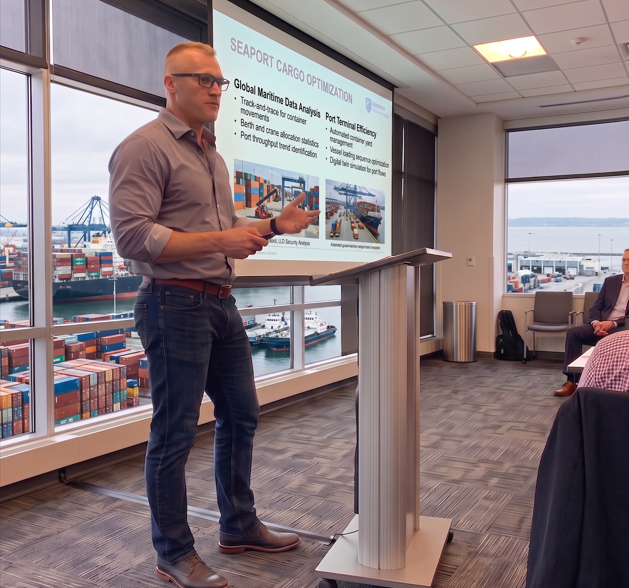
Retired Army Captain and Logistics Innovator Michael Curtis Broughton Releases THE SEAPORT EXECUTION SYSTEM, a 2050 Blueprint for Automated Container Terminals. New book argues seaports must trade outdoor container stacking for indoor automated storage and retrieval, adapting systems proven by Amazon and Walmart to break freight’s worst bottleneck.
HOUSTON, Sept. 04, 2026 (GLOBE NEWSWIRE) — Retired U.S. Army Captain, combat veteran, industrial engineer and logistics strategist Michael Curtis Broughton has published THE SEAPORT EXECUTION SYSTEM: A 2050 Systems-Engineering Blueprint for High-Density, Cyber-Physical Container Terminals, now available in the Amazon Kindle Store. The book lays out a blueprint for converting the world’s outdated container terminals into automated indoor hubs built for continuous, zero-emission flow.
Broughton opens with what he calls the Great Material Disconnect. Global trade relies on Ultra-Large Container Vessels to move goods, yet these high-velocity pipelines stall at outdated seaports. While logistics technology has evolved, marine terminals remain frozen in the 1960s, stacking containers up to six high in open-air yards. That Last-In-First-Out (LIFO) model forces slow gantry cranes into wasteful “digging” shuffles to retrieve buried freight, friction that causes massive truck idling, exposes cargo to harsh weather, increases energy use and strains power grids.
“Transitioning to the Seaport Execution System yields a 66.2% increase in container velocity, complete elimination of rehandling shuffles, a 75.0% smaller land footprint, a 57.2% cut in energy use and a 75.3% reduction in carbon emissions,” Broughton writes. “It’s an empirically verified blueprint for continuous, zero-emission flow.”
THE SEAPORT EXECUTION SYSTEM argues the fix doesn’t come from inside the maritime industry. Broughton’s solution adapts Fortune 50 retail systems, like those built by Amazon and Walmart, to heavy maritime freight. Retail networks eliminated LIFO bottlenecks years ago with automated high-bay racks where every item is individually accessible. By treating containers as heavy industrial pallets and storing them inside a Rack-Supported Building Automated Storage and Retrieval System (AS/RS), terminals give every container direct random-access addressability, while structural frame pins bear the load and eliminate rehandling shuffles altogether.
The book presents the Seaport Execution System (SES), a blueprint for converting legacy terminals into automated indoor hubs. SES applies the VERONIC Reference Standard established in Broughton’s earlier book THE VERONIC INDUSTRIAL STANDARD, translating the four-pillar framework into a domain-specific application for maritime container operations. Framed by that standard, it integrates systems engineering, smart microgrids, multi-modal flows and cybersecurity, all backed by Model-Based Systems Engineering simulations across 27 parameters. The volume unfolds across six parts:
- Part I: Outlines the outdoor stacking crisis, the SES transition, VERONIC standards and microgrid governance.
- Part II: Details the indoor AS/RS rack architecture, shuttle kinematics, 4D path reservations and predictive staging.
- Part III: Replaces quay cranes with Hybrid Continuous Over-Berth Bridges to service standard ships.
- Part IV: Addresses landside interfaces, including automated portals, electric tractor fleets, megawatt charging and rail links.
- Part V: Covers sensor fusion, digital twin forensics, civil rack engineering, software architecture and a 36-month deployment plan.
- Part VI: Stress-tests the system via Monte Carlo simulations across five operational tiers, enforcing cybersecurity controls and mathematical validation rules.
Taken together, the six parts build toward what Broughton calls continuous, zero-emission flow: terminals that eliminate rehandling, cut energy use and free up land for other purposes, all while meeting the throughput demands of the ultra-large vessels calling on ports today. The book is written for terminal operators, port authorities, systems engineers, urban planners and investors looking for a practical blueprint for the seaports of 2050.
About Michael Curtis Broughton
Michael Curtis Broughton is a retired U.S. Army Captain, combat veteran, industrial engineer and logistics innovator whose career spans frontline operations, extreme-environment aviation sustainment, advanced academic systems research and enterprise-scale commercial supply chain optimization. He earned his GED at 17 and enlisted in the U.S. Army as an infantryman, rising through the ranks over nearly two decades before retiring honorably as a commissioned officer. He served on the front lines of the Global War on Terrorism during Operation Inherent Resolve, work that included JPADS airdrop missions supporting Peshmerga refugees fleeing ISIL, and he later led Arctic FARP deployments while directing more than $1 billion in DOD air mobility operations as an FSC Platoon Leader at Fort Wainwright, Alaska.
Broughton built an early orientation toward structured process, spatial reasoning and discipline through competitive swimming, strategic chess, crisis-response and Red Cross training. He went on to build an extensive multi-degree academic foundation across Sam Houston State University, American Military University, Texas A&M University and Northern Illinois University, earning master’s degrees spanning Industrial and Systems Engineering, Industrial Management, Industrial Distribution and Transportation and Logistics. He also holds the Designated Master Logistician (DML) credential from the International Society of Logistics (SOLE). His graduate work produced an approved engineering thesis titled “Large Retail Logistics Warehouse Execution System,” which originated the LRL MHE-R DIBS (Material Handling Equipment-Robotized Dynamic Integrated Bulk Slotting) framework to bridge the gap between digital software intent (WMS/WES) and physical floor automation. His thesis is indexed at Northern Illinois University’s Huskie Commons and cataloged in his ResearchGate profile.
Following his military service, Broughton translated operational precision to commercial supply chains, holding senior logistics leadership roles at The Home Depot and Samsung, where he managed $57 million in inventory across 114 stores. He also served as a corporate logistics analyst at McLane Company, conducting onsite research to optimize a national tractor-trailer fleet.
He graduated from Northern Illinois University’s School of Engineering with Honors and is a member of Alpha Pi Mu (APM), the premier international honor society dedicated exclusively to industrial engineering. Through that affiliation he works closely with the Institute of Industrial and Systems Engineers (IISE).
Outside of his professional work, Broughton is a lifelong endurance athlete with a competitive swimming background and remains active in running, swimming and biking today. He’s also a supporter of veteran mental health policy advocacy and STEM mentorship.
THE SEAPORT EXECUTION SYSTEM: A 2050 Systems-Engineering Blueprint for High-Density, Cyber-Physical Container Terminals is available now in the Amazon Kindle Store.
CONTACT: MEDIA CONTACT

TheBestReputation
Media Relations
content@thebestreputation.com
thebestreputation.com


