


Commercial vehicles and plug-in hybrid electric vehicles (PHEVs) will hold significant shares, while Europe remains a key EV manufacturing hub
EV Assembly Market
Dublin, Aug. 12, 2026 (GLOBE NEWSWIRE) — The “EV Assembly Market by Manufacturing Strategy, Platform Type, EV Component, Integration Type, OEM Analysis, and Region – Global Forecast to 2035” has been added to ResearchAndMarkets.com’s offering.
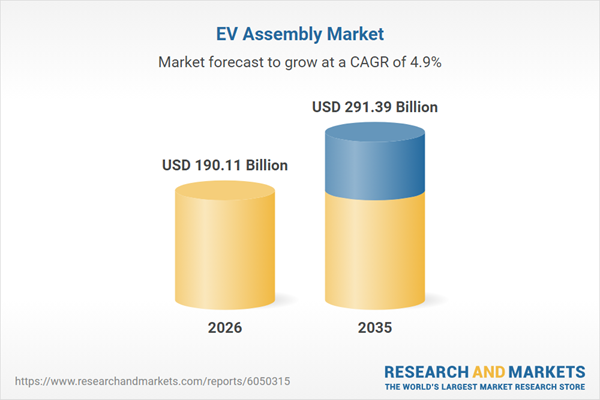
The global EV assembly market is projected to grow from USD 190.11 billion in 2026 to USD 291.39 billion by 2035, registering a compound annual growth rate of 4.9%. Market expansion is being supported by dedicated electric vehicle platforms, localized battery manufacturing, advanced automation, software-defined vehicle architectures and the conversion of conventional automotive plants into EV-focused production facilities.

Automakers are increasingly adopting gigacasting to consolidate stamped and welded components into large cast structures, reducing part counts, tooling requirements, material waste and production cycles. At Gigafactory Texas, Tesla replaced 70 individual components with a single rear body casting and reduced casting cycle times from approximately 120 minutes to 80-90 seconds, enabling production of 40-45 castings per hour.
Volvo plans to replace approximately 100 stamped components with a single megacast structure for the rear chassis section of the EX60. The process is expected to deliver a 15-20% weight reduction and approximately 95% material utilization through the in-house recycling of casting scrap. These manufacturing advances support cost-effective, high-volume EV production while simplifying vehicle assembly.
Commercial Electric Vehicles to Represent a Significant Market Share
The commercial vehicle segment is projected to hold a significant share of the EV assembly market during the forecast period. Electrification across logistics fleets, public transportation systems and last-mile delivery operations is generating large-volume procurement contracts, improving factory utilization and encouraging OEMs to establish dedicated commercial EV assembly lines.
Manufacturers are also investing in purpose-built platforms that create opportunities across tooling, platform engineering and assembly operations. Yutong’s YEA architecture and Daimler Truck’s eActros platform enable component standardization across multiple vehicle models, improving manufacturing efficiency, lowering development costs and supporting large-scale electric bus and truck production.
Government initiatives promoting local production of electric buses and trucks are encouraging investment in regional manufacturing facilities and supply chains. Advanced telematics, fleet management systems, connected vehicle technologies and high-voltage architectures are also increasing the assembly value of commercial EVs. Daimler Truck, Volvo Trucks, BYD, Yutong, Scania and Tata Motors continue to expand dedicated commercial EV production capacity, strengthening the segment’s market contribution.
PHEV Assembly Supported by Flexible Multi-Energy Platforms
Plug-in hybrid electric vehicles are expected to account for a significant share of the EV assembly market due to their manufacturing content and assembly value. Their dual-powertrain architecture incorporates battery packs, electric motors, inverters, internal combustion engines, fuel systems and advanced control units, increasing component integration and production complexity.
Automakers are using flexible multi-energy platforms such as Volkswagen’s MQB, BMW’s CLAR and Geely’s CMA to produce ICE, HEV, PHEV and BEV models on shared assembly lines. This strategy improves plant utilization, supports flexible production planning and allows manufacturers to expand electrified vehicle output while continuing to use established engine plants, facilities and supply networks.
Volkswagen’s MQB platform supports more than 40 vehicle models across multiple powertrain configurations, reducing the requirement for dedicated assembly infrastructure and helping limit capital expenditure and transition risks. Manufacturers are also investing in proprietary hybrid systems, including BYD’s DM-i, Geely’s Thor Hybrid and Changan’s Blue Core Hybrid, which require specialized component integration and assembly processes.
Strong demand for PHEVs and extended-range electric vehicles in China is being led by BYD, Li Auto, Geely and Changan. Continued European adoption is also supporting production volumes and assembly activity.
Europe Remains a Major EV Assembly Hub
Europe is expected to secure a significant share of the global EV assembly market, supported by an established automotive manufacturing ecosystem and accelerating investment in electrified vehicle production. Volkswagen Group, Mercedes-Benz, BMW, Stellantis, Renault Group and Volvo operate extensive vehicle assembly plants and powertrain facilities while expanding regional battery manufacturing investments.
European automakers are standardizing production around dedicated EV architectures, including Volkswagen’s MEB and upcoming SSP platforms, BMW’s Neue Klasse, Mercedes-Benz’s MMA and MB.EA, Stellantis’ STLA architectures, Renault’s AmpR platforms and Volvo’s SPA2. These strategies enable vehicle models to share battery systems, electrical architectures, software stacks and manufacturing processes, improving production efficiency and reducing development costs.
OEMs are converting conventional plants into EV-focused facilities and increasing investment in automation, smart factories and digital manufacturing. Europe is also localizing battery supply chains and integrating battery pack assembly closer to vehicle production sites, strengthening supply chain resilience and operational efficiency.
Competitive Landscape
The EV assembly market is led by Tesla of the US, BYD Company Ltd. of China, Volkswagen AG of Germany, Geely Auto of China and Hyundai Motor Company of South Korea. These companies use scalable EV platforms, highly automated plants, vertically integrated supply chains and advanced manufacturing technologies to reduce costs, improve assembly efficiency and accelerate global EV commercialization.
The competitive assessment also covers vehicle manufacturers and contract assembly providers, including their manufacturing capabilities, production footprints, assembly facilities, EV platform strategies, partnerships, investments and expansion plans.
Research Coverage and Methodology
The report analyzes the EV assembly market by vehicle type, covering passenger cars and commercial vehicles; by propulsion, covering battery electric vehicles and plug-in hybrid electric vehicles; and by region. Primary research included in-depth interviews with CEOs, marketing directors, innovation and technology directors, managers and other executives from key market organizations.
Key Attributes
| Report Attribute | Details |
| No. of Pages | 501 |
| Forecast Period | 2026-2035 |
| Estimated Market Value (USD) in 2026 | $190.11 Billion |
| Forecasted Market Value (USD) by 2035 | $291.39 Billion |
| Compound Annual Growth Rate | 4.9% |
| Regions Covered | Global |
Market Dynamics
- Drivers
- OEM transition to dedicated EV platforms and software-defined vehicle (SDV) architectures
- Localization of EV supply chains and battery manufacturing ecosystems
- Challenges
- Battery and power electronics localization bottlenecks
- High capital investment and EV capacity utilization risks
- Balancing manufacturing flexibility across diverse EV platforms and vehicle segments
- Case Studies
- Volkswagen launched industrial cloud-based manufacturing strategy to improve production efficiency
- Intralox eliminated EV battery pack damage and reduces maintenance through advanced conveyor automation
- Tesla’s unboxed manufacturing concept: modular approach to EV manufacturing
- BMW iFactory enabled AI-driven and virtual EV manufacturing across global production network
- Hyundai Motor Group Metaplant America (HMGMA) established AI-powered smart factory for large-scale EV manufacturing
- Opportunities
- Expansion of battery recycling and closed-loop manufacturing
- Rise of AI-enabled smart factories and digital manufacturing technologies
- Growing adoption of EV platform-based contract manufacturing
Company Profiles
- Tesla
- BYD Company Ltd.
- Volkswagen AG
- Geely Auto
- Hyundai Motor Company
- Stellantis NV
- SAIC Motor Corporation Limited
- BMW Group
- General Motors
- Toyota Motor Corporation
- Ford Motor Company
- Renault Group
- Mercedes-Benz Group AG
- Rivian
- NIO
- XPeng Inc.
- Changan
- Leapmotor International B.V.
- Xiaomi Auto Technology Co., Ltd.
- GAC Group
- Chery
- FAW Group
- Beijing Automotive Group Co., Ltd. (BAIC Group)
- Dongfeng Motor Company
- Tata Motors Limited
- Mahindra&Mahindra Ltd.
- Hon Hai Precision Industry Co., Ltd. (Foxconn)
- Watt Electric Vehicles
- Valmet Automotive
- VDL Nedcar
For more information about this report visit https://www.researchandmarkets.com/r/f4z069
About ResearchAndMarkets.com
ResearchAndMarkets.com is the world’s leading source for international market research reports and market data. We provide you with the latest data on international and regional markets, key industries, the top companies, new products and the latest trends.
Attachment
- EV Assembly Market
CONTACT:
CONTACT: ResearchAndMarkets.com
         Laura Wood,Senior Press Manager
         press@researchandmarkets.com
         For E.S.T Office Hours Call 1-917-300-0470
         For U.S./ CAN Toll Free Call 1-800-526-8630
         For GMT Office Hours Call +353-1-416-8900