
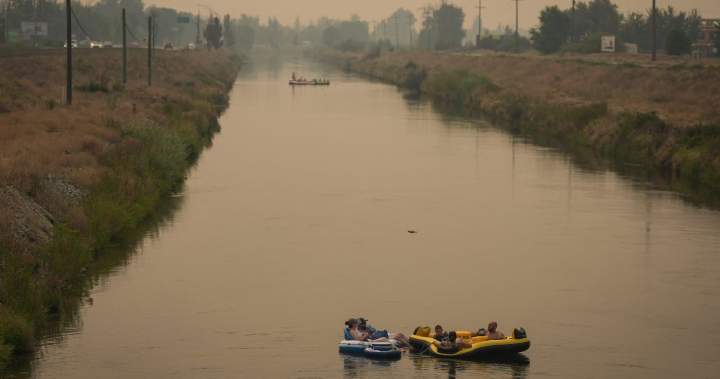
Deaths from wildfire smoke have jumped approximately 275 per cent in Canada since the early 2000s, according to a major global report, a number public health experts say solidifies the need for more serious climate action.
“Climate change and the impacts on health are not some abstract environmental issue that will affect us some at some point in decades from now. We can measure its effect on health in Canada today,” Ian Culbert, executive director of the Canadian Public Health Association, told Global News.
The report, published in The Lancet on Tuesday, found there were an average of 4,000 annual deaths associated with wildfire smoke between 2021-25, compared to an average of 1,050 annually in 2003-12.
The data comes as Canada has experienced repeated intense wildfire seasons – the past three of which are among the 10 worst on record. As fires scorched across much of the country, with particularly hot spots in B.C., Alberta, the Northwest Territories and northern Ontario, smoke continued to billow into major urban centres creating hazardous air quality conditions.
“You don’t have to live beside a forest fire to experience its health effects,” Culbert said. “Smoke travels enormous distances, so wildfire increasingly becomes a population health issue for communities far removed from the fires themselves.”
Scott Weichenthal, a professor in the department of epidemiology and biostatistics at McGill University, told Global News the casualties of wildfire smoke are far greater than the death toll numbers suggest.
PM 2.5, or fine particulate matter, is commonly the metric quantified as it is a primary pollutant that can travel deep into the lungs and enter the blood stream.
“When wildfires happen, PM 2.5 goes up and we know that PM 2.5 is a cause of premature death – I think that’s where those numbers are coming from,” he said. “But in addition to PM 2.5 fires release a whole range of harmful things, many of which we know cause cancer.”
“Mortality is not the sort of total, it doesn’t reflect totally the impacts of these events on people’s exposures or health effects,” he added.
During intense wildfire seasons, many people look to various Air Quality Indexes, but Weichenthal said these measures of PM 2.5, ozone and nitrogen dioxide are representative of the acute and immediate health effects.

Get weekly health news
Receive the latest medical news and health information delivered to you every Sunday.
“If you have an existing heart or lung condition, you’re going to be more sensitive to any kind of short-term spikes in pollutant concentrations, which is why we see increases in hospitalizations for heart and lung problems during these wildfire smoke events,” he said.
In terms of long term consequences, Weichenthal said people who live in more polluted areas are at greater risk of dying from cardio respiratory effects, but more research is needed on how prevalent air quality-induced cancers and other ailments are.
According to the report, Canada lost 5.2 million hectares of tree cover in 2024, which is 148 per cent more than in 2016. Wildfires accounted for 86 per cent of this loss. The loss of essential tree cover also makes heat an even more pressing issue.
In 2025, 80 per cent of the heatwave days experienced across Canada were directly attributable to climate change, the report found.
Further, people in Canada were exposed to approximately 36 more hours annually during which heat posed a moderate or higher risk of heat stress during moderate outdoor activity.
Vulnerable groups, including older adults, young children, pregnant women, and those with pre-existing conditions, face the greatest risks.
“This isn’t just, it was a hot summer,” Culbert said. “This is directly the effect of the rising temperature of the planet.”
The ongoing El Niño event, which is expected to peak around December and weaken through early 2027, is setting next summer up for hot and dry conditions. While El Niño typically creates uncharacteristically hot weather, on top of climbing temperatures, the effects on the population could be exacerbated.
“The data that we’re seeing is really serious, and the trends are moving in the wrong direction,” Culbert said.
The Canadian Public Health Association said all levels of government need to take further action to protect communities as the consequences of climate change continue to pile up.
One of the association’s recommendations is to create a permanent climate and health adaptation fund as current Health Canada funding ends in 2027-28.
“Public health really needs predictable, sustained capacity to prepare for heat, wildfire smoke and other climate related threats,” Culbert said. “These aren’t one-off emergencies anymore and so public health really needs the capacity to be in response.”
© 2026 Global News, a division of Corus Entertainment Inc.