





Cell Encapsulation Market
Dublin, Aug. 26, 2026 (GLOBE NEWSWIRE) — The “Cell Encapsulation Market by Type of Encapsulation Material, Type of Encapsulation Method, Type of Manufacturing Technique, Type of Technology, Application Area, End User, and Geographical Regions – Trends and Forecast Till 2035” has been added to ResearchAndMarkets.com’s offering.
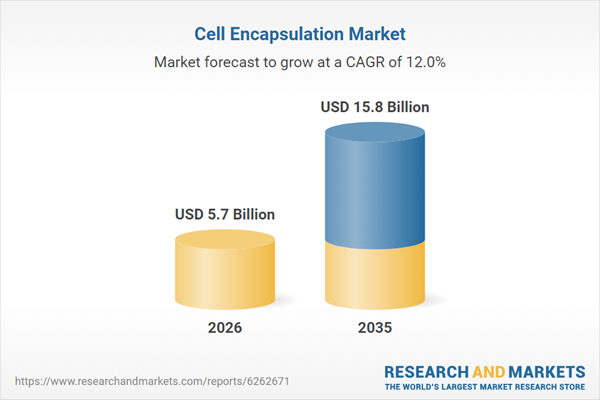
The global cell encapsulation market is projected to increase from USD 5.7 billion in 2026 to USD 15.8 billion by 2035, representing a compound annual growth rate (CAGR) of 12.0% during the forecast period. Market growth is being driven by the rising prevalence of chronic diseases, expanding investment in regenerative medicine, and continued advances in cell-based therapies, biomaterials, and scalable manufacturing technologies.

Cell Encapsulation Market Growth and Trends
The increasing global burden of cancer, Type 1 diabetes, and other chronic conditions is creating demand for innovative therapeutic platforms. In the United States alone, approximately 2.11 million new cancer cases and 626,140 cancer-related deaths are projected in 2026, according to the American Cancer Society. At the same time, approximately 9.5 million people worldwide are affected by Type 1 diabetes, strengthening the need for therapies capable of restoring physiological function and supporting sustained disease management.
Cell encapsulation technologies are gaining commercial and clinical attention because they can improve therapeutic cell viability, enable sustained and targeted delivery, and reduce immune rejection. Encapsulated pancreatic islet and beta-cell therapies are particularly promising for glucose regulation without lifelong immunosuppression. Advancements in electrostatic dripping, co-axial airflow, extrusion, microfluidics, and 3D printing are also improving capsule uniformity, manufacturing reproducibility, and product scalability.
Despite this progress, market participants must address significant biological and manufacturing barriers. Fibrotic tissue formation around implanted capsules can restrict oxygen and nutrient transport, affecting long-term cell performance. Clinical-grade production also requires controlled environments, specialized infrastructure, stringent quality systems, and reproducible processes. Maintaining cell viability and capsule consistency during large-scale manufacturing remains a central commercialization challenge.
Key Cell Encapsulation Market Segment Insights
- Encapsulation material: Natural polymers currently account for the largest market share due to their biocompatibility, low cytotoxicity, mild gelation conditions, and established use in islet cell transplantation and regenerative medicine. Synthetic polymers are expected to grow more rapidly because of their mechanical strength, chemical stability, and batch-to-batch reproducibility.
- Encapsulation method: Microencapsulation leads the market, supported by effective immunoisolation, nutrient and oxygen diffusion, minimally invasive administration, and established alginate-based and microfluidic platforms. Nanoencapsulation is projected to register the fastest growth as demand increases for targeted delivery and next-generation therapies.
- Manufacturing technique: Electrostatic dripping holds approximately 40% of the market, reflecting its established clinical manufacturing history, capsule uniformity, and process consistency. Co-axial airflow is anticipated to expand quickly because its low-shear processing conditions can protect fragile cell populations.
- Technology: Extrusion currently leads due to its scalability, cost efficiency, high throughput, mature equipment base, and suitability for microsphere and hydrogel bead production. Meanwhile, 3D printing is forecast to grow at approximately 15% annually, supported by improvements in bioinks, printing precision, and biomimetic tissue fabrication.
- Application: Drug delivery accounts for nearly 40% of global revenue, driven by the sustained release of insulin, enzymes, antibody fragments, and other biologically active molecules. Regenerative medicine is expected to be the fastest-growing application as investment in stem cell research, tissue engineering, organoids, and immune-evasive therapies accelerates.
Regional Cell Encapsulation Market Outlook
North America is expected to retain its position as the largest regional cell encapsulation market, accounting for approximately 45% of global revenue throughout the forecast period. Its leadership is supported by strong venture capital activity, advanced contract development and manufacturing capabilities, established translational research infrastructure, and supportive regulatory pathways. Commercial progress in encapsulated cell therapies, including Neurotech Pharmaceuticals’ FDA-approved treatment for Macular Telangiectasia Type 2, is further strengthening market confidence.
Asia-Pacific is projected to record the highest CAGR through 2035. Regional growth is being supported by government funding for advanced therapeutics, expanding regenerative medicine research, cost-efficient manufacturing, strengthening intellectual property frameworks, and a rising chronic disease burden. Technology licensing and commercialization initiatives across India, China, Japan, South Korea, and Australia are expected to create additional opportunities.
Competitive Landscape
Companies active in the cell encapsulation market include Beta-Cell, Betalin Therapeutics, Beta-O2 Technologies, Diatranz Otsuka, Neurotech, Semma Therapeutics, Sernova, and ViaCyte. Competition is increasingly centered on immune protection, long-term cell survival, manufacturing scalability, clinical validation, and strategic partnerships. Funding, licensing agreements, research collaborations, and intellectual property development are expected to remain important market expansion strategies.
Cell Encapsulation Market Report Coverage
The report evaluates the market by encapsulation material, encapsulation method, manufacturing technique, technology, application, end user, and geography. It also examines the competitive landscape, company portfolios, partnerships, funding activity, patents, grants, market drivers, emerging opportunities, operational barriers, and commercialization challenges.
Geographic coverage includes North America, Europe, Asia-Pacific, Latin America, and the Middle East and North Africa, with country-level analysis of major markets such as the United States, Canada, Germany, France, the United Kingdom, China, India, Japan, South Korea, Brazil, Saudi Arabia, and Egypt.
The study provides revenue forecasts, segment-level opportunity analysis, technology competitiveness assessments, company profiles, and strategic insights for biotechnology companies, pharmaceutical manufacturers, academic institutions, investors, contract development and manufacturing organizations, and other stakeholders seeking opportunities in the global cell encapsulation market through 2035.
Key Attributes
| Report Attribute | Details |
| No. of Pages | 501 |
| Forecast Period | 2026-2035 |
| Estimated Market Value (USD) in 2026 | $5.7 Billion |
| Forecasted Market Value (USD) by 2035 | $15.8 Billion |
| Compound Annual Growth Rate | 12% |
| Regions Covered | Global |
A selection of companies mentioned in this report includes, but is not limited to:
- Beta-Cell
- Betalin Therapeutics
- Beta-O2 Technologies
- Diatranz Otsuka
- Neurotech
- Semma Therapeutics
- Sernova
- ViaCyte
For more information about this report visit https://www.researchandmarkets.com/r/r9hh72
About ResearchAndMarkets.com
ResearchAndMarkets.com is the world’s leading source for international market research reports and market data. We provide you with the latest data on international and regional markets, key industries, the top companies, new products and the latest trends.
Attachment
- Cell Encapsulation Market
CONTACT:
CONTACT: ResearchAndMarkets.com
         Laura Wood,Senior Press Manager
         press@researchandmarkets.com
         For E.S.T Office Hours Call 1-917-300-0470
         For U.S./ CAN Toll Free Call 1-800-526-8630
         For GMT Office Hours Call +353-1-416-8900


