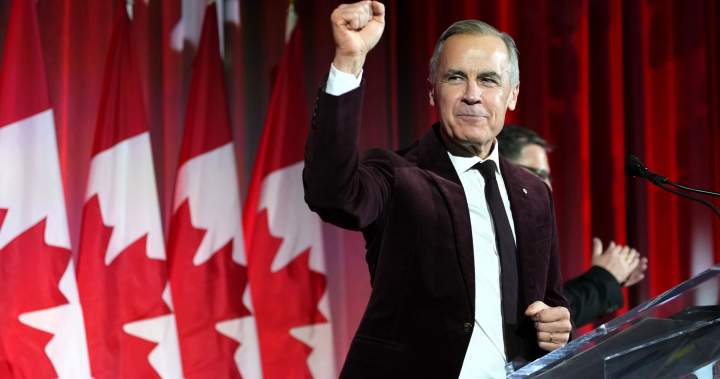
New polling suggests more Canadians approve of Prime Minister Mark Carney than his Liberal party, which continues to hold a slight lead over the federal Conservatives as 2025 draws to a close.
The Ipsos poll conducted exclusively for Global News and released Tuesday shows 40 per cent of voters would cast a ballot for the Liberals if an election were held tomorrow, compared to 37 per cent for the Conservatives.
Those numbers are down three and two points, respectively, since September, while the NDP and Bloc Québécois have each risen two points over the same time period to nine per cent.
Approval of the Liberal government under Carney, according to the poll, sits at 55 per cent — 15 points ahead of the party overall.
“Obviously (Carney) has had quite an effect on public opinion personally, but the interesting thing is it hasn’t really seemed to have gone over to his party. It’s really more attached to him,” Darrell Bricker, CEO of Ipsos Public Affairs, said in an interview.
“The gap between the Liberals and the Conservatives … is about what it was during the last election, but Carney’s own personal performance is actually quite strong. And in this era of personality politics, when people really do look at the leaders, that’s a real advantage for him.”
Ipsos polled over 1,500 Canadian adults last week for the poll, which has a 3.1-point margin of error that is about the same size as the gap between the Liberals and Conservatives.
Carney’s approval of 55 per cent is driven almost entirely by Liberal voters, 91 per cent of whom said they approve, compared to 58 per cent of New Democrats and just 27 per cent of Conservatives.
Asked by Ipsos if another federal election should be held in 2026, Canadians as a whole appeared split: 40 per cent said yes, compared to 38 per cent who don’t want to go back to the ballot box and 22 per cent who aren’t sure.
Yet the groups itching for a new election are telling. Beyond the 71 per cent of Conservatives who said they want another shot at toppling the Liberals, 54 per cent of young voters aged 18 to 34 said they would return to the polls, and so did 52 per cent of respondents in Alberta.


Get breaking National news
For news impacting Canada and around the world, sign up for breaking news alerts delivered directly to you when they happen.
Those results speak to trouble for Carney and the Liberals, Bricker said.
“The people who are opposed to Mark Carney … or opposed to the Liberal Party have not come over to (the) Liberal Party,” he said.
“There’s still a lot of displeasure among the Canadian population about how the country is going, particularly among opposition voters and people who voted particularly for the Conservative Party.”
Carney’s Liberals won April’s federal election thanks in part to support from older Canadians galvanized by U.S. President Donald Trump’s trade war and threats against Canada’s sovereignty, according to exit polls at the time.
Those polls found younger voters were primarily concerned with affordability, an issue that has continued to plague Carney as he tries to boost Canada’s economy through major infrastructure projects and diversifying trade.
Bricker said the polling underscores the increasing pressure Carney and his government is under to produce tangible results.
“If they don’t start making progress on some of the things that they claim that they want to make progress on — everything from getting a deal with the United States to getting a pipeline built through to tidewater to diversifying our economy to increasing our defence — then maybe it starts to become a problem for them,” he said.
That also applies to the energy memorandum of understanding between Ottawa and Alberta, which Bricker said has not had an impact on the numbers coming out of that province.
“Albertans have heard this before,” he said. “Until things physically start to happen, and they actually see that the promise is actually leading to some form of construction … it’s just another promise.”
Yet the poll also contains warning signs for Conservative Leader Pierre Poilievre and his party, who narrowly missed out on winning the last election and has not managed to close the gap with the Liberals since, according to Ipsos.
Poilievre is facing a leadership review in January and is trying to regain control of his caucus, which has seen two members cross the floor to the Liberals and a third MP announce his plans to resign since November.
The saving grace for Conservatives in the poll, Bricker said, is that most of the voters now pledging support for the NDP and Bloc have left the Liberals — not to mention the lingering dissatisfaction among some Canadians after 10 years of Liberal government.
“The people who are voting for the Conservative Party, it’s not about Pierre Poilievre, it’s even about the Conservative brand, it’s about change in a country in which they feel is not headed in the direction that works for them,” Bricker said.
“Even though it’s a three-point gap, when you take a look at how the votes distributed itself (with) the surge of the Bloc Québécois with a bit of a recovery for the NDP, that all hurts the Liberals and doesn’t hurt the Conservatives as much.”
That dynamic — along with growing speculation of more floor-crossings and a potential Liberal majority, as well as upcoming elections in Quebec and the United States — means 2026 is shaping up to be “a very consequential year in Canadian politics,” Bricker added.
These are some of the findings of an Ipsos poll conducted between December 8 and 15, 2025, on behalf of Global News. For this survey, a sample of 1,502 Canadians aged 18+ was interviewed online. Quotas and weighting were employed to ensure that the sample’s composition reflects that of the Canadian population according to census parameters. The precision of Ipsos online polls is measured using a credibility interval. In this case, the poll is accurate to within ± 3.1 percentage points, 19 times out of 20, had all Canadians aged 18+ been polled. The credibility interval will be wider among subsets of the population. All sample surveys and polls may be subject to other sources of error, including but not limited to coverage error and measurement error.
© 2025 Global News, a division of Corus Entertainment Inc.