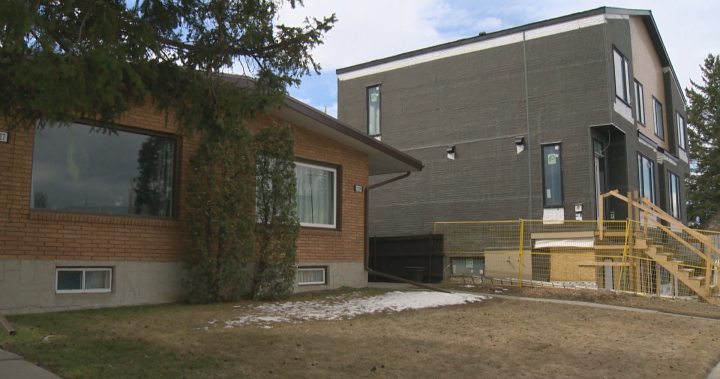
The City of Calgary is proposing an overhaul to the zoning district at the centre of the citywide rezoning debate, as a public hearing into the policy’s repeal continues at city hall.
Citywide rezoning, often referred to as blanket rezoning, saw the city’s base residential zoning changed to Residential Grade-oriented Infill District (R-CG) in August 2024 after an historic public hearing earlier that year.
R-CG was first introduced as a zoning district in 2014, and allows the development of rowhouses, townhomes, semi-detached and single-detached homes with up to four units as well as four secondary suites on a single property.
Redevelopment using the R-CG district would still be allowed even if citywide rezoning is repealed, but it would require property owners and developers to obtain a land-use change at a public hearing.
The changes to the R-CG zoning district up for debate were proposed by Ward 2 Coun. Jennifer Wyness when council voted in favour of kickstarting the process to repeal citywide rezoning back in December.
Those proposed changes include prohibiting mid-block rowhouses and townhouses, limiting where they could be built to the first three parcels at the end of a block.
Wyness’ motion also seeks clawed-back density from 75 to 60 units per hectare, which would reduce the maximum number of units to three with an additional three secondary suites.
A reduction of lot coverage from 60 per cent to 55 per cent, as well as limiting building heights at 10 metres, adding a requirement for contextual setbacks, and eliminating zero lot lines are also proposed.


Get daily National news
Get daily Canada news delivered to your inbox so you’ll never miss the day’s top stories.
“When we listen to everyone speaking today, these are the commonalities of the frustrations of what is being built,” Wyness said in council chambers Friday.
Many of those frustrations are prominent in Ward 4 communities, according to area councillor DJ Kelly.
Kelly said corner lots can have ample parking and can “fit a four-plex for the most part,” while mid-block R-CG developments are “the big problem” in his area.
“Especially when you add in the secondary suites, the four-plus-fours, where are people going to park? It’s absolutely ridiculous, it doesn’t make any sense,” Kelly said.
Although the majority of Calgarians speaking to council during this week’s public hearing are focused on whether citywide rezoning should be repealed, Calgary Mayor Jeromy Farkas told reporters Thursday he is surprised the proposed changes to the zoning district itself aren’t getting more attention.
While in line at the start of the public hearing Monday, Chris Davis with the group Calgarians for Thoughtful Growth said he’s hoping for more consultation.
“I’m concerned about getting into the weeds and starting to amend the R-CG district on the fly without doing what we needed to do all along, which was go out and consult with the community,” said Davis.
Local builders are also warning that making changes to the district “on the floor of council” could result in “unforeseen consequences” that could stifle development and disrupt the city’s approvals process.
According to an analysis by the Calgary Inner City Builders Association (CICBA), a three unit R-CG development isn’t viable and could result in an increased cost of $143,000 per unit for the end user.
“This is a result of spreading the fixed costs of a similar four-by-four project across a unit and a suite in three-by-three project,” CICBA president Grace Lui told city council Monday.
CICBA requested city council strike a stakeholder committee to look at the proposed amendments and the city’s approvals process.
A similar proposal in Edmonton, which would’ve capped the number of units in a midblock redevelopment at six instead of eight, was defeated by council in that city in February.
Around 475 people have signed up to speak at the public hearing to repeal citywide rezoning at Calgary city hall.
If city council approves a repeal, the city’s land-use bylaw would be reset to what was in place prior to the previous city council approving citywide rezoning, with the exception of properties that had development permits approved or any currently under review in the permit process.
City data shows citywide rezoning enabled 1,655 units in 2025, which made up 63 per cent of units through low-density development permits, but 4,500 units have been enabled since the policy took effect in August 2024.
© 2026 Global News, a division of Corus Entertainment Inc.