


Biopharmaceutical Contract Manufacturing Market
Dublin, Aug. 11, 2026 (GLOBE NEWSWIRE) — The “Biopharmaceutical Contract Manufacturing Market (7th Edition) by Type of Service Offered, Type of Biologic Manufactured, Type of Expression System Used, Scale of Operation, Company Size, Therapeutic Area, and Geographical Regions – Trends and Forecast Till 2035” has been added to ResearchAndMarkets.com’s offering.
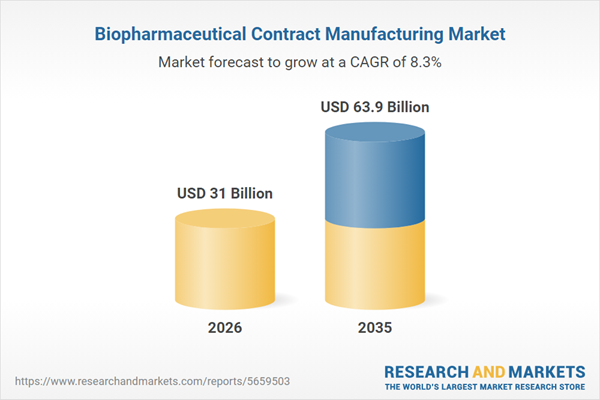
The global biopharmaceutical contract manufacturing market is projected to grow from USD 31 billion in 2026 to USD 63.9 billion by 2035, registering a compound annual growth rate of 8.3% during the forecast period. Market expansion is being supported by rising demand for biologics, increasingly complex drug pipelines, and greater reliance on specialized contract development and manufacturing organizations.

Biopharmaceutical Contract Manufacturing Market Growth and Trends
The increasing prevalence of chronic, oncological, autoimmune, infectious, and rare diseases is accelerating demand for monoclonal antibodies, vaccines, proteins, peptides, cell therapies, gene therapies, and nucleic acid-based medicines. As development pipelines expand, pharmaceutical and biotechnology companies are outsourcing more manufacturing activities to access specialized expertise, advanced infrastructure, and flexible production capacity.
Analytical testing, toxicity testing, fill-and-finish operations, and downstream process development remain prominent outsourcing areas. Continuous and intensified bioprocessing, single-use systems, continuous perfusion technologies, and AI-enabled process automation are also improving productivity and reducing per-unit manufacturing costs. Smaller and mid-sized service providers are responding through capability expansion and strategic partnerships that support more comprehensive service portfolios.
Geopolitical uncertainty, tariffs, and supply chain risks are influencing manufacturing investment decisions. Several CDMOs are establishing or expanding capacity in the United States to reduce cross-border exposure and position production closer to major end markets. At the same time, commercial-scale facility expansion in China and South Korea is increasing demand for regional logistics, cold-chain, and regulatory support.
Growth Drivers and Market Challenges
Key market drivers include rising demand for complex biologics and personalized medicines, limited in-house technical capabilities, and the need to control capital expenditure. Outsourcing enables sponsors to adjust production capacity according to demand while redirecting resources toward research, clinical development, and commercialization.
Growth may be constrained by the substantial capital required for specialized bioprocessing infrastructure, evolving regulatory requirements, and the technical difficulty of scaling novel modalities. Cell and gene therapy manufacturing remains particularly challenging because of process complexity, quality controls, and capacity limitations. Trade tensions and tariff exposure may also create near-term uncertainty around facility planning, supplier selection, and operating costs.
Key Market Insights
- Drug substance manufacturing accounts for approximately 60% of market revenue, supported by strong demand for outsourced upstream biologics production.
- Antibodies represent around 60% of revenue because of their extensive use across oncology, autoimmune diseases, infectious diseases, and rare disorders.
- Cell therapy manufacturing is expected to record comparatively faster growth as automation and allogeneic platforms address scalability constraints.
- Mammalian expression systems hold more than 80% of the market and are projected to expand at approximately 8.6% CAGR.
- Commercial-scale operations account for close to 90% of market revenue, while preclinical and clinical-scale outsourcing is expected to grow more rapidly.
- Large and very large companies generate nearly 60% of market revenue, reflecting their established infrastructure, regulatory experience, and sponsor relationships.
- Asia-Pacific holds close to 40% of global revenue, supported by lower operating costs, expanding capacity, and government investment.
China leads Asia-Pacific growth through substantial investment in biopharmaceutical infrastructure and extensive capabilities in monoclonal antibody and biosimilar production. North American growth is being strengthened by onshoring, domestic capacity expansion, and efforts to improve supply chain resilience.
Opportunities for Distributors and Logistics Partners
Biopharmaceutical CDMOs primarily work with pharmaceutical companies through direct commercial relationships and long-term supply agreements. However, distributors, logistics providers, and service integrators can capture opportunities in temperature-controlled transportation, inventory management, regulatory documentation, and specialized handling.
Validated cold-chain infrastructure and GMP-aligned processes are becoming essential as antibodies, cell therapies, gene therapies, antibody-drug conjugates, and GLP-1-class biologics account for a growing share of industry output. Competition among channel partners is consequently shifting from logistics cost alone toward service quality, regulatory support, supply visibility, and modality-specific expertise.
Recent Biopharmaceutical Deal Activity
- In May 2026, Bristol Myers Squibb entered a licensing agreement with Jiangsu Hengrui Pharmaceuticals covering oncology, hematology, and immunology programs.
- In March 2026, Servier announced plans to acquire Day One Biopharmaceuticals and strengthen its rare oncology portfolio.
- In January 2026, Mendra raised USD 82 million in Series A financing to develop rare-disease assets.
- In January 2026, Samsung Biologics agreed to acquire GSK’s Human Genome Sciences facility in Rockville, Maryland, establishing a direct US manufacturing presence.
- In October 2025, Novartis completed its acquisition of Tourmaline Bio, continuing cross-border consolidation in biologics.
These transactions demonstrate sustained investor and strategic interest in biologics manufacturing capacity, oncology, rare diseases, and US onshoring.
Market Segmentation
The biopharmaceutical contract manufacturing market is analyzed by service type, including drug substance and drug product manufacturing; biologic type, including antibodies, proteins and peptides, vaccines, cell therapies, and gene therapies; and expression system, including mammalian and microbial platforms. The assessment also covers preclinical, clinical, and commercial production scales; company size; therapeutic area; and major markets across North America, Europe, and Asia-Pacific.
Competitive Landscape
Prominent companies operating in the market include AbbVie, Agilent Technologies, Boehringer Ingelheim, Catalent, Cipla, Eurofins, Fresenius Kabi, Lonza, Novartis, Sandoz, WACKER, and WuXi Biologics. Consolidation among major CDMOs is increasing competitive barriers, while creating opportunities for specialized regional providers and partners with expertise in specific modalities, regulatory environments, or supply chain requirements.
Research Coverage
The Roots Analysis report examines market sizing, competitive positioning, company profiles, installed manufacturing capacity, outsourcing demand, partnerships, funding, mergers and acquisitions, facility expansions, and major pharmaceutical company initiatives. It also assesses biosimilar outsourcing, in-house manufacturing strategies, make-versus-buy decisions, total cost of ownership, and emerging demand for antibody-drug conjugates and cell therapies.
The study applies top-down and bottom-up forecasting methodologies and incorporates primary research from executives and commercial leaders across small, mid-sized, and large biopharmaceutical manufacturing companies. Its segmentation framework supports opportunity assessment by service, biologic, expression system, operating scale, company size, therapeutic area, and geography.
Market Outlook
The biopharmaceutical contract manufacturing market is positioned for sustained growth through 2035 as sponsors seek scalable production, advanced technologies, regulatory expertise, and resilient supply networks. Continued investment in commercial capacity, cold-chain infrastructure, automation, and regional manufacturing is expected to strengthen outsourcing demand and create opportunities for CDMOs, distributors, logistics providers, channel partners, and investors.
Key Attributes
| Report Attribute | Details |
| No. of Pages | 575 |
| Forecast Period | 2026-2035 |
| Estimated Market Value (USD) in 2026 | $31 Billion |
| Forecasted Market Value (USD) by 2035 | $63.9 Billion |
| Compound Annual Growth Rate | 8.3% |
| Regions Covered | Global |
A selection of companies mentioned in this report includes, but is not limited to:
- AbbVie
- Agilent Technologies
- Boehringer Ingelheim
- Catalent
- Cipla
- Eurofins
- Fresenius Kabi
- Lonza
- Novartis
- Sandoz
- WACKER
- WuXi Biologics
For more information about this report visit https://www.researchandmarkets.com/r/vg7ig8
About ResearchAndMarkets.com
ResearchAndMarkets.com is the world’s leading source for international market research reports and market data. We provide you with the latest data on international and regional markets, key industries, the top companies, new products and the latest trends.
Attachment
- Biopharmaceutical Contract Manufacturing Market
CONTACT:
CONTACT: ResearchAndMarkets.com
         Laura Wood,Senior Press Manager
         press@researchandmarkets.com
         For E.S.T Office Hours Call 1-917-300-0470
         For U.S./ CAN Toll Free Call 1-800-526-8630
         For GMT Office Hours Call +353-1-416-8900