



DETROIT, May 18, 2026 (GLOBE NEWSWIRE) — Released by Plante Moran, the 2026 North American Automotive OEM-Supplier Working Relations Index® (WRI®) Study reveals unprecedented results. For the first time in its 26-year history, the study that evaluates relations between U.S. automakers and their suppliers indicates overall improvements across all six North American manufacturers, with Ford, Toyota and Stellantis leading the automaker gains.
The results reflect the influence of four undercurrents. The WRI® scores suggest that tariffs and electric vehicle (EV) cost recovery were two factors shaping suppliers’ perceptions of commercial fairness, as purchasing teams that lacked full control over how much their OEMs absorbed those costs leaned into relationship-related factors within their control. In these efforts, they received a boost from two unexpected influences: Return-to-office (RTO) mandates and “permacrisis” fatigue.
What are the OEMs’ WRI® scores?
Ford experienced the biggest jump in WRI® scores this year, up 32 points. Toyota rose 23 points, Stellantis gained 22 points, Honda added 13 points, General Motors increased eight points, and Nissan improved six points.
Even with these notable upturns, however, the manufacturers’ rank order remained the same as in last year’s survey:
- At 409 points, Toyota surpassed 400 for the first time since 2007. It’s the automaker’s second-highest score ever; it scored 415 in both 2005 and 2007.
- Honda also reached its highest score since 2007, at 360 points. This score bumped it up into the study’s “good-very good” range.
- General Motors (GM) achieved its highest-ever WRI® score at 318 points, although it lost some ground to Toyota and Honda.
- In a corporate turnaround, Nissan erased last year’s losses to return to its 2024 score of 255 points, which marks its highest score since 2014.
- Ford notched 223 points. The 32-point rise is the OEM’s second-largest increase in WRI® history. Its largest-ever jump was 41 points in 2008-2009, followed by 32 points in 2009-2010.
- Stellantis totaled 163 points in its strong rebound, for its best score since 2021. The automaker’s 22-point jump is significant given its top leadership changes and turnaround initiatives throughout the year.
Why did all WRI® scores improve?
That the WRI® scores climbed for all six North American OEMs is noteworthy in light of the “trust gap” observed in last year’s survey data. The 2025 WRI® study revealed a widening gap between top-rated and bottom-rated automakers in measures of trust. This year, the bottom-rated automakers made the greatest strides.
“In 2026, all six automakers improved trust scores through enhanced communication, accessibility and their ability to solve problems,” said Dr. Angela Johnson, principal in Plante Moran’s automotive and mobility consulting practice, responsible for supplier relations analytics. “Also, in the 10,000 supplier comments we received (more than three times the number of comments received in prior years), we saw an emerging, collective recognition that working together is the best way to face permacrisis challenges, innovate, and grow.”
Fueling the score increases across the board were better supplier perceptions of:
- Their ability to make a long-term profit. Toyota remains the frontrunner, but Ford, Stellantis, and Nissan made strong gains, signaling improving supplier sentiment about these OEMs’ future direction.
- Commercial fairness and cost management. Ford and Stellantis made the largest gains in commercial fairness (although Toyota and Honda lead the category), while Toyota and Honda led efforts to help suppliers reduce costs. GM posted the biggest advances in covering sunk costs and EV cost recovery, but faced pushback on its supply chain resiliency initiatives.
- Buyer performance. Buyer accessibility, engagement and responsiveness strongly influenced scores as OEM workers began spending more time in the office. Measures of buyer performance, especially buyers’ ability to resolve supplier issues, improved for all OEMs.
- OEMs’ efforts to communicate and earn trust. While Toyota and Honda continue to lead the pack, Ford and Stellantis made the biggest jumps. Ford’s Liz Door made the largest strides in improving trust among purchasing chiefs.
“Suppliers appeared to acknowledge efforts OEMs made over the past year to control what they could and to help suppliers navigate industry uncertainty,” added Johnson, who advocates for building efficiencies through stronger OEM-supplier relationships. “Even if suppliers didn’t experience their ideal outcome, they credited the OEMs for taking their meetings, listening and acting.”
What distinguishes top from bottom WRI® rankings?
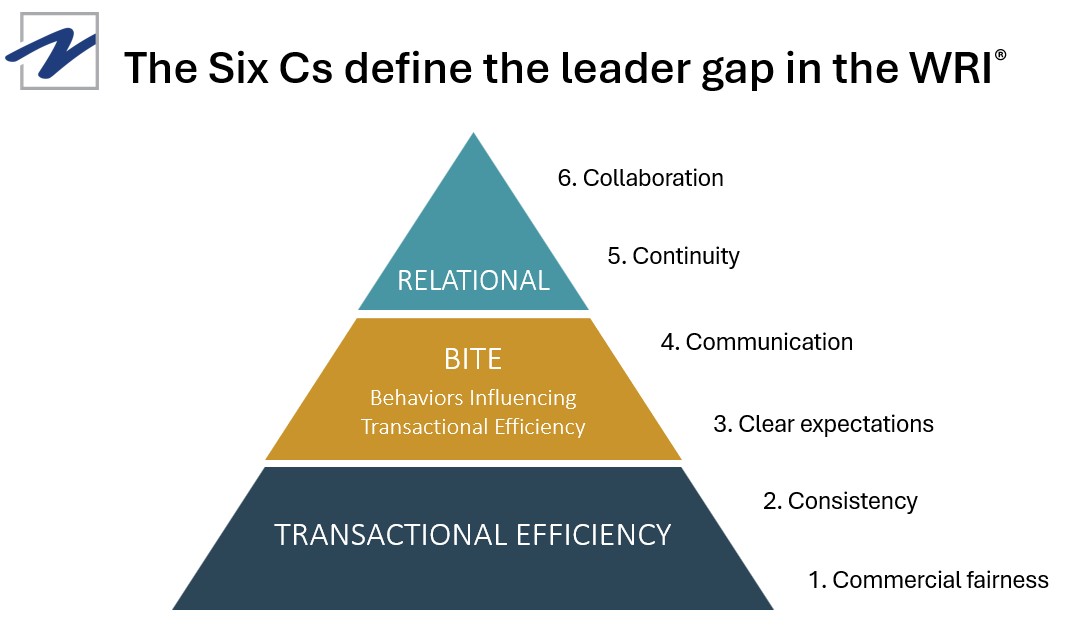

The survey results indicate that “controllable” behaviors — those that bridge the gap between purely transactional and more relational interactions — accounted for many of the WRI® score increases. They also represent an essential layer separating the top-performing from the bottom-performing manufacturers.
“We often see the continuum from ‘transactional’ to ‘relational’ illustrated as the opposite ends of a line, but the reality is more complex,” explained Johnson. “I like to characterize it as a pyramid, progressing from transactional to relationship through a spectrum of behaviors that I call the Six Cs. These behaviors enhance the efficiency and reduce the costs for suppliers to serve their customers.”
The Six Cs:
- Commercial fairness (e.g., more equitable risk and cost sharing)
- Consistency (e.g., longer-term scheduling and production plans)
- Clear expectations
- Communication (proactive, clear, and simple; from OEMs and buyers)
- Continuity (a long-term strategy for OEM and supplier)
- Collaboration
“The WRI® Study suggests a growing emphasis on organizational behaviors. And the benefits are bidirectional. Will subsequent WRI® studies show the industry is adapting to its permacrisis existence by embracing an era of mutualism?” Johnson asked.
What’s new in the 2026 WRI® Study?
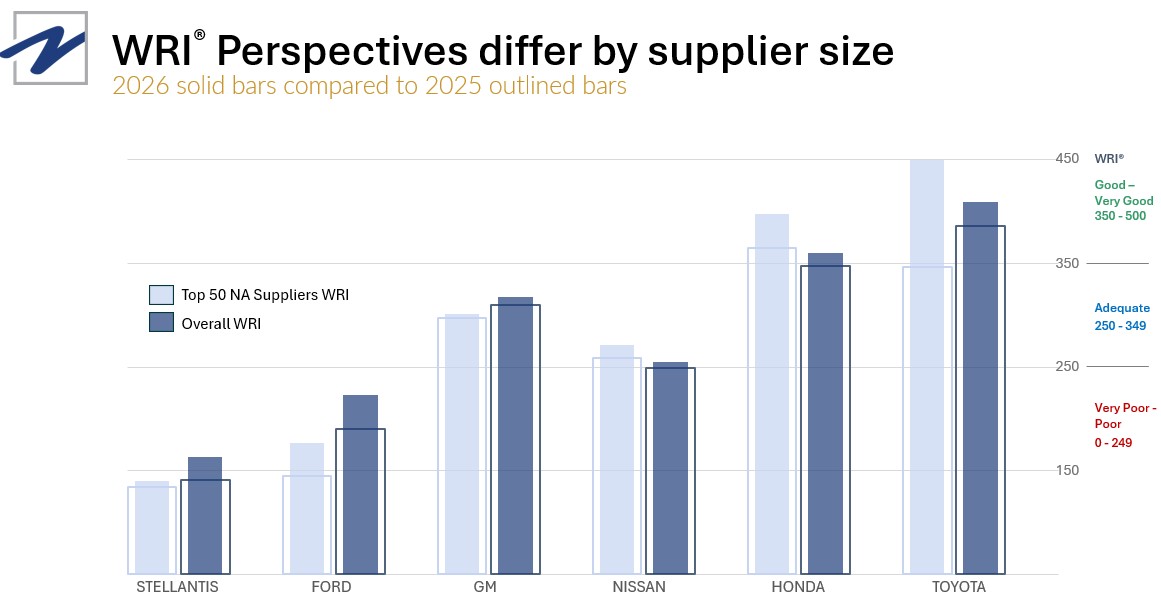

This year, the Plante Moran team evaluated data specifically from the Top 50 North American suppliers to see if additional trendlines emerged. These suppliers have deeply entrenched OEM relationships and heftier tariff and EV cost recovery impacts.
To be clear: Suppliers’ perspectives on cost recovery efforts ranged from “highly favorable” to “zero” for all six OEMs, and the Top 50 North American suppliers improved their ratings of all six manufacturers, mirroring the full survey group.
However, the results showed historical cultural influences at play. The Top 50 North American suppliers rated Nissan, Honda and Toyota above their averages. They rated GM, Stellantis and Ford below their respective averages, with the disparity especially noticeable in measures of trust, communication and profit opportunity.
“Organizational memory is very long. That’s not to discredit the hard work of any OEM, but it seems that the Detroit Three are still fighting to overcome the cultural inertia of historically adversarial purchasing organizations,” notes Johnson. “Those longstanding relationships take time and persistence to overcome, while Toyota, Honda and Nissan enjoy the benefit of partnerships historically built on respect and trust.”
Additionally, Toyota’s more conservative EV strategy created less commercial strain, whereas GM, Ford, Stellantis, and Honda faced greater supplier impacts from significant EV write-offs. The Top 50 North American scores align with general perceptions that Toyota and Honda are the most fair and efficient in cost recovery.
The picture painted by responses from the Top 50 North American suppliers testifies to the multiplying, circular effect of building trust, respect and mutual commercial benefit.
What are the 2026 WRI® Study’s top takeaways?
Plante Moran identified three overarching trends and themes in its survey analysis:
- Overall WRI® scores for all manufacturers rose for the first time in the study’s 26-year history, despite significant industry upheaval from market forces, trade and supply chain threats.
- OEMs whose scores increased the most appeared to hone in on “controllable” aspects of the supplier relationship, such as better communication with suppliers.
- The spread between the top and bottom automakers can be distinguished by evaluating advances in the Six Cs: commercial fairness, consistency, clear expectations, communication, continuity and collaboration.
About the WRI® Study
The annual study tracks suppliers’ perceptions of working relationships with their automaker customers. Suppliers rate the OEMs across eight major purchasing areas and 20 commodity areas.
The six automakers participating in the syndicated WRI® Study closely monitor its results. The OEMs use the data to identify strengths and opportunities and define supplier partnership initiatives and performance targets. The 26 years of data gathering demonstrate a correlation between WRI® scores and OEM commercial performance: OEMs with stronger commercial relationships receive both direct and indirect benefits from healthy partnerships. These benefits contribute to OEM operating profits and competitive strength.
Plante Moran conducted the 2026 WRI® Study from March to mid-April. A total of 750 responses were collected (up from 665 in 2025) from executives of Tier-1 suppliers serving Ford, General Motors, Honda, Nissan, Stellantis and Toyota. They represent 78 of the top 100 North American automotive suppliers, including 42 of the top 50, according to the Automotive News 2025 list. This year’s analysis encompassed 2,348 buying situations, compared with 2,104 last year. A buying situation is defined as a “supplier + OEM + commodity” combination. More than 10,000 supplier comments were received this year, compared with 2,800 last year.
The WRI® Study was founded in 2001 by Dr. John Henke, CEO of Planning Perspectives, Inc., and acquired by Plante Moran in 2019. The team that conducted and analyzed the industry-leading study in 2026 was led by Dr. Angela Johnson.
Johnson is a principal at Plante Moran with more than 30 years of automotive experience at General Motors across multiple functions. With a doctorate in Industrial Engineering from Wayne State University and deep expertise in analytics and ethnographic research, Johnson helps organizations understand how trust, governance and day‑to‑day commercial behaviors shape performance across large manufacturing ecosystems. She leads Plante Moran’s supplier relations analytics, translating sound research into practical insight that supports stronger, more resilient partnerships across sectors.
About Plante Moran
Plante Moran is among North America’s largest accounting, tax, consulting and wealth management firms and provides a full line of services to organizations in the following industries: manufacturing and distribution, service, health care, private equity, public sector, financial services, real estate, construction and energy. Throughout its more than 100 years in business, the firm has grown to a staff of more than 4,500 professionals throughout the United States and internationally. Plante Moran has been recognized by a number of organizations, including FORTUNE magazine, as one of the best places to work in America. For more information, visit plantemoran.com.
Media Contact:
Jamie Allyn
MERGE
plantemoran@mergeworld.com
Photos accompanying this announcement are available at
https://www.globenewswire.com/NewsRoom/AttachmentNg/1294b654-4db5-48bd-8bb3-c0df30b319ac
https://www.globenewswire.com/NewsRoom/AttachmentNg/4b7ec9a6-e478-40d0-ada1-dee759d6113c
https://www.globenewswire.com/NewsRoom/AttachmentNg/8716d5c0-613f-4dd7-9b8e-e10a26920906


