



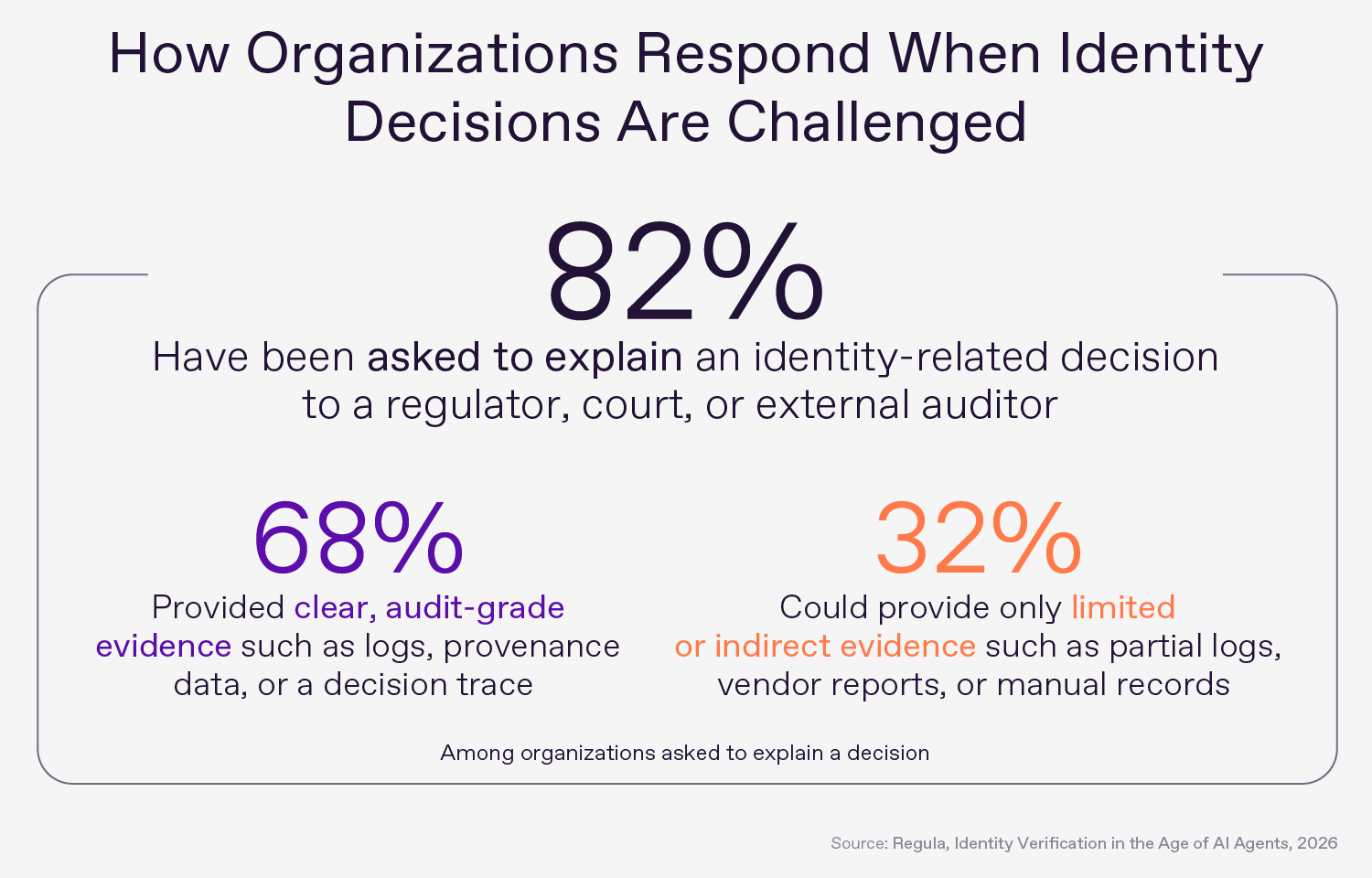
RESTON, Va., Sept. 09, 2026 (GLOBE NEWSWIRE) — 82% of organizations have been asked to document or explain an identity-related decision to a regulator, court, or external auditor, according to a global study by Regula of 850 fraud prevention and financial crime decision-makers. Among that group, 32% could provide only limited or indirect evidence, making it harder to defend decisions, investigate fraud, resolve disputes, and demonstrate compliance.
Among organizations that had already been asked to explain an identity-related decision, nearly one-third could provide only limited or indirect evidence
Of the organizations that had been asked to explain a decision, 68% could produce clear, audit-grade evidence, such as logs, provenance data, or a decision trace. The other 32% had only limited or indirect evidence, including partial logs, vendor reports, or manual records. The difference matters when a business must demonstrate not only what outcome its system produced, but why.
Visibility is not the same as full traceability
The same study found that only 50% of organizations can fully reconstruct an identity verification decision across all contributing systems, signals, and decision logic. Another 42% can identify the main systems and signals involved but cannot fully reconstruct how the final outcome was reached. A further 7% report only limited visibility, while 1% say reconstruction is not possible in practice.
These findings point to two distinct capabilities. Decision traceability helps teams understand what happened. Audit-grade evidence helps them prove it to someone else. As AI-assisted fraud increases the speed and complexity of identity interactions, organizations are adding more checks, data sources, and automated rules to their workflows – making both capabilities more important and potentially more difficult to achieve.
A complete identity decision trace should show:
- What identity evidence was presented.
- Which checks were performed.
- What signals and risk indicators were generated.
- Which rules or thresholds were applied.
- Whether manual intervention occurred.
- How these inputs produced the final outcome.
“The challenge of building reliable audit trails is partly architectural. Many identity verification systems were designed to answer an immediate operational question: should this user pass, fail, or be sent for manual review? They were not necessarily built to preserve the full chain of evidence and decision logic behind that outcome. Auditability can be added later, but it can be like installing new wiring after a building is finished – much harder than designing for it from the start,” says Henry Patishman, Executive Vice President of Identity Verification Solutions at Regula.
Making identity decisions traceable by design
One way to address the problem is to make traceability part of the identity architecture rather than reconstructing it across disconnected systems after the fact.
Regula IDV Platform records checks and actions performed throughout an identity verification workflow in a unified environment. This helps organizations preserve the decision trace and later reconstruct which evidence, rules, and workflow stages contributed to a particular outcome.
The goal is not simply to generate more logs. It is to keep a clear connection between the evidence presented, the checks performed, the signals generated, the decision logic applied, and the resulting action. As identity verification becomes embedded in more regulated and high-risk digital interactions, the ability to defend an identity decision may become almost as important as the ability to make the right one in the first place.
About the Regula’s Identity Verification in the Age of AI Agents study
Identity Verification in the Age of AI Agents is a global study conducted by Sapio Research in March 2026 among 850 decision-makers responsible for fraud prevention and financial crime across the UK, US, Germany, Singapore, UAE, Brazil, and Mexico. Respondents represent banking, financial services, crypto, telecommunications, government, and gaming sectors.
The report is released in two parts. The first examines how AI-assisted actors, deepfakes, and synthetic identities are reshaping identity threats. The second explores how organizations are adapting identity verification to AI-driven threats, where confidence gaps remain, and what capabilities are needed to make identity decisions more reliable and explainable.
Read the full report to learn how organizations are adapting identity verification as digital interactions become more complex.
FAQ
What is identity decision traceability?
Identity decision traceability is the ability to reconstruct how an identity verification outcome was reached. It connects the evidence presented, the checks performed, the signals generated, and the decision logic applied to the final result, such as pass, fail, or manual review.
Why are system logs not enough to explain an identity decision?
System logs may confirm that individual checks or actions took place, but they do not always show how those events were connected or how they influenced the final decision. When logs are distributed across different systems, organizations may be able to see the individual steps without being able to reconstruct the complete decision path. A unified platform approach can help close this gap by keeping the evidence, checks, signals, decision rules, and resulting outcomes connected within a single workflow.
Why does identity verification explainability matter for businesses?
Organizations may need to explain an identity verification decision when investigating fraud, responding to a customer dispute, reviewing an error, providing evidence to an auditor or regulator, or defending a decision in court. A clear decision record helps them respond faster, defend legitimate decisions, identify weaknesses in their verification processes, and manage compliance, financial, and operational risk.
About Regula
Regula is a global developer of identity verification (IDV) solutions and forensic devices, trusted by over 2,000 organizations across regulated industries worldwide. Regula IDV solutions deliver end-to-end document verification, biometric authentication, and identity lifecycle management. They enable organizations to prevent fraud by ensuring the integrity of every signal behind each decision. Built on 34 years of document forensics expertise, fully proprietary technology, and an in-house forensic laboratory, Regula maintains the world’s largest template library of 16,000+ ID templates from 254 countries and territories. The company’s technologies are deployed at 80+ border control authorities worldwide. Regula was recognized in the 2025 and 2026 Gartner® Magic Quadrant™ for Identity Verification.
Learn more at www.regulaforensics.com.
A photo accompanying this announcement is available at https://www.globenewswire.com/NewsRoom/AttachmentNg/c16eda36-2d03-47b1-b691-70814618bc4a
CONTACT: Contact:
Kristina – ks@regulaforensics.com