




Global MSME Lending & Financing Market
Dublin, Aug. 13, 2026 (GLOBE NEWSWIRE) — The “Global MSME Lending & Financing Market Size by Value and Volume Across 75+ KPI by Finance Type, Alternative & Digital Lending, Enterprise Size, Industry Vertical, Loan Type, Loan Tenure, Lender Type, Geographic Distribution – Databook Q2 2026 Update” has been added to ResearchAndMarkets.com’s offering.
The global micro, small, and medium enterprise financing market is projected to grow by 10.0% annually to reach US$8.39 trillion in 2026. Following a compound annual growth rate of 12.1% between 2021 and 2025, the market is expected to maintain strong momentum through the end of the decade.
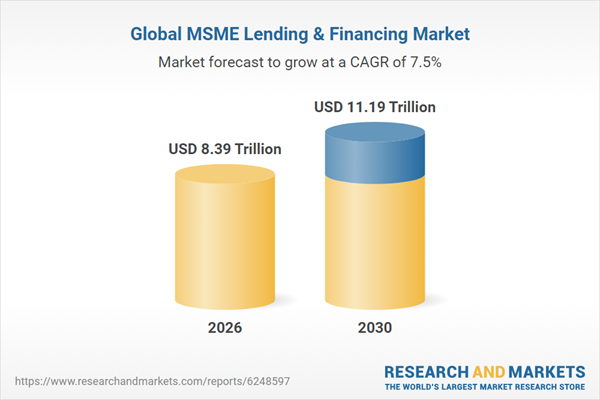

Global MSME lending and financing activity is forecast to record a compound annual growth rate of 7.5% from 2026 to 2030, increasing from US$7.63 trillion in 2025 to approximately US$11.19 trillion by 2030. Market expansion will be supported by rising credit penetration, digital lending adoption, alternative underwriting models, and policy initiatives across bank, non-bank, fintech, and public-sector lending channels.
Digital Infrastructure Accelerates MSME Formalization
Digital public infrastructure is bringing more MSMEs into formal payment, compliance, and financing systems. India’s UPI ecosystem, Brazil’s Pix platform, and Indonesia’s QRIS standard are expanding digital transaction participation among small merchants. Payment providers such as Paytm and PhonePe are building merchant services on these systems, creating richer transaction datasets for credit assessment.
As governments integrate payments, lending, insurance, and compliance services, transaction-based underwriting is expected to improve credit access for businesses without extensive conventional financial records. This trend is particularly significant across Asia and Latin America, where financial inclusion remains a major policy priority.
Platform Ecosystems and Embedded Finance Reshape Lending
MSMEs are increasingly operating through integrated commerce and technology platforms. Tencent and Alibaba Group connect Chinese merchants with payments, logistics, marketing, and customer engagement services, while Shopify and Block Inc. provide payments and working capital directly within merchant workflows in the United States and the United Kingdom.
Embedded finance is expected to expand beyond e-commerce into logistics, software-as-a-service platforms, and business-to-business marketplaces. Access to real-time transaction data allows platform providers and fintech lenders to develop alternative credit models, while open banking and data-sharing frameworks support faster and more targeted financing decisions.
Supply Chain Diversification Creates New Opportunities
Global supply chain realignment is creating additional opportunities for MSMEs in export-oriented manufacturing markets. Businesses in Vietnam are joining supplier networks connected to international electronics manufacturers, while Mexican MSMEs are benefiting from nearshoring demand linked to United States supply chains.
Trade agreements, government incentives, and corporate sourcing diversification will encourage greater MSME participation in global value chains. However, suppliers will face increased requirements related to product quality, operational capacity, regulatory compliance, and sustainability performance.
Competitive Landscape
Competition in the global MSME financing market is fragmented across banks, non-bank financial institutions, fintech lenders, and technology platforms. JPMorgan Chase and HSBC continue to expand digital banking services for smaller enterprises, while Stripe, Block Inc., and other fintech providers are strengthening payment and embedded lending capabilities.
Traditional financial institutions are expected to increase partnerships with fintech and software providers over the next two to four years. Visa and Mastercard are also expanding collaborations designed to improve MSME payment acceptance and credit access. In Europe and Asia, banks are integrating accounting, invoicing, payments, and lending services into unified business platforms.
Competitive advantage will increasingly depend on the ability to combine financial products with operational tools, data-driven underwriting, and streamlined digital experiences. Neobanks in Southeast Asia and digital lenders in Africa are also targeting underserved enterprises through alternative credit assessment models.
Comprehensive Global MSME Financing Market Coverage
The research provides a data-centric assessment of the MSME lending and financing ecosystem, including more than 75 key performance indicators covering credit disbursement value, transaction volumes, average loan size, interest rates, credit penetration, digital lending share, loan tenure, and non-performing loan ratios.
Market analysis covers:
- Bank-based, non-bank, alternative platform, and government-supported financing
- Micro, small, and medium enterprise segments
- Retail, services, manufacturing, construction, transport, and logistics industries
- Term loans, working capital, trade finance, equipment finance, property-backed lending, and government-supported loans
- Short-, medium-, and long-term financing
- Commercial banks, fintech lenders, microfinance institutions, credit unions, and non-bank financial companies
- Urban and rural MSME lending activity
- Borrower behavior, credit barriers, lender selection, product preferences, and underserved segments
The bundled offering combines 21 country and global databooks containing 756 tables and 1,029 figures. Geographic coverage includes the global market, China, Germany, Brazil, the United States, Saudi Arabia, India, France, Mexico, Canada, the United Arab Emirates, South Korea, Italy, Chile, Egypt, Japan, the United Kingdom, Colombia, South Africa, Vietnam, and Spain.
Strategic Value for Market Participants
The report supports banks, fintech lenders, investors, policymakers, development institutions, and technology providers with historical data for 2021-2025 and forecasts for 2026-2030. Its structured databook format enables financial benchmarking, market modelling, competitive assessment, risk evaluation, and strategic planning.
By combining market sizing, granular segmentation, financial performance indicators, borrower insights, and country-level forecasts, the research provides decision-ready intelligence on the evolving global MSME financing market and the technologies, policies, and competitive strategies shaping its growth through 2030.
Key Attributes
| Report Attribute | Details |
| No. of Pages | 2520 |
| Forecast Period | 2026-2030 |
| Estimated Market Value (USD) in 2026 | $8.39 Trillion |
| Forecasted Market Value (USD) by 2030 | $11.19 Trillion |
| Compound Annual Growth Rate | 7.5% |
| Regions Covered | Global |
For more information about this report visit https://www.researchandmarkets.com/r/tk9d78
About ResearchAndMarkets.com
ResearchAndMarkets.com is the world’s leading source for international market research reports and market data. We provide you with the latest data on international and regional markets, key industries, the top companies, new products and the latest trends.
Attachment
- Global MSME Lending & Financing Market
CONTACT:
CONTACT: ResearchAndMarkets.com
         Laura Wood,Senior Press Manager
         press@researchandmarkets.com
         For E.S.T Office Hours Call 1-917-300-0470
         For U.S./ CAN Toll Free Call 1-800-526-8630
         For GMT Office Hours Call +353-1-416-8900