
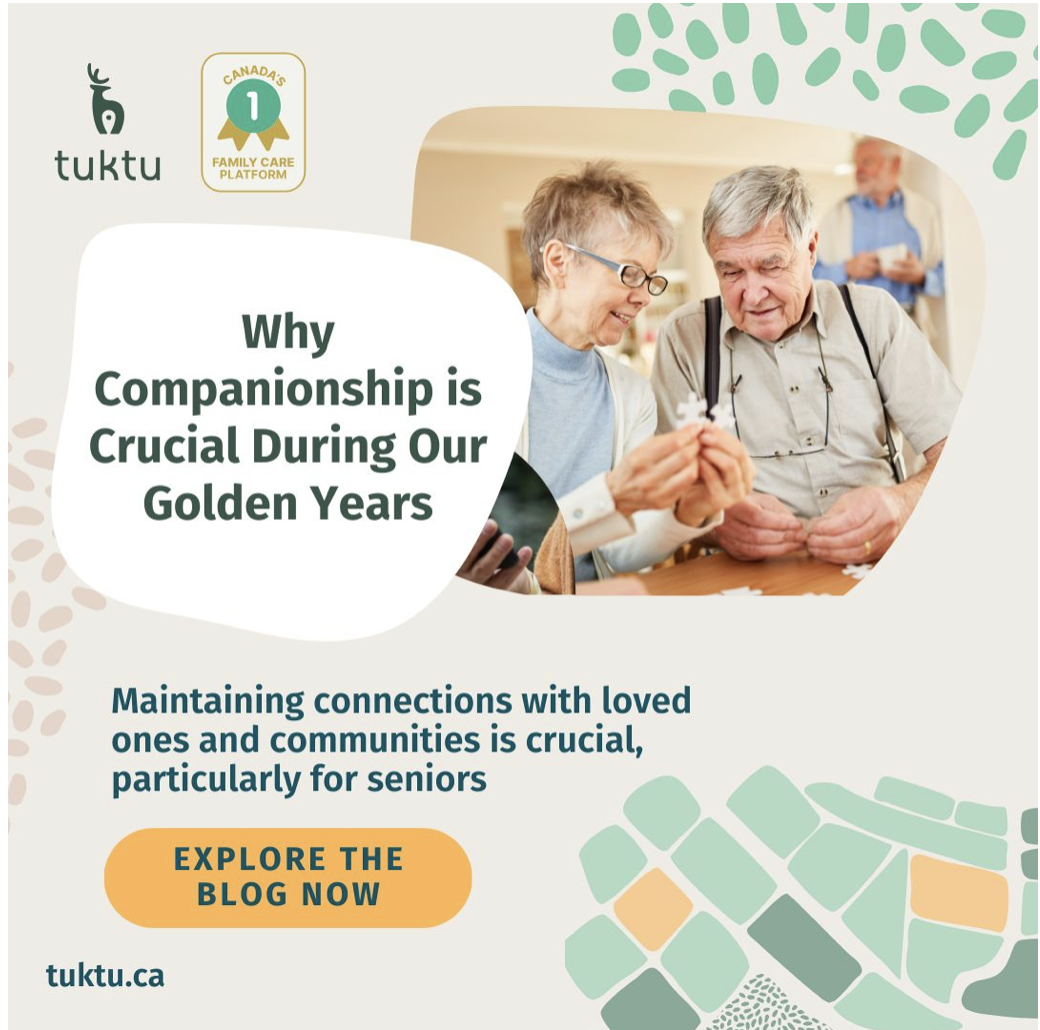
“I feel like I am simply another number waiting to go into the doctor’s office. I don’t feel like I have been cared for as a person,” Luke tells me as we talk about his experience in Canadian healthcare.
Three months ago, I started providing service as a companion with Tuktu Care(www.tuktu.ca).
I had just finished university and was looking for something part time while I searched for jobs. I came across Tuktu Care while sifting through jobs online. The company’s website stated it was a family care platform which connected people who require support to local providers. Growing up I had volunteered quite a bit at a senior’s home near my house and had enjoyed the experience. I was intrigued by the on-demand nature of the work and applied. Knowing I would be in control of the hours I work was convenient as it meant I would have enough time to do other things.
After completing onboarding, I opted to do companionship services where I would go to a person’s house, chat with them and help with basic tasks or go for outings. I was paired with an older gentleman Luke C*. He was reliant on a wheelchair but lived an independent life. He liked having a companion with whom he could chat with and go out for coffee from time to time. Although he had worked in a consultancy firm most of his life, Luke enjoyed talking about diverse cultures; having studied Sociology, I had a deep interest in culture as well, the common ground on which Tuktu’s AI had matched us. The first time I accompanied Luke, we spent two hours drinking coffee and discussing tea cultures across the world.
Luke had enjoyed our conversation and proceeded to set up recurring times when I would visit him. Our conversations were primarily about global cultures, but as I saw Luke regularly, he opened up about his disability. About five years ago Luke had been in a fatal car accident which had left him wheelchair bound. After his surgery, Luke said he did not feel as though he was adequately equipped to handle the changes in his life. His doctors had prescribed some medications and informed him about emergency situations. He felt unprepared to handle the physical and mental challenges that came with his reduced mobility.
I had asked Luke what he thinks would have helped him after the surgery. He told me having access to a therapist as part of his care team would have significantly helped him prepare for the mental shift he had to make. Luke had spent a big part of his recovery period reading up on care practices and what would help people like him transition from a completely mobile life to one which required reliance on a mobility aid. He said in his experience with healthcare services was that services lacked a person-centred approach. He had felt like he was simply a number with a disability instead of being seen as a human who had faced a traumatic accident and now had to learn a whole new way of living.
Luke’s comment about person-centred care led me to do some of my own research into healthcare and caregiving in Canada. Canadian health bodies emphasise on two concepts: person-centred care and continuity of care. Person-centred care values patients as individuals with unique needs instead of a person with an illness. Continued long-term care comprises services required to fulfil the long-term functional needs of a patient. Continuity of care from a patient’s perspective includes having appropriate support services as they navigate their condition.
My conversations with Luke did not make it seem like he had received the help he required. Luke told me immediately after his accident he had received emergency surgery which had saved his life but waiting times for follow up appointments for pain management would take him anywhere between 8 to 12 weeks. Even when he was able to book a follow up appointment, Luke said he would feel rushed and was not able to discuss the issues he had in detail. Once Lukehad laughingly told me he was lucky he had an emergency procedure and not developed a neurological condition because a 2022 report from the Fraser Institute said averagewaiting times between a GP referral and neurosurgical procedures was 58.9 weeks. Despite not having received adequate care, he does not blame the doctors. When I expressed indignation and shock at the way he was treated, Luke told me he is aware of how many patients his doctors must see daily and the pressures they face.
Luke said the initial few months after his surgery were the hardest for him. He went from having a high-powered, people centric job to being home bound to recover. He had been divorced several years before and none of his children were able to take time off work to live with him for several months while he recovered. At that time, the most social interaction he had was with the home aide who would come to help him with household tasks. That period left him deeply lonely and depressed for over a year. Recognising that he needed to deal with his depression, Luke found a therapist to speak to.At one point he said he wanted to give up on searching for a therapist. Finding a therapist who was trained in working with people who have disabilities and would take his insurance was not easy but after a lot of searching Luke was able to find someone. With the help of his therapist, they identified Luke’s depression stemmed from not having social interaction and suddenly stopping work. Luke was able to pick himself up by attending a tennis group for wheelchair users and taking up a mentoring position at a consultancy firm. Having the social connection and mental stimulationhe needed helped Luke deal with his depression and live a healthier life.
For Luke, his entire journey with adjusting to the realities of his disability was something he had to figure out for himself. The emotional and mental tolls of the accident were not suitably addressed leading to his mental health deteriorating. For someone who might not have the same mental fortitude as Luke, finding the right resources and help is not as easy. To fulfil the principles of person-centred care and ensure continuity of care, post-surgery recovery has to be a part of the care plan conversation.
In the Canadian healthcare system, person-centred care and continuity of care theoretically exist and expectation for implementation exists. However, on ground innumerable people like Luke are let down by the system. The aim of Canadian healthcare and social systems should be to build a landscape that honestly addresses the needs of its population. Adopting a person-centred approach is crucial to achieving this goal, as it not only addresses the physical health of patients but also the mental, emotional and social well-being. Luke’s experience only underscores the necessity of integrative and continuous care to prevent issues which arise after a major medical intervention. By ensuring that post-surgery recovery includes comprehensive mental health and social support, the healthcare system can better fulfil its promise of person-centred care and continuity of care, ultimately leading to healthier outcomes for patients.
*Name changed for privacy
Article is written and edited by Shailaja Yasmine Das based on a Tuktu provider’s account.
Shailaja Yasmine Das is in her third year of her bachelors, majoring in Anthropology and minoring in Mandarin at the University of British Columbia.She is passionate about working with seniors and uplifting their voices. She enjoys talking to people and learning about relevant social issues. Her other hobbies include walking, scrolling social media, cooking new dishes and watching sad movies. She is currently working with seniors at Tuktu Care Inc. – Canada’s first on-demand care platform. Tuktu provides seniors, people with special needs and their family members with companions for non-medical support. Check them out at www.tuktu.ca.