
Starlight propulsion system validated on orbit to pave the way for customer constellation deployments later in 2026
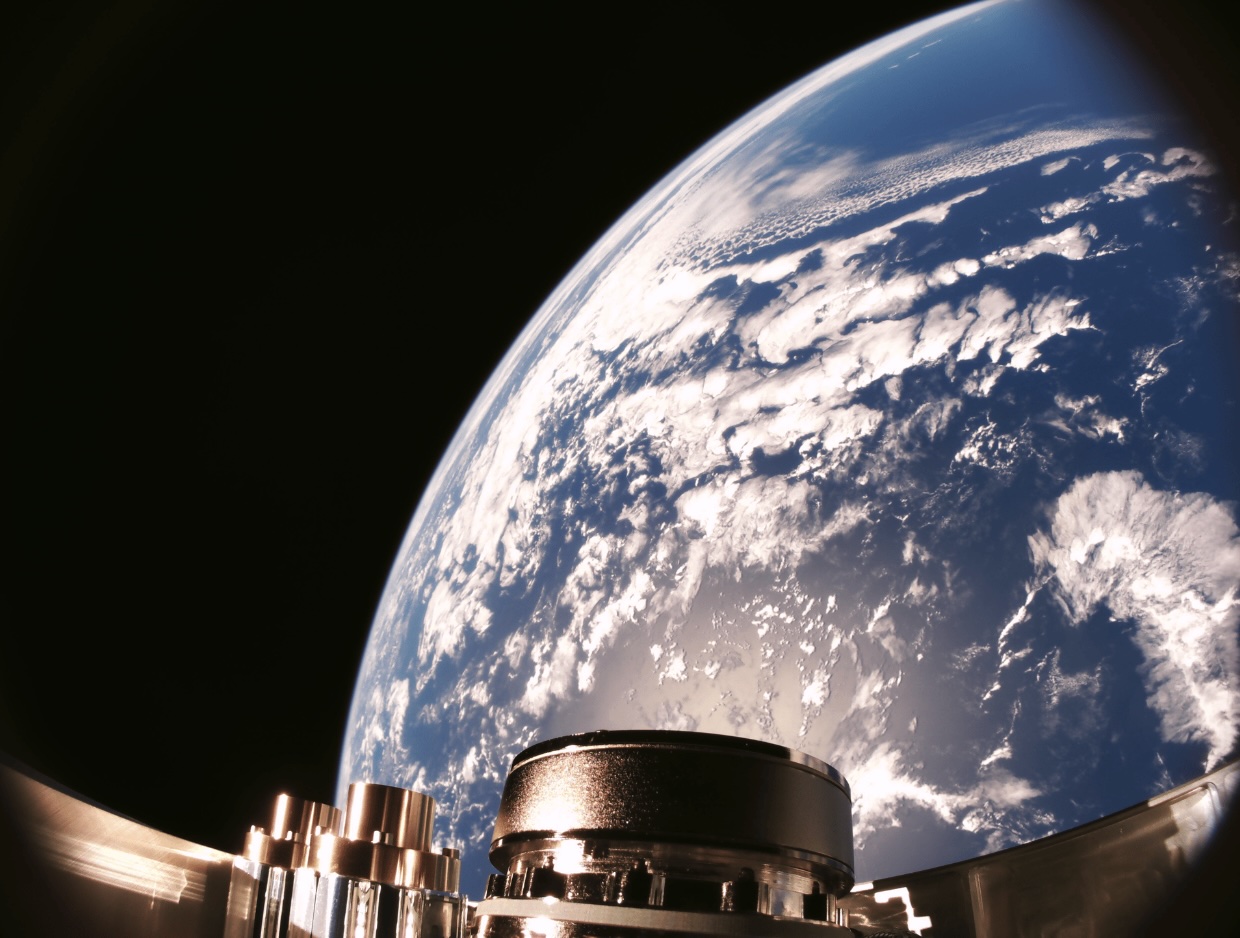
Muon Space’s zinc-fueled Starlight Hall-effect thruster on orbit, imaged by an onboard camera on SERT-III.
MOUNTAIN VIEW, Calif., Sept. 10, 2026 (GLOBE NEWSWIRE) — Muon Space, the Mission Foundry for high-performance satellite constellations, today announced the successful first-ever in-space firing of a zinc-fueled Hall-effect thruster. The burn was executed aboard SERT-III, a dedicated propulsion test spacecraft designed, built, and launched by Muon in less than one year. The milestone firing validates the company’s Starlight electric propulsion system end-to-end in the orbital environment, and establishes a new benchmark for what is possible in commercial electric propulsion.

Muon Space’s Starlight thruster during hot fire testing.
Performed on July 1, 2026, the inaugural activation was completed successfully on the first attempt. In-orbit telemetry aligned closely with ground test predictions, and orbital tracking data provided unambiguous confirmation of thrust. The achievement marks the first time in history that an entirely solid-metal propellant Hall-effect thruster system has operated in space.
“Firing a zinc-fueled Hall-effect thruster in space for the first time is a milestone that the electric propulsion community has been working toward for years,” said Jonny Dyer, CEO of Muon Space. “We bet on Starlight Propulsion’s technology when we acquired them last year because this technology is a game changer for a very troubled part of the space supply chain – and we’ve now demonstrated that it performs in space on an incredibly fast timeline.”
Changing the Economics of Constellation Propulsion
Hall-effect Thrusters (HETs) have become the workhorse of high-efficiency satellite propulsion, but they have historically relied on xenon or krypton propellants that are expensive, require high-pressure storage, and impose meaningful cost, mass, and integration complexity — particularly at constellation scale. Muon’s Starlight thruster instead uses solid zinc as its propellant, simplifying spacecraft propulsion while reducing the cost and supply chain constraints associated with traditional electric propulsion.
Zinc is abundant, inexpensive, non-toxic, and solid at room temperature, eliminating pressurized propellant tanks and greatly simplifying spacecraft integration, ground handling, and launch logistics. The result is a propulsion system that retains the high specific impulse and propellant efficiency expected from Hall-effect propulsion while reducing cost and operational complexity. Starlight enables capable orbit raising, station keeping, and deorbit maneuvers on small and mid-sized spacecraft. Because zinc is widely available and inexpensive, it also reduces dependence on constrained noble gas supply chains that have become an increasing concern for satellite manufacturers.
For satellite constellation operators facing pressure to reduce cost while scaling to dozens or hundreds of spacecraft, this combination of performance and economics represents a step-change in what propulsion can offer.
Successful On-Orbit Validation of the Full Technology Stack
Prior to flight, Muon subjected the Starlight system to extensive testing and environmental qualification campaigns at its Silicon Valley facilities, including repeated vacuum-chamber testing across multiple flight-representative thrusters. These tests characterized performance across throttle settings, thermal conditions, and start-up cycles, establishing the baseline against which in-orbit performance would be evaluated.
SERT-III was instrumented specifically to capture thruster performance data, spacecraft compatibility data, and propellant plume contamination measurements across all phases of in-orbit operations — generating a comprehensive dataset that would otherwise only be obtainable through costly, time-consuming integration onto a primary mission spacecraft.
The first firing of the Starlight thruster was completely successful. Telemetry confirmed that the thruster activated and completed a full burn on the first attempt, with no adverse effects on the spacecraft from electromagnetic interference, power transients, or plasma interactions. Orbital tracking data shows a clear and measurable change in the spacecraft’s orbit, confirming that thrust was generated as designed. In-orbit data from the firing is consistent with ground test data — validating that neither microgravity nor the broader space environment imposes unexpected constraints on the system’s operation.
Contamination measurements collected by Thermoelectric Quartz Crystal Microbalance (TQCM) sensors distributed across the spacecraft confirmed that zinc deposition near the thruster was below conservative pre-mission model predictions – providing valuable calibration data for plume interaction and contamination models. Initial analysis of performance telemetry indicates the system is meeting or exceeding design thrust and efficiency targets.
“SERT-III gave us an unambiguous, successful validation of the Starlight system in a flight environment,” said Todd Bailey, Director of Propulsion at Muon Space. “We confirmed that solid zinc propellant feeds and vaporizes reliably in microgravity, that our contamination models are functional and conservative, and that the thruster integrates cleanly with a real spacecraft bus. This is the future and it works, and we’re right around the corner from delivering validated, production ready systems for customers.”
The Path to Customer Deployment
The on-orbit test campaign produced useful performance, compatibility, and contamination data that is being actively incorporated into Muon’s ongoing thruster development and validation program. These learnings combined with an extensive and continuous ground test campaign are informing targeted refinements to optimize the Starlight system’s reliability, manufacturability, and plume management across full mission lifecycles.
Muon plans to begin deploying the current-generation Starlight thruster on customer missions before the end of 2026.
A second-generation Starlight system, extending thrust range to larger spacecraft classes, is already in development. Gen2 will perform its first on-orbit test in Q1 2027, and is slated for its first commercial customer mission in 2027.
About Muon Space
Muon Space is the Mission Foundry, designing, building, and operating high-performance satellite constellations for defense, civil, and commercial customers. Founded in 2021, the company has engineered every layer: spacecraft, instruments, software, and operations — all designed to work together from simulation to orbit. With advanced production facilities in Silicon Valley and multiple constellations already on orbit, Muon delivers in months, not years. For more information, visit: muonspace.com.
Photos accompanying this announcement are available at:
https://www.globenewswire.com/NewsRoom/AttachmentNg/8f06a22b-5993-436a-81f2-455343259d57
https://www.globenewswire.com/NewsRoom/AttachmentNg/7684da80-4abb-473c-8ce8-93700d6536ed
CONTACT: Media Contact:

Michael Sias
Firm 19
[email protected]
