
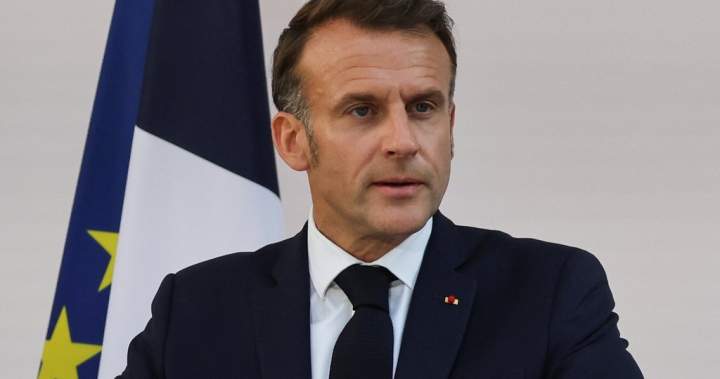
French President Emmanuel Macron on Thursday cited U.S. President Donald Trump’s threat to make Canada the “51st state” as an example of American foreign policy that is sacrificing allies for “the law of the strongest.”
Macron’s blunt remarks were matched by similar comments from German President Frank-Walter Steinmeier in a separate speech that showed European leaders’ growing concern as Trump seeks to impose U.S. dominance over the Western Hemisphere, including actions in Venezuela and threats of a potential U.S. takeover of Greenland.
In an address to French ambassadors at the Élysée presidential palace on Thursday, Macron said, “It’s the greatest disorder, the law of the strongest, and everyday people wonder whether Greenland will be invaded, whether Canada will be under the threat of becoming the 51st state (of the United States) or whether Taiwan is to be further circled.”
The United States is “gradually turning away from some of its allies and freeing itself from the international rules,” Macron said.
The comments appear to be the first time Macron has directly addressed Trump’s threats against Canada’s sovereignty, which the U.S. president has not raised for several weeks after repeatedly making the assertions last year.
However, Canada’s former United Nations ambassador, Bob Rae, and other experts have warned Trump’s recent behaviour suggests Canada is “on the menu” for his plans in the hemisphere when taken alongside the “51st state” rhetoric.
Macron’s speech referenced recent U.S. actions, including the capture of Venezuelan President Nicolas Maduro last weekend, and Trump’s overall national security strategy that envisions America as a hemispheric superpower.

Get breaking National news
For news impacting Canada and around the world, sign up for breaking news alerts delivered directly to you when they happen.
The remarks also come amid growing concern about Trump’s plans for Greenland. U.S. Secretary of State Marco Rubio is set to meet with Danish officials next week.
Macron joined Prime Minister Mark Carney and other European leaders Tuesday in defending Greenland’s sovereignty in the wake of Trump’s comments about how the U.S. “need(s)” the self-governing Danish territory, which is part of the NATO military alliance.
The Prime Minister’s Office on Thursday said Carney spoke to German Chancellor Friedrich Merz about “their shared support for the sovereignty and territorial integrity of Denmark, including Greenland, which must be respected in accordance with international law.”
“Prime Minister Carney reaffirmed that the future of Greenland is for Greenland and Denmark to determine,” a readout of the conversation said. The two leaders also discussed Ukraine and efforts to strengthen Arctic and “Euro-Atlantic security.”
Separately, Steinmeier said in remarks at a symposium in Germany late on Wednesday that Trump’s actions and comments show global democracy is being attacked as never before.
Describing Russia’s annexation of Crimea and the full-scale invasion of Ukraine as a watershed, Steinmeier said the behaviour of the United States represented a second historic rupture.
“Then there is the breakdown of values by our most important partner, the USA, which helped build this world order,” he said.
“It is about preventing the world from turning into a den of robbers, where the most unscrupulous take whatever they want, where regions or entire countries are treated as the property of a few great powers,” he said.
Although the German president’s role is largely ceremonial, his words carry some weight and he has more freedom to express views than politicians.
The remarks from Macron and Steinmeier are an escalation from European leaders’ immediate reaction to Maduro’s capture, which called for all parties to respect international law without criticizing the U.S. directly.
Experts previously told Global News that world leaders were likely hoping to not anger a “volatile White House” amid ongoing trade and security negotiations.
On Thursday, a poll for public broadcaster ARD indicated 76 per cent of Germans surveyed now felt the United States was not a partner that Germany could rely on, an increase of three percentage points since June 2025.
Only 15 per cent felt Germany could now trust the United States, the lowest level recorded in the regular survey of attitudes.
By contrast, roughly three-quarters felt they could rely on France and Britain.
The survey found 69 per cent of Germans concerned about security in Europe, about the same number that thought NATO partners could not rely on the protection of the United States, the strongest member of the alliance.
—with files from the Associated Press and Reuters
© 2026 Global News, a division of Corus Entertainment Inc.