
Highlights
- First pass regional surface geochemical sampling over Mpongwe Licence identifies additional Cu soil anomalies for follow-up in similar stratigraphic and structural setting to Lwabufubu target.
- Repeat soil sampling results confirm Lwabufubu target as a priority for further work on the Mpongwe licence.
- Drill program at Luanshya West planned for late season 2026.
- Initial consent granted for the transfer of the two earn-in licences to Koryx Zambia.
LUXEMBOURG, June 23, 2026 (GLOBE NEWSWIRE) — Koryx Copper S.A. (“Koryx” or the “Company“) (TSX:KRY.V) (NSX:KYX) (OTCQB:KRYXF) is pleased to provide an update on exploration results and progress on its two large scale exploration licences in Zambia, namely the Luanshya West project (LEL 23246, 54 km2) and Mpongwe project (LEL 23248, 675 km2) (the “Project”).
Koryx holds the option to acquire up to 80% of the Projects in the Copperbelt in Zambia. The Zambian Copperbelt makes up part of the larger Central African Copperbelt (CACB) which extends north into the Democratic Republic of Congo. The CACB is the world’s largest sedimentary rock hosted stratiform copper province and includes at least 14 giant deposits such as First Quantum Mineral’s Kansanshi and Sentinel, as well as Ivanhoe’s Kamoa and Kakula.
Heye Daun, Koryx Copper’s President and CEO commented: “While our focus remains the Haib Copper Project in Namibia, this update on our Zambian Projects shows the progress we are making by carrying out systematic exploration aimed at identifying legitimate targets for drill testing and turning over ground that is less prospective. The heavy rains in Zambia have delayed our field programmes this year, but we remain committed to advancing our projects there, particularly once we have secured the transfer of the two licences to our local subsidiary. Our next phase of work will focus on drilling at Luanshya West, while we assess surface anomalies at Mpongwe for possible drill testing later in the year”.
Mpongwe Project
Results from soil sampling carried out in late 2025 have been compiled and interpreted along with historical data.
A total of approximately 4,000 soil samples (excluding Quality Assurance and Quality Control (“QAQC”) samples) were collected and analysed by Inductively Coupled Plasma Optical (Atomic) Emission Spectrometry (ICP-OES) for a suite of 33 elements. The sampling was carried out with three different aims and sample spacings:
- Repeat sampling over historical soil sampling points to confirm historical surface geochemistry data, carried out on selected lines at a sample spacing of 50m at Lwabufubu target and the area of previous diamond drilling in the northeast of the licence.
- Regional sampling targeting interpreted Upper Roan Group rocks and the contact zone with the underlying Lower Roan Group at 250m x 250m sample spacing.
- Regional sampling at 500m x 500m spacing testing the large areas of low-lying relief and drainages interpreted as Lower Roan Group and possible shallow or sub-cropping basement lithologies.
Outcrop over the licence area is poor and interpretations of the underlying geology have been driven by a few isolated outcrops, historical geophysical data (magnetics, radiometrics and airborne electromagnetics) and to some extent satellite imagery. Multi-element geochemistry data from the 2025 soil sampling has augmented these interpretations and refined our understanding of the potential for Cu mineralisation.
The map below shows the sampling undertaken in 2025 and the key outcomes of the results using gridded raw Cu values plotted on first vertical derivative airborne magnetics data. Also shown are the samples impacted by drainages (known locally as dambos), particularly in the lower parts of the interpreted Upper Roan stratigraphy. These low lying areas are interpreted to be related to preferential weathering of carbonate and gabbroic rocks.
Figure 1: Gridded 2025 soil results (Cu) as a transparent layer on greyscale first vertical derivative magnetic data
Additional sampling was trialled using Intertek’s Terraleach™ partial leach analytical technique over areas of known low-level Cu anomalism (in the two diamond drillholes in the northeast of the licence), and along selected lines at the Lwabufubu target area.
The specific leach selected is designed for use in high iron-manganese regolith conditions, such as those encountered in the lateritic overburden found over the licence area. Results were equivocal, with conventional ICP-OES analyses generally giving better anomaly discrimination and more consistent identification of Cu anomalism. In general, the sampling indicates that conventional soils and ICP analyses are suitable in this environment where soils, even where laterite is developed, are residual in nature.
The 2025 soil geochemistry results:
- Confirmed the Cu anomalism in the Lwabufubu target area.
- Highlighted additional areas of Cu anomalism along strike to the southwest.
- Screened large areas of Lower Roan stratigraphy where only limited follow up will be required.
Lwabufubu Target
Confirmation sampling validated historical surface geochemistry data and indicated that the results were comparable for the suite of elements sampled previously (Cu, Co, Mn, Ni, Pb, Zn), with means, minimum and maximum values and correlation between the datasets almost identical.
The combined data defines a priority target with patchy, but consistent Cu anomalism coincident with de-magnetisation over 2,500m x 1,500m, within a larger target area of Cu anomalism of 5,500m x 2,500m.
The Cu:Sc ratios for the 2025 check samples carried out over selected lines at Lwabufubu suggest that most of the elevated Cu values defining the target are not from gabbroic sources and warrant further work to assess the possibility that they are associated with Cu mineralisation (as shown in the map below).
Additional anomalies detected with regional 250m x 250m – Upper Roan
Isolated outcrop and the airborne geophysics indicates that the lower part of the Upper Roan in the licence area contains abundant mafic / gabbroic intrusive rocks (indicated by a mottled high magnetic signature). In addition, minor ironstone outcrops and float have been observed in these areas. It is also likely that these areas are underlain by carbonate rocks, giving rise to lower relief dambo and pooled drainage areas.
The 2025 sampling identified two areas with elevated Cu values which also show Cu:Sc ratios suggesting a possible source other than mafic / gabbroic intrusive rocks. The peak Cu values are in the range 190-223ppm, similar to those at Lwabufubu and warrant further work. The map below shows the significant influence of dambos in the areas around these two areas (labelled as MP1 and MP2).
Additional elevated Cu:Sc ratio values occur in areas east and northeast of Lwabufubu which are associated with relatively low Cu values (up to 73ppm) warrant checking in the field prior to possible follow up.
Regional 500m x 500m sampling over Lower Roan Group (and possible Basement)
The widely spaced sampling over the poorly exposed, low-lying and generally magnetically quiet interpreted Lower Roan Group sedimentary rocks and possible Basement lithologies has largely screened these areas and little follow up is required.
Interpreted mafic dykes evident in the magnetics data show slightly elevated Cu (and related elements), which suggests the soil sampling is effective and sampling residual material.
Slightly elevated Cu:Sc ratio values occur over the high-magnetic granitic intrusion / Basement rocks interpreted to occur below thin sedimentary cover intersected in historical diamond drill holes in this area.
2026 Field Season Planning
Field work is expected to commence in late July (after a heavy rain season) and will include:
- Initial reconnaissance visits to Lwabufubu target, and MP1 and MP2 soil anomalies – mapping, in-fill soil sampling and preliminary pitting and sampling
- Completion of regional soil sampling in areas to the north and west of Lwabufubu
- Ground geophysics to assist with prioritising drill targets at Lwabufubu
- Shallow drilling to test bedrock in the vicinity of soil geochemistry anomalies / geophysical targets
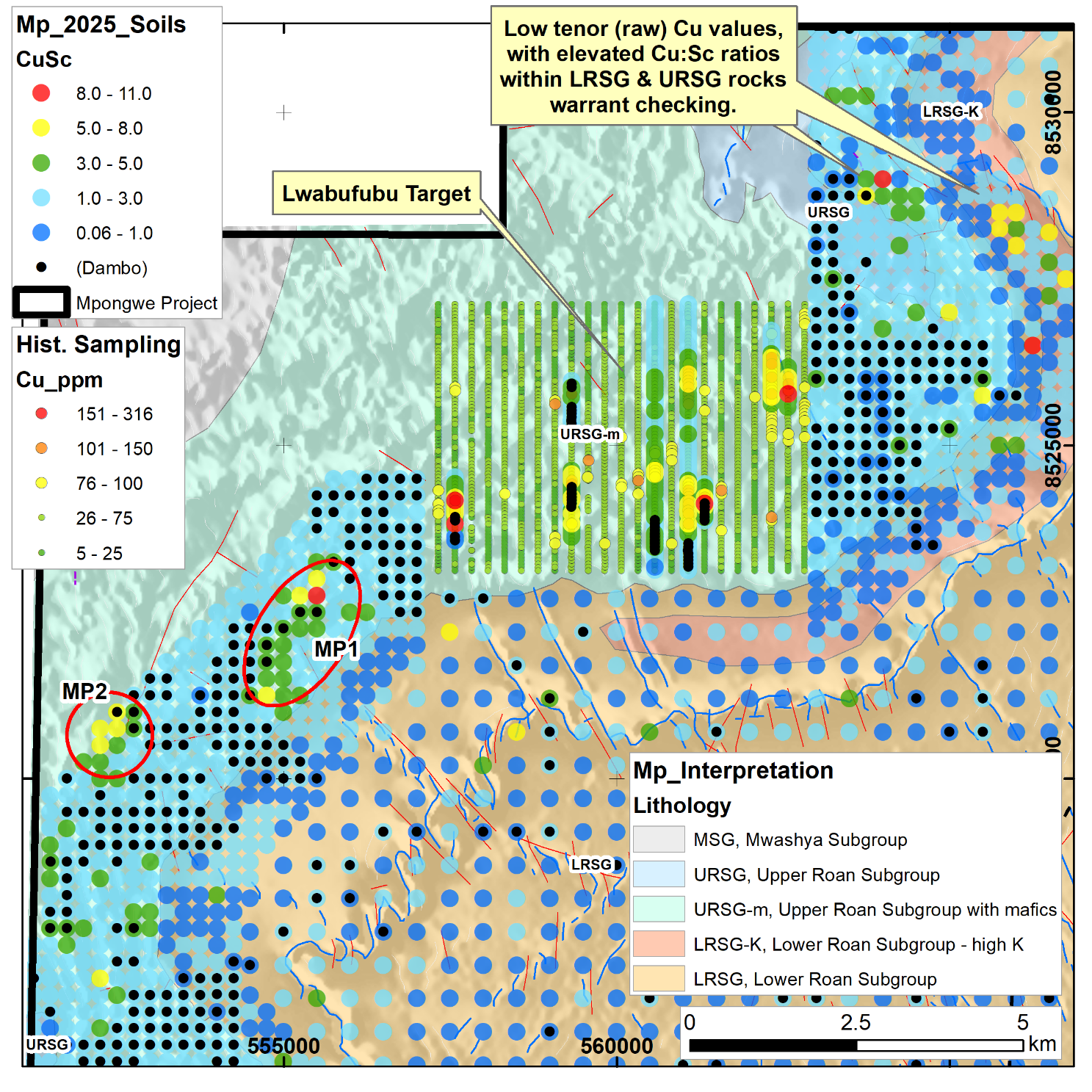
Figure 2: Lwabufubu target and MP1 and MP2 soil geochem anomalies.
Luanshya West Project
The final results for sampling within the forestry area in the southwest of the licence were also received earlier in the year and have been incorporated into planning for the upcoming field programmes, but there is no change in the prioritisation and planned drill programmes (mentioned in the news release dated December 5, 2025). The drill program has been delayed by the rain season and is expected to be carried out before the end of 2026.
Licences Update
The process to transfer the licenses into the Company’s Zambia registered wholly owned subsidiary is ongoing, with initial consent for the transfers having been received from the Director of Mining and Non-Mining Rights.
The Company currently owns 51% of the licenses and has an option to earn up to 80% with an additional US$2 million expenditure over the next 18 months. The Company has retained legal counsel in Zambia to assist with the official lodging of documentation with the Ministry of Mines and Minerals Development in Zambia.
Quality Control
Soil samples were collected from the ‘B’ horizon at an approximate depth of 25-30cm at each sample site. Samples were dried if required and sieved to 180 microns / -80 mesh yielding approximately 100g of sieved material. QAQC samples were inserted at a frequency of approximately 5%, including blank, certified reference material (“CRM”) and field duplicates. Samples were submitted to the Intertek Genalysis preparation laboratory in Kitwe, Zambia and analyses were carried out at the Intertek Genalysis Perth laboratory using code 4A/OE, which uses a multi-acid digest including Hydrofluoric, Nitric, Perchloric and Hydrochloric acids in Teflon Tubes and analysed by Inductively Coupled Plasma Optical (Atomic) Emission Spectrometry.
Qualified Person
Mr. Dean Richards Pr.Sci.Nat., MGSSA – BSc. (Hons) Geology is the Qualified Person for Koryx Copper and has reviewed and approved the scientific and technical information in this news release and is a registered Professional Natural Scientist with the South African Council for Natural Scientific Professions (Pr. Sci. Nat. No. 400190/08). Mr. Richards is independent of the Company and its mineral properties and is a Qualified Person for the purposes of National Instrument 43-101.
About Koryx Copper S.A.
Koryx Copper S.A. is a Luxembourg domiciled copper development Company focused on advancing its 100% owned Haib Copper Project in Namibia whilst also advancing a portfolio of copper exploration licenses in Zambia. Haib is a large copper/molybdenum/gold porphyry deposit in southern Namibia with a long history of exploration and project development by multiple operators.
More than 120,000m of drilling has been conducted at Haib since the 1970’s with significant exploration programs led by companies including Falconbridge (1964), Rio Tinto (1975) and Teck (2014). Extensive further drilling, metallurgical testing and various technical studies have been completed at Haib to date. Additional studies are underway aiming to demonstrate Haib as a future long-life, low-cost, low-risk open pit, sulphide flotation copper project with the potential for additional copper production from heap leaching.
Mineralisation at Haib is typical of a porphyry copper deposit and is dominantly chalcopyrite with minor bornite and chalcocite present and only minor secondary copper minerals at surface due to the arid environment. Haib is one of only a few examples of a Paleoproterozoic porphyry copper deposit in the world and one of only two in southern Africa (both in Namibia). Due to its age, the deposit has been subjected to multiple metamorphic and deformation events but still retains many of the classic mineralisation and alteration features typical of these deposits.
Further details of the Haib Copper Project are available in the technical report titled “March 2026 Mineral Resource Estimate Haib Copper Project, Namibia, National Instrument 43-101 Technical Report” dated effective March 16, 2026. The report and other information are available on the Company’s website at www.koryxcopper.com and under the Company’s profile on SEDAR+ at www.sedarplus.ca.
Additional information is also available by contacting the Company:
Julia Becker
Corporate Communications
[email protected]
+1-604-785-0850
Neither the TSX Venture Exchange nor its Regulation Services Provider (as that term is defined in the policies of the TSX Venture Exchange) accepts responsibility for the adequacy or accuracy of this release.
Cautionary Statement Regarding Forward-Looking Information
This press release contains “forward-looking information” within the meaning of applicable Canadian securities legislation. Forward-looking information includes, without limitation, statements regarding the future or prospects of the Haib project or the Company, including prospective production rates and life-of-mine, the timing of publishing a PFS, the commencement of trading of the Shares under the new Company name, and the effective date of the new CUSIP and ISIN assigned to the Shares. Generally, forward-looking information can be identified by the use of forward-looking terminology such as “plans”, “expects” or “does not expect “, “is expected “, “budget”, “scheduled”, “estimates”, “forecasts”, “intends”, “anticipates” or “does not anticipate”, or “believes”, or variations of such words and phrases or state that certain actions, events or results “may”, “could”, “would”, “might” or “will be taken”, “occur” or “be achieved”. Forward-looking statements are necessarily based upon a number of assumptions that, while considered reasonable by management, are inherently subject to business, market, and economic risks, uncertainties, and contingencies that may cause actual results, performance, or achievements to be materially different from those expressed or implied by forward-looking statements. Although the Company has attempted to identify important factors that could cause actual results to differ materially from those contained in forward-looking information, other factors may cause results not to be as anticipated, estimated, or intended. There can be no assurance that such information will prove to be accurate, as actual results and future events could differ materially from those anticipated in such statements. Accordingly, readers should not place undue reliance on forward-looking information. Other factors which could materially affect such forward-looking information are described in the risk factors in the Company’s most recent annual management discussion and analysis. The Company does not undertake to update any forward-looking information, except in accordance with applicable securities laws.
Photos accompanying this announcement are available at
https://www.globenewswire.com/NewsRoom/AttachmentNg/05c8cf83-7520-4f54-8508-906034c6d774
https://www.globenewswire.com/NewsRoom/AttachmentNg/9135eedd-19fd-4315-926f-57ad4b438fe7
