
Automation, Rapid Changeovers and Sustainability Drive Modular Packaging Equipment Adoption Across FMCG and Pharmaceuticals
Global Modular Packaging Equipment Market
Dublin, Aug. 12, 2026 (GLOBE NEWSWIRE) — The “Global Modular Packaging Equipment Market Opportunity, Growth Drivers, Industry Trend Analysis, and Forecast 2026-2035” has been added to ResearchAndMarkets.com’s offering.
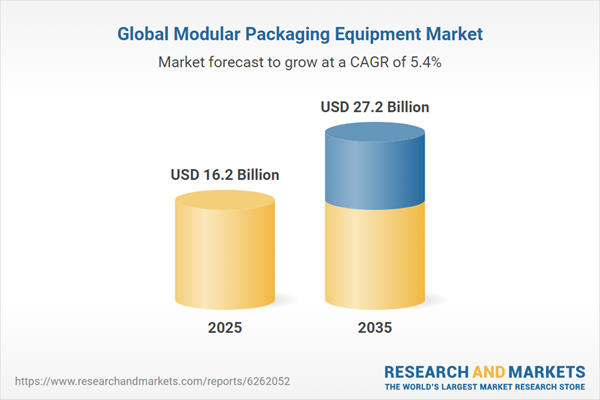
The Global Modular Packaging Equipment Market was valued at USD 16.2 billion in 2025 and is estimated to grow at a CAGR of 5.4% to reach USD 27.2 billion by 2035.
Growth is shaped by multiple structural forces, including the increasing complexity of product portfolios that require rapid changeover capabilities, stricter environmental regulations linked to packaging waste reduction policies in Europe, and ongoing labor shortages in advanced manufacturing economies. These combined factors are accelerating the adoption of modular equipment designs that allow manufacturers to enhance production agility while maintaining regulatory compliance and operational efficiency. Demand is particularly strong across fast-moving consumer goods and pharmaceutical manufacturing, where frequent product variation, strict quality standards, and shorter product life cycles require highly adaptable production infrastructure. Manufacturers are increasingly prioritizing systems that support rapid configuration changes and scalable production capacity, enabling them to respond more effectively to shifting market requirements. As production environments continue to evolve toward greater flexibility and automation, modular packaging equipment is becoming a core component of next-generation manufacturing strategies across global industries.
The primary packaging equipment segment accounted for a 55.3% share in 2025 and is projected to grow at a CAGR of 5% through 2035. This segment continues to lead due to strong demand for filling, sealing, and forming systems across food, beverage, and pharmaceutical applications. The need for flexible production lines capable of handling diverse product formats, strict hygiene requirements, and evolving material standards is reinforcing the adoption of modular primary packaging solutions. In pharmaceutical manufacturing, the increasing production of advanced therapies and specialized drug delivery formats is further strengthening demand for adaptable and reconfigurable equipment systems.
The direct distribution channel represented a 55.8% share in 2025 and is expected to grow at a CAGR of 4.7% through 2035. This channel includes direct engagement between equipment manufacturers and end users through customized system deployment, integrated production line solutions, and long-term service agreements. It remains the preferred model for complex manufacturing installations that require tailored engineering, system validation, and ongoing technical support. Direct procurement structures also enable closer collaboration between manufacturers and equipment providers, improving system performance optimization and lifecycle management.
The North American Modular Packaging Equipment Market held a 28.4% share in 2025 and is projected to grow at a CAGR of 4.3% through 2035. Demand in the region is primarily driven by the food and beverage and pharmaceutical manufacturing sectors, where investment in modular systems is supported by increasing labor costs, strict regulatory compliance requirements, and rising demand for flexible production capabilities. Manufacturers are increasingly adopting automated and reconfigurable packaging systems to improve operational efficiency and reduce downtime associated with product changeovers, further supporting regional market growth.
Key companies operating in the Global Modular Packaging Equipment Market include Coesia Group, Syntegon Technology, Krones AG, Multivac Group, IMA Group, Schubert Group, ProMach Inc., Sidel Group, Optima Packaging Group, Ishida Co., Ltd., ULMA Packaging, Marchesini Group, Robopac/Aetna Group, Fuji Machinery Co., Ltd., TNA Solutions, Mpac Group plc, Nichrome India Pvt. Ltd., Combi Packaging Systems, Massman Companies, Truking Technology Ltd., and Cama Group. Companies operating in the modular packaging equipment market are focusing on advanced automation integration, enhanced system modularity, and the digitalization of packaging operations to strengthen their competitive positions. Manufacturers are investing in smart equipment technologies, predictive maintenance capabilities, and IoT-enabled production monitoring systems to improve efficiency and reduce downtime. Strategic partnerships with end-use industries are enabling the co-development of customized packaging solutions tailored to specific production requirements. Companies are also expanding global service networks and aftermarket support capabilities to enhance customer retention and lifecycle value. In addition, firms are emphasizing sustainability-driven innovation, including energy-efficient machinery designs and systems that reduce material waste, to align with evolving environmental regulations.
Comprehensive Market Analysis and Forecast
. Industry trends, key growth drivers, challenges, future opportunities, and regulatory landscape
. Competitive landscape with Porter’s Five Forces and PESTEL analysis
. Market size, segmentation, and regional forecasts
. In-depth company profiles, business strategies, financial insights, and SWOT analysis
Key Attributes:
| Report Attribute | Details |
| No. of Pages | 200 |
| Forecast Period | 2025 – 2035 |
| Estimated Market Value (USD) in 2025 | $16.2 Billion |
| Forecasted Market Value (USD) by 2035 | $27.2 Billion |
| Compound Annual Growth Rate | 5.4% |
| Regions Covered | Global |
Key Topics Covered:
Chapter 1 Methodology & Scope
1.1 Research approach
1.2 Quality Commitments
1.2.1 GMI AI policy & data integrity commitment
1.2.1.1 Source consistency protocol
1.3 Research Trail & Confidence Scoring
1.3.1 Research Trail Components
1.3.2 Scoring Components
1.4 Data Collection
1.4.1 Partial list of primary sources
1.5 Data mining sources
1.5.1 Paid sources
1.5.1.1 Sources, by region
1.6 Base estimates and calculations
1.6.1 Base year calculation for any one approach
1.7 Forecast model
1.7.1 Quantified market impact analysis
1.7.1.1 Mathematical impact of growth parameters on forecast
1.8 Research transparency addendum
1.8.1 Source attribution framework
1.8.2 Quality assurance metrics
1.8.2.1 Our commitment to trust
Chapter 2 Executive Summary
2.1 Industry 360 synopsis, 2022-2035
2.2 Key market trends
2.2.1 Region
2.2.2 Type
2.2.3 Automation Level
2.2.4 End Use
2.2.5 Distribution channel
Chapter 3 Industry Insights
3.1 Industry ecosystem analysis
3.1.1 Supplier landscape
3.1.2 Profit margin
3.1.3 Value addition at each stage
3.1.4 Factor affecting the value chain
3.2 Industry impact forces
3.2.1 Growth drivers
3.2.1.1 Rising SKU proliferation & demand for rapid format changeover across FMCG & pharma
3.2.1.2 Labor cost escalation & skilled technician shortages driving automation adoption
3.2.1.3 Growth of e-commerce & direct-to-consumer fulfillment requiring flexible line configurations
3.2.2 Industry pitfalls & challenges
3.2.2.1 Standardization gaps- interoperability between multi-vendor modular components
3.2.2.2 Cybersecurity risks in IIoT-connected modular packaging lines
3.2.3 Opportunities
3.2.3.1 Industrialization & packaging modernization in Asia-Pacific & MEA
3.2.3.2 Modular-as-a-service (MaaS) & equipment-as-a-service (EaaS) business model adoption
3.3 Growth potential analysis
3.4 Regulatory framework
3.4.1 Standards & Compliance Requirements
3.4.2 Regional Regulatory Frameworks
3.4.3 Certification Standards
3.5 Major market trends and disruptions
3.6 Technology/innovation landscape
3.6.1 Current trends
3.6.2 Emerging trends
3.7 Pricing Analysis (driven by primary research)
3.7.1 Historical price trend analysis (driven by primary research)
3.7.2 Pricing strategy by player type (premium / value / cost-plus) (driven by primary research)
3.8 Future market trends
3.9 Trade data analysis (driven by paid database) (HS Code-8422)
3.9.1 Import/export volume & value trends (driven by primary research)
3.9.2 Key trade corridors & tariff impact (driven by primary research)
3.10 Impact of AI & Generative AI on the Market
3.10.1 AI-driven disruption of existing business models
3.10.2 Gen-AI use cases & adoption roadmap by segment
3.10.3 Risks, limitations & regulatory considerations
3.11 Porter’s analysis
3.12 PESTEL analysis
3.13 Capacity & production landscape (driven by primary research)
3.13.1 Installed capacity by region & key producer (driven by primary research)
3.13.2 Capacity utilization rates & expansion pipelines(driven by primary research)
Chapter 4 Competitive Landscape, 2025
4.1 Introduction
4.2 Company market share analysis
4.2.1 by Region
4.2.1.1 North America
4.2.1.2 Europe
4.2.1.3 Asia-Pacific
4.2.1.4 Latin America
4.2.1.5 Middle East and Africa
4.3 Company matrix analysis
4.4 Competitive analysis of major market players
4.5 Competitive positioning matrix
4.6 Key developments
4.6.1 Mergers & acquisitions
4.6.2 Partnerships & collaborations
4.6.3 New product launches
4.6.4 Expansion plans
Chapter 5 Market Estimates and Forecast, by Type, 2022-2035 (USD Billion) (Thousand Units)
5.1 Key trends
5.2 Primary Packaging Equipment
5.2.1 Filling Machines
5.2.2 Sealing Machines
5.2.3 Labeling Machines
5.2.4 Coding & Marking Equipment
5.3 Secondary Packaging Equipment
5.3.1 Cartoning Machines
5.3.2 Case Packing Systems
5.3.3 Shrink Wrapping Machines
5.3.4 Palletizing Equipment
5.4 Tertiary Packaging Equipment
5.4.1 Stretch Hooding Systems
5.4.2 Unitizing & Strapping Systems
Chapter 6 Market Estimates and Forecast, by Automation Level, 2022-2035 (USD Billion) (Thousand Units)
6.1 Key trends
6.2 Manual modular equipment
6.3 Semi-automatic systems
6.4 Automatic systems
Chapter 7 Market Estimates and Forecast, by End Use, 2022-2035 (USD Billion) (Thousand Units)
7.1 Key trends
7.2 Food and beverage
7.3 Pharmaceuticals
7.4 Cosmetics and personal care
7.5 Chemical and agrochemical
7.6 Electronics
7.7 Others (automotive, etc.)
Chapter 8 Market Estimates and Forecast, by Distribution Channel, 2022-2035 (USD Billion) (Thousand Units)
8.1 Key trends
8.2 Direct
8.3 Indirect
Chapter 9 Market Estimates & Forecast, by Region, 2022-2035, (USD Billion) (Thousand Units)
9.1 Key trends
9.2 North America
9.2.1 U.S.
9.2.2 Canada
9.3 Europe
9.3.1 Germany
9.3.2 U.K.
9.3.3 France
9.3.4 Italy
9.3.5 Spain
9.4 Asia-Pacific
9.4.1 China
9.4.2 India
9.4.3 Japan
9.4.4 South Korea
9.4.5 Australia
9.5 Latin America
9.5.1 Brazil
9.5.2 Mexico
9.5.3 Argentina
9.6 MEA
9.6.1 UAE
9.6.2 Saudi Arabia
9.6.3 South Africa
Chapter 10 Company Profiles
10.1 Global Companies
10.1.1 Coesia Group
10.1.1.1 Business Overview
10.1.1.2 Financial Data
10.1.1.3 Product Landscape
10.1.1.4 Strategic Outlook
10.1.1.5 SWOT Analysis
10.1.2 IMA Group
10.1.3 Krones AG
10.1.4 Multivac Group
10.1.5 ProMach Inc.
10.1.6 Sidel Group
10.1.7 Syntegon Technology
10.2 Regional Companies
10.2.1 Fuji Machinery Co., Ltd.
10.2.2 Ishida Co., Ltd.
10.2.3 Marchesini Group
10.2.4 Optima Packaging Group
10.2.5 Robopac / Aetna Group
10.2.6 Truking Technology Ltd.
10.2.7 ULMA Packaging
10.3 Emerging Companies
10.3.1 Cama Group
10.3.2 Combi Packaging Systems
10.3.3 Massman Companies
10.3.4 Mpac Group plc
10.3.5 Nichrome India Pvt. Ltd.
10.3.6 Schubert Group
10.3.7 TNA Solutions
For more information about this report visit https://www.researchandmarkets.com/r/h7axdp
About ResearchAndMarkets.com
ResearchAndMarkets.com is the world’s leading source for international market research reports and market data. We provide you with the latest data on international and regional markets, key industries, the top companies, new products and the latest trends.
Attachment
- Global Modular Packaging Equipment Market
CONTACT:
CONTACT: ResearchAndMarkets.com
         Laura Wood,Senior Press Manager
         [email protected]
         For E.S.T Office Hours Call 1-917-300-0470
         For U.S./ CAN Toll Free Call 1-800-526-8630
         For GMT Office Hours Call +353-1-416-8900
