
Can Opener Market Gains Momentum as Safety-Focused Designs, Stainless Steel Premiumization and E-Commerce Expansion Reshape Consumer Demand
Can Opener Market
Dublin, Aug. 24, 2026 (GLOBE NEWSWIRE) — The “Can Opener Market Opportunity, Growth Drivers, Industry Trend Analysis, and Forecast 2026-2035” has been added to ResearchAndMarkets.com’s offering.
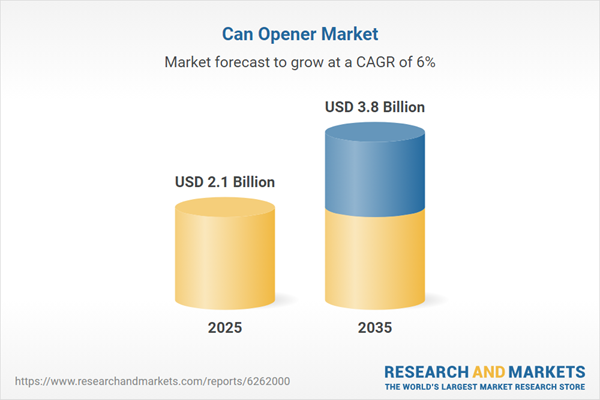
The global can opener market was valued at USD 2.1 billion in 2025 and is estimated to grow at a CAGR of 6% to reach USD 3.8 billion by 2035. Market growth is supported by demographic changes, the increasing penetration of digital retail platforms, and growing consumer willingness to spend on premium kitchen tools.
The industry continues to benefit from the widespread use of canned food products in households worldwide, creating a stable foundation for replacement and upgrade demand. While easy-open packaging formats have gained popularity, conventional canned food consumption remains substantial, sustaining long-term demand for can-opening solutions. Expanding urban populations, increasing preference for packaged food products, and the need for longer-shelf-life food options continue to support canned food production globally.
As modern retail networks expand across developed and emerging economies, consumption of canned products remains strong, providing a dependable demand base for can openers. Furthermore, manufacturers are increasingly focusing on ergonomic designs, enhanced safety features, and premium materials to differentiate their offerings. The combination of steady household demand, product innovation, and premiumization trends is expected to create favorable growth opportunities for the can opener market throughout the forecast period.
The specialty and safety category accounted for a 29.1% share in 2025 and is anticipated to grow at a CAGR of 5.6% through 2035. This segment represents one of the most attractive areas of growth from a profitability perspective. Consumers are increasingly prioritizing products that improve safety and ease of use, encouraging demand for can openers designed to minimize sharp edges and reduce the risk of injury. Growing awareness of household safety, combined with retailer preference for products that enhance consumer protection, continues to strengthen demand within this segment. Manufacturers are responding by introducing innovative designs that improve user convenience while maintaining durability and performance standards.
Based on material type, the stainless steel segment held a 41.8% share in 2025 and is projected to grow at a CAGR of 6.1% through 2035. Consumers widely associate stainless steel construction with superior durability, enhanced hygiene, long product life, and premium visual appeal. As a result, stainless steel can openers continue to command higher average selling prices than alternatives manufactured with plastic components. The preference for durable kitchen tools that offer long-term value remains a major factor driving growth within this segment.
The North American can opener market held a 36.3% share in 2025 and is expected to grow at a CAGR of 5.6% through 2035. The United States remains the primary contributor to regional demand, supported by consistently strong consumption of canned food products and an extensive retail distribution ecosystem. The region benefits from a well-established multichannel sales environment that includes mass-market retailers, specialty stores, and e-commerce platforms. This broad distribution reach enables manufacturers to effectively serve both value-conscious consumers and premium product buyers, supporting stable market expansion throughout the forecast period.
Major companies operating in the global can opener market include Hamilton Beach, Groupe SEB, Helen of Troy, Bradshaw, and Cuisinart. Companies are focusing on product innovation, premium material integration, and consumer-centric design enhancements to strengthen their competitive positions. Manufacturers are introducing ergonomic handles, advanced safety mechanisms, and durable stainless steel construction to improve functionality and justify premium pricing. Many companies are expanding their online presence through direct-to-consumer platforms and major e-commerce marketplaces to increase visibility and customer reach. Strategic investments in product differentiation, including electric and specialty can openers, are helping brands address evolving consumer preferences. Businesses are also enhancing packaging, branding, and marketing initiatives to strengthen customer loyalty.
Comprehensive Market Analysis and Forecast:
- Industry trends, key growth drivers, challenges, future opportunities, and regulatory landscape
- Competitive landscape with Porter’s Five Forces and PESTEL analysis
- Market size, segmentation, and regional forecasts
- In-depth company profiles, business strategies, financial insights, and SWOT analysis
Key Attributes:
| Report Attribute | Details |
| No. of Pages | 220 |
| Forecast Period | 2025-2035 |
| Estimated Market Value (USD) in 2025 | $2.1 Billion |
| Forecasted Market Value (USD) by 2035 | $3.8 Billion |
| Compound Annual Growth Rate | 6% |
| Regions Covered | Global |
Key Topics Covered
Chapter 1 Methodology and Scope
1.1 Market scope and definition
1.2 Research design
1.2.1 Research approach
1.2.2 Data collection methods
1.3 Data mining sources
1.3.1 Global
1.3.2 Regional/Country
1.4 Base estimates and calculations
1.4.1 Base year calculation
1.4.2 Key trends for market estimation
1.5 Primary research and validation
1.5.1 Primary sources
1.6 Forecast model
1.7 Research assumptions and limitations
Chapter 2 Executive Summary
2.1 Industry 360 degree synopsis
2.2 Key market trends
2.2.1 Regional
2.2.2 Product type
2.2.3 Material
2.2.4 Price
2.2.5 End user
2.2.6 Distribution channel
Chapter 3 Industry Insights
3.1 Industry ecosystem analysis
3.1.1 Raw material suppliers
3.1.2 Component Manufacturers & Assemblers
3.1.3 Brand Owners & OEM/ODM Players
3.1.4 Distributors
3.1.5 End users
3.1.6 Profit margin
3.1.7 Value addition at each stage
3.1.8 Factor affecting the value chain
3.2 Industry impact forces
3.2.1 Growth drivers
3.2.1.1 Rising global canned food consumption driving sustained baseline demand
3.2.1.2 Growing aging population spurring ergonomic & electric can opener adoption
3.2.1.3 E-commerce expansion improving product accessibility & discovery globally
3.2.2 Market pitfalls
3.2.2.1 Proliferation of pull-tab & easy-open packaging reducing can opener dependency
3.2.2.2 Extended product durability & low replacement frequency limiting volume growth
3.2.3 Market Opportunities
3.2.3.1 Accessibility-focused product innovation for elderly & differently-abled users
3.2.3.2 Untapped growth in outdoor, camping & emergency preparedness segment
3.2.3.3 Emerging market expansion
3.3 Growth potential analysis
3.4 Technology and innovation landscape
3.4.1 Evolution of manual can opener mechanisms
3.4.2 Electric & battery-operated motor technology advances
3.4.3 Smooth-edge & safety cutting technology
3.4.4 Ergonomic design & accessibility-driven innovation
3.4.5 Smart & connected can opener concepts
3.5 Regulatory & licensing framework
3.5.1 Product safety standards by region
3.5.2 WEEE & RoHS compliance for electric can openers
3.5.3 Food-Contact material regulations
3.5.4 Energy efficiency standards for electric appliances
3.5.5 Import/Export tariff landscape & trade policy
3.6 Pricing analysis (driven by primary research)
3.6.1 Historical price trend analysis by product category
3.6.2 Pricing strategy by player type (premium / value / cost-plus)
3.7 Supply chain analysis
3.7.1 Global sourcing hubs
3.7.2 Supply chain disruption risks & mitigation strategies
3.7.3 Nearshoring & reshoring trends
3.8 Trade data analysis (driven by paid database) (HS code- 8205.51.10.)
3.8.1 Import/export volume & value trends by product category
3.8.2 Key trade corridors & tariff impact
3.9 Impact of AI & generative AI on the market
3.9.1 AI-driven disruption of existing business models
3.9.2 GenAI use cases & adoption roadmap by segment
3.9.3 Risks, limitations & regulatory considerations
3.10 Distribution infrastructure & channel penetration landscape (driven by primary research)
3.10.1 Channel coverage by region & format (modern vs. traditional trade)
3.10.2 Last-mile infrastructure gaps & emerging channel shifts
Chapter 4 Competitive Landscape, 2025
4.1 Introduction
4.2 Company market share analysis
4.2.1 by region
4.2.1.1 North America
4.2.1.2 Europe
4.2.1.3 Asia-Pacific
4.2.1.4 Latin America
4.2.1.5 Middle East and Africa
4.3 Company matrix analysis
4.4 Competitive analysis of major market players
4.5 Competitive positioning matrix
4.6 Key developments
4.6.1 Mergers & acquisitions
4.6.2 Partnerships & collaborations
4.6.3 New product launches
4.6.4 Expansion plans
Chapter 5 Market Estimates and Forecast, by Product Type, 2022-2035 (USD Billion) (Million Units)
5.1 Key trends
5.2 Manual can openers
5.2.1 Handheld manual can openers
5.2.2 Wall-mounted manual can openers
5.2.3 Military/compact style
5.3 Electric can openers
5.3.1 Corded electric can openers
5.3.2 Battery-operated (cordless) can openers
5.3.3 Under-cabinet mounted electric can openers
5.4 Specialty/safety can openers
5.4.1 Smooth-edge side-cut can openers
5.4.2 Adaptive/assistive can openers (accessibility-focused)
5.5 Others
Chapter 6 Market Estimates and Forecast, by Material, 2022-2035 (USD Billion) (Million Units)
6.1 Key trends
6.2 Stainless steel
6.2.1 Brushed stainless steel
6.2.2 Polished stainless steel
6.3 Plastic
6.3.1 ABS plastic
6.3.2 BPA-free / food-grade plastic
6.4 Aluminum
6.5 Others (zinc alloy, rubberized, composite/mixed materials)
Chapter 7 Market Estimates and Forecast, by Price Range, 2022-2035 (USD Billion) (Million Units)
7.1 Key trends
7.2 Low
7.3 Medium
7.4 High
Chapter 8 Market Estimates and Forecast, by Application, 2022-2035 (USD Billion) (Million Units)
8.1 Key trends
8.2 Residential
8.2.1 Standard households
8.2.2 Senior & accessibility-focused households
8.3 Commercial
8.3.1 Restaurants & quick service foodservice
8.3.2 Hotels & hospitality
8.3.3 Cafeterias & canteens
8.3.4 Catering services & food trucks
8.4 Industrial
8.4.1 Food processing plants
8.4.2 Institutional kitchens (hospitals, military, schools)
Chapter 9 Market Estimates and Forecast, by Distribution Channel, 2022-2035 (USD Billion) (Million Units)
9.1 Key trends
9.2 Online
9.2.1 Company website
9.2.2 E-commerce website
9.3 Offline
9.3.1 Specialty stores (kitchen & home goods retailers)
9.3.2 Department stores
9.3.3 Others (wholesale clubs, pharmacy, etc.)
Chapter 10 Market Estimates and Forecast, by Region, 2022-2035 (USD Billion) (Million Units)
10.1 Key trends
10.2 North America
10.2.1 U.S.
10.2.2 Canada
10.3 Europe
10.3.1 Germany
10.3.2 UK
10.3.3 France
10.3.4 Italy
10.3.5 Spain
10.4 Asia-Pacific
10.4.1 China
10.4.2 Japan
10.4.3 India
10.4.4 Australia
10.4.5 South Korea
10.5 Latin America
10.5.1 Brazil
10.5.2 Mexico
10.5.3 Argentina
10.6 Middle East and Africa
10.6.1 South Africa
10.6.2 Saudi Arabia
10.6.3 UAE
Chapter 11 Company Profiles
11.1 Global players
11.1.1 Hamilton Beach Brands, Inc.
11.1.2 Helen of Troy Limited (OXO)
11.1.3 Conair Corporation (Cuisinart)
11.1.4 Groupe SEB SA (WMF)
11.1.5 Stanley Black & Decker (Black+Decker)
11.1.6 Bradshaw International (GoodCook)
11.1.7 Fackelmann GmbH & Co. KG
11.1.8 Victorinox AG
11.2 Regional players
11.2.1 Edlund Company, LLC
11.2.2 Westmark GmbH
11.2.3 Sammic S.L.
11.2.4 Rosle GmbH & Co. KG
11.2.5 Leifheit AG
11.2.6 IMUSA USA
11.2.7 Atlantic Promotions Inc.
11.2.8 Yuyao Holon Electrical Appliance Co., Ltd.
11.3 Emerging players
11.3.1 Joseph Joseph Ltd.
11.3.2 Kuhn Rikon AG
11.3.3 Kitchen Mama LLC
11.3.4 Brabantia N.V.
11.3.5 John J. Steuby Co.
For more information about this report visit https://www.researchandmarkets.com/r/2pydig
About ResearchAndMarkets.com
ResearchAndMarkets.com is the world’s leading source for international market research reports and market data. We provide you with the latest data on international and regional markets, key industries, the top companies, new products and the latest trends.
Attachment
- Can Opener Market
CONTACT:
CONTACT: ResearchAndMarkets.com
         Laura Wood,Senior Press Manager
         [email protected]
         For E.S.T Office Hours Call 1-917-300-0470
         For U.S./ CAN Toll Free Call 1-800-526-8630
         For GMT Office Hours Call +353-1-416-8900
