
Global Application Security Market
Dublin, Aug. 13, 2026 (GLOBE NEWSWIRE) — The “Global Application Security Market Opportunity and Future Growth Dynamics (Databook) – Market Size and Forecast, Spend Analysis by Industry, Security Type, Deployment, and Enterprise Size – Q2 2026 Update” has been added to ResearchAndMarkets.com’s offering.
The global application security market is forecast to grow 15.5% year over year to reach US$67.2 billion in 2026. Following a compound annual growth rate of 12.9% between 2021 and 2025, the market is expected to expand at a CAGR of 14.6% from 2026 to 2030. By 2030, global application security spending is projected to reach approximately US$116.0 billion, up from US$58.2 billion in 2025.
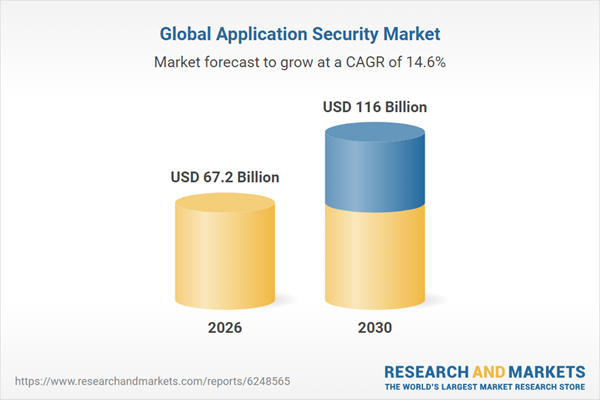
Market growth is being driven by secure-by-design engineering, artificial intelligence adoption, software supply-chain exposure, expanding API ecosystems, regulatory requirements, and the consolidation of application security capabilities into broader cybersecurity platforms. Enterprises are increasing investment in security controls spanning source code, dependencies, cloud applications, containers, APIs, CI/CD workflows, runtime environments, and AI-enabled systems.
Secure-by-Design Engineering Becomes an Enterprise Priority
Application security is moving earlier into product design, coding standards, dependency selection, development pipelines, and release governance. Buyers increasingly expect software vendors to demonstrate that security controls are integrated throughout the software development lifecycle. Initiatives from the Cybersecurity and Infrastructure Security Agency, the National Institute of Standards and Technology, and major technology providers reinforce the industry’s focus on secure defaults, vulnerability reduction, identity controls, and product-level accountability.
Organizations in financial services, healthcare, retail, critical infrastructure, and the public sector are demanding stronger evidence of secure development and vulnerability management. Payment security requirements are also increasing scrutiny of payment applications, checkout pages, browser scripts, and third-party components. As a result, application security teams are becoming more closely integrated with product development, DevOps, and platform engineering functions.
AI-Enabled Applications Create New Security Requirements
Generative AI applications, copilots, retrieval-augmented generation systems, chatbots, and agentic workflows are introducing risks that extend beyond conventional web application testing. Key concerns include prompt injection, insecure output handling, excessive agency, sensitive data exposure, model supply-chain vulnerabilities, and weaknesses involving plugins, tools, and vector databases.
Enterprises are embedding AI into customer service, software development, fraud detection, knowledge management, and workflow automation. AI coding tools can accelerate delivery, but they can also expand the attack surface by accessing repositories, generating code, calling external tools, triggering workflows, and interacting with sensitive enterprise systems.
Application security programs will increasingly require AI-specific threat modeling, red-team testing, model governance, prompt security, output validation, access controls, and continuous monitoring. AI application security is expected to become a distinct operational layer within broader enterprise AppSec strategies.
Software Supply-Chain Security Moves to the Center of AppSec
Modern application security now encompasses open-source packages, container images, build scripts, infrastructure-as-code modules, package registries, secrets, APIs, CI/CD workflows, and third-party software. Heavy reliance on external components enables faster development but increases the potential impact of compromised packages, credentials, build systems, and automated workflows.
Enterprises are moving beyond basic vulnerability scanning toward comprehensive software supply-chain governance. Investment priorities include software bills of materials, signed builds, dependency provenance, secrets prevention, verified sources, CI/CD hardening, workflow security, and policy enforcement before deployment. These requirements are also increasing collaboration among application security, procurement, legal, DevOps, engineering, and vendor-risk teams.
APIs and Client-Side Applications Drive Digital-Business Risk
APIs and web applications have become critical interfaces for digital commerce, mobile banking, SaaS platforms, partner integrations, payment systems, and AI-enabled workflows. Security programs are consequently expanding beyond traditional application firewalls to include API discovery, authentication and authorization testing, bot management, business-logic analysis, runtime protection, and browser-side script monitoring.
Retail, travel, financial services, and digital platform operators depend on APIs for checkout, loyalty, inventory, account access, personalization, and payment processing. These interfaces expose business logic and identity flows that are increasingly targeted through automated abuse and blended application attacks. Continuous API inventory, payment-page script governance, behavioral monitoring, and runtime visibility will become essential as customer journeys and AI agents rely more heavily on enterprise APIs.
Competitive Landscape and Market Consolidation
Competition in the global application security market is shifting from standalone tools toward integrated, platform-led offerings. Buyers are seeking consolidated coverage across static application security testing, dynamic testing, software composition analysis, API security, secrets management, containers, cloud posture, CI/CD security, and AI-generated code.
Specialist vendors including Snyk, Checkmarx, Veracode, Semgrep, and GitLab continue to compete through developer-focused workflows and software risk management capabilities. Cloud security and cybersecurity platform providers, including Palo Alto Networks and Wiz, are extending their offerings across code, cloud, runtime, security operations, identity, and AI security.
Recent acquisition activity reflects growing demand for AI security, autonomous remediation, and software supply-chain protection. Snyk’s acquisition of Invariant Labs, Checkmarx’s acquisition of Tromzo, and Veracode’s acquisition of Phylum technology demonstrate how vendors are expanding their ability to identify, prioritize, prevent, and remediate vulnerabilities across AI-generated code, dependencies, and development pipelines.
Report Coverage
The research provides a data-centric assessment of the global application security industry, supported by more than 80 country-level key performance indicators. It examines market size, forecasts, competitive positioning, spending patterns, adoption trends, growth opportunities, and investment risks across major cybersecurity and application security segments.
Application security spending is analyzed across the following dimensions:
- Industries, including IT and telecommunications, banking and financial services, healthcare and life sciences, retail and consumer goods, manufacturing and distribution, government and defense, travel and hospitality, and media and entertainment.
- Security types, including web, mobile, cloud application, API, container, and related application security categories.
- Deployment models, including cloud, on-premises, and hybrid environments.
- Solutions and services, including application firewalls, security information and event management, identity and access management, dynamic application security testing, static application security testing, runtime application self-protection, and other software solutions.
- Enterprise sizes, including small, mid-tier, and large organizations.
The bundled offering combines 18 application security market reports containing 1,584 tables and 1,962 figures. Coverage includes the global market and individual databooks for Australia, Brazil, Canada, China, France, Germany, India, Indonesia, Italy, Japan, Mexico, Russia, South Korea, Spain, Taiwan, the United Kingdom, and the United States.
Reasons to Purchase
- Evaluate global application security market growth: Assess historical performance, current spending, five-year forecasts, emerging risks, and long-term revenue opportunities.
- Develop market-specific strategies: Identify high-growth industries, security categories, deployment models, enterprise segments, and geographic markets.
- Benchmark competitive positioning: Examine the transition from standalone AppSec tools to integrated code-to-cloud and AI security platforms.
- Analyze enterprise adoption: Track spending across web, mobile, cloud, API, container, software supply-chain, and runtime security.
- Support investment and planning decisions: Use country-level KPIs, market forecasts, segment analysis, and competitive intelligence to prioritize product development, partnerships, acquisitions, and market entry.
The research methodology follows established industry practices and uses a proprietary analytics platform to provide an independent view of application security market dynamics, emerging technologies, competitive developments, and global business opportunities.
Key Attributes
| Report Attribute | Details |
| No. of Pages | 2480 |
| Forecast Period | 2026-2030 |
| Estimated Market Value (USD) in 2026 | $67.2 Billion |
| Forecasted Market Value (USD) by 2030 | $116 Billion |
| Compound Annual Growth Rate | 14.6% |
| Regions Covered | Global |
For more information about this report visit https://www.researchandmarkets.com/r/rywzb1
About ResearchAndMarkets.com
ResearchAndMarkets.com is the world’s leading source for international market research reports and market data. We provide you with the latest data on international and regional markets, key industries, the top companies, new products and the latest trends.
Attachment
- Global Application Security Market
CONTACT:
CONTACT: ResearchAndMarkets.com
         Laura Wood,Senior Press Manager
         [email protected]
         For E.S.T Office Hours Call 1-917-300-0470
         For U.S./ CAN Toll Free Call 1-800-526-8630
         For GMT Office Hours Call +353-1-416-8900
