
- 100,000-metre drilling program underway, targeted for completion by year-end
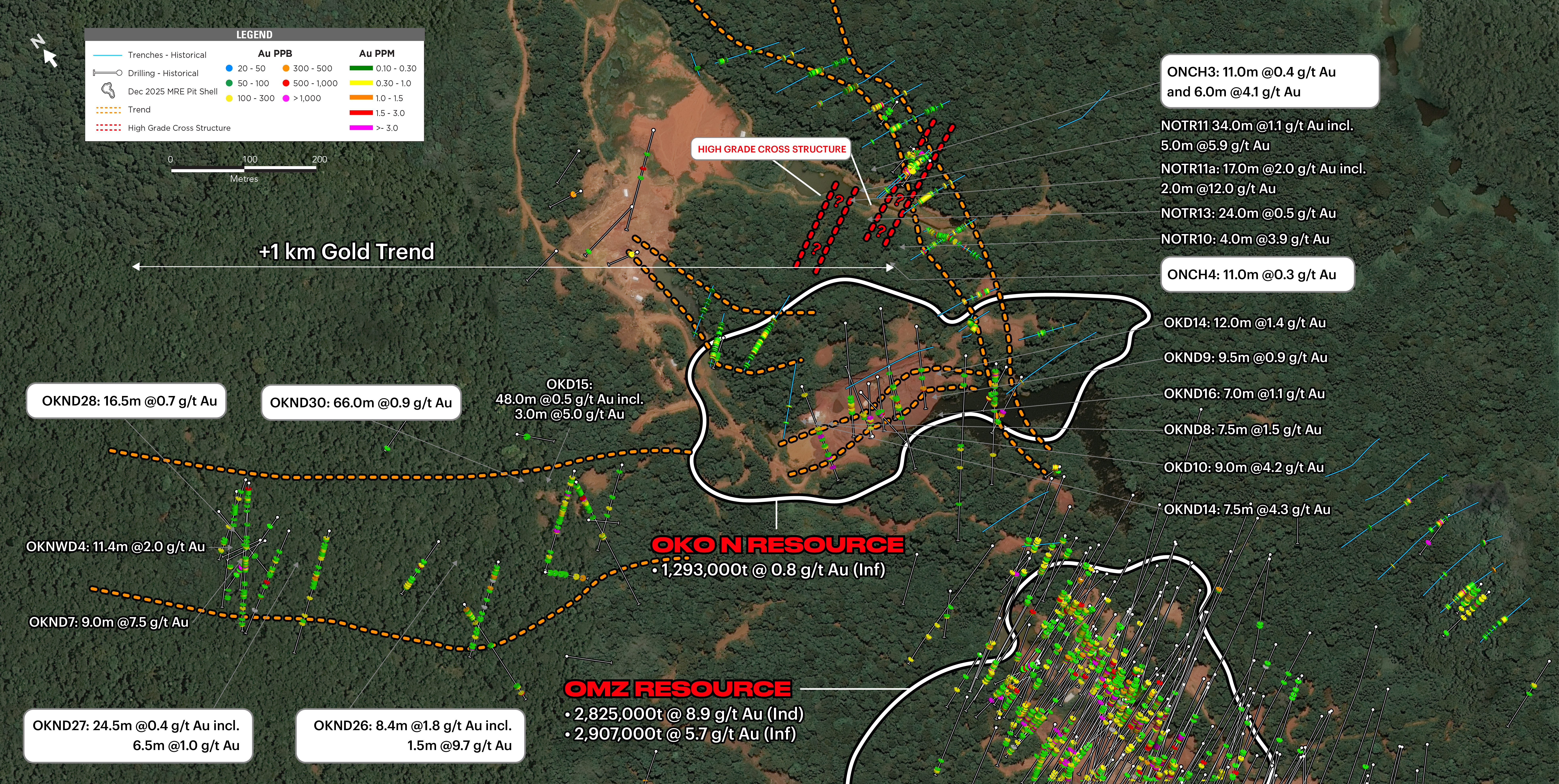
- Drilling and trenching immediately north of the high-grade OMZ resource delivers significant oxide intercepts, including: 66m @ 0.9 g/t Au (OKND 30) and 6m @ 4.1 g/t Au (trench ONCH 3)
- New discovery at the “Sands” target area delivers near-surface, oxidized drill intercepts, including: 24m @ 2.5 g/t Au (NWOD 70), 5m @ 4.8 g/t Au (NWOD 69), and 21.4 m @ 0.5 g/t Au (NWOD 75)
TORONTO, Feb. 11, 2026 (GLOBE NEWSWIRE) — G2 Goldfields Inc. (“G2” or the “Company”) (TSX: GTWO; OTCQX: GUYGF) is pleased to provide an update on the Company’s high-grade OKO Gold Project (“Oko” or the “Project”), Guyana, including a 100,000-meter drilling campaign and new gold discoveries located outside existing mineral resources.
The Company recently published a Preliminary Economic Assessment for the OKO Project, which outlined the potential for the construction and development of a 10,000 tonne-per-day gold mining operation with total production of 3.2 million ounces of gold at all-in sustaining costs¹ of US$1,232 per ounce over a 14-year mine life (see report titled “NI 43-101 Technical Report for the Preliminary Economic Assessment (PEA) on the Oko Gold Project in the Co-operative Republic of Guyana, South America”, available on SEDAR+).
G2 continues to actively expand the Project through; (i) drilling extensions to known gold mineralisation along the +15km OKO trend, and (ii) drilling new greenfields discoveries along the rapidly developing 20km Aremu gold trend, where the Company has made several new gold discoveries (refer to Figure 1).
Corporate Update
During 2026, the Company’s exploration campaigns will run in parallel with early works programs, as well as ongoing environmental and geotechnical studies, to further define and de-risk the mining operation, with the objective of completing a Feasibility Study and formal construction decision by mid-2027.
At present, G2 has two drilling contractors on site with six fully operational drill rigs. Two additional drill rigs are expected to be added next month to expedite the ongoing programs. Currently, four rigs are committed to resource expansion and exploration, and two rigs are devoted to upgrading and converting Inferred mineral resources to Indicated mineral resources for inclusion in the forthcoming Feasibility Study. The current 100,000-meter drill program supporting these deliverables is expected to be completed by year-end.
Figure 1 – Oko-Aremu Gold Trend District Map
Exploration Update
G2 Goldfields continues to see considerable exploration success, further establishing the Oko Project both as a top-tier existing gold resource and a world-class gold exploration camp with significant upside potential. Ongoing drilling has confirmed the continuation of meaningful gold mineralization down-plunge of existing resources (see press release dated January 6, 2026), while greenfields exploration programs continue to generate new discovery success. At Oko North, diamond drill hole OKND 30 intercepted 66m @ 0.9 g/t Au from 25.5 meters downhole. In addition, discrete higher-grade intercepts at surface have been identified, including 6m @ 4.1 g/t Au from trench ONCH 3 in an exposed quartz vein system at surface (see Figure 2).
Figure 2 – OMZ North Drilling Area
Additionally, G2 exploration teams conducted a modest reconnaissance drilling program in late 2025 in the Sands exploration area, located 4km northwest of the main Oko gold resource (see Figure 3). The Sands area, which is part of a broader 20km Aremu trend, has been the subject of widespread gold mining. This initial 1,513-meter drill program was successful in the discovery of a new, near surface gold discovery at the Oko Project, with shared geological characteristics with the high-grade OMZ deposit. Significant intercepts from the 11-hole program are outlined in Table 1 and are associated with the sheared contact between the strongly bleached volcanic rocks and carbonaceous mudstones, as is the case at the OMZ resource. The initial drilling targeted an interpreted shear zone and was successful in establishing a 200-meter strike length of intense shearing. This zone hosts laminated, textured quartz reefs containing fine visible gold grains, as recorded in the high-grade intercepts from holes NWOD 69 and NWOD 70. Encouragingly, multiple gold-in-soil anomalies exceeding 500 ppb Au have been identified up to 350 meters along strike to the east of the discovery area. Complete results for the Sands reconnaissance program are available here.
Table 1 – Sands Discovery Drilling Results
| DRILL HOLE |
FROM (METRES) |
TO (METRES) |
INT. (METRES) |
GRADE (G/T AU) |
GRADE x DH WIDTH |
| NWOD 69 | 40.5 | 45.5 | 5.0 | 4.8 | 24.2 |
| Incl. | 41.4 | 42.0 | 0.6 | 31.9 | 19.1 |
| NWOD 70 | 37.0 | 61.0 | 24.0 | 2.5 | 59.9 |
| Incl. | 37.0 | 41.0 | 4.0 | 12.8 | 51.7 |
| NWOD 70 | 180.0 | 181.0 | 1.0 | 3.0 | 3.0 |
| NWOD 70 | 254.4 | 255.8 | 1.4 | 1.8 | 2.5 |
| NWOD 75 | 101.1 | 122.5 | 21.4 | 0.5 | 11.1 |
Notes to Table 1: Insufficient drilling has been completed to determine true widths at the sands target area.
Figure 3 – OMZ North, Oko NW and Sands Discovery

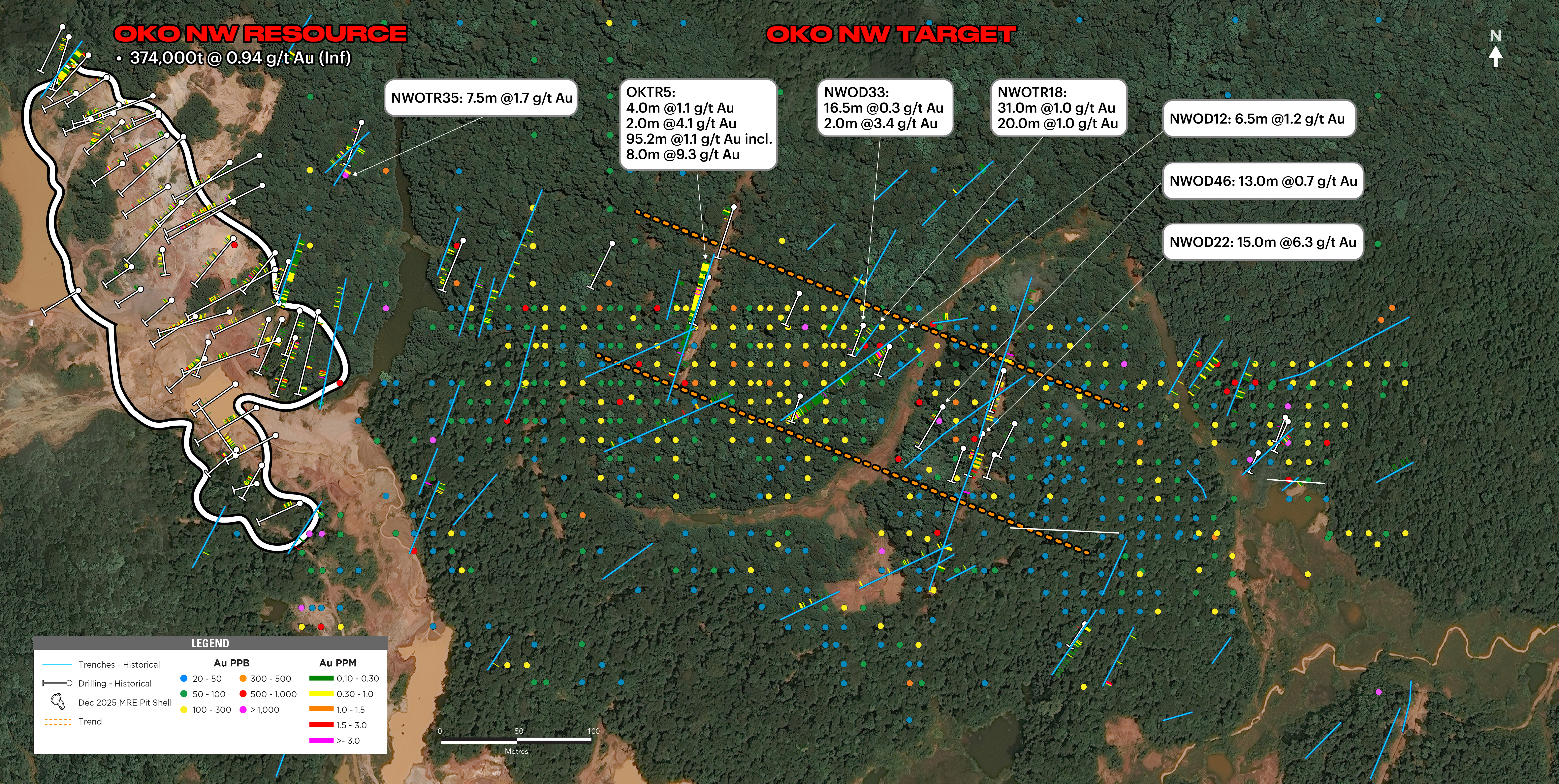
Another area within the Aremu trend that will be a focus of drilling in the first quarter is the Oko NW area (Figure 4), which currently hosts a modest oxide resource. Reinterpretation of possible geological controls has resulted in a new drill program focused on the central portion of the district, where previous drilling and trenching identified significant potential for further follow-up. Notably, trench OKTR 5 returned 95.2m @ 1.1 g/t Au including 8m @ 9.3 g/t Au, and drill hole NWOD 22, located approximately 200 meters southeast of OKTR 5, intercepted 15m @ 6.3 g/t Au. Both intercepts occurred within highly oxidized material.
Figure 4 – Oko NW Target
Dan Noone, G2 CEO, stated “As we continue to advance the OKO Project towards production, our focus remains on aggressive drilling to further grow and upgrade the Project’s gold resource base. Recent results and discovery success continue to demonstrate the remarkable exploration potential and significant remaining upside across the Oko District.”
Endnotes
- All references to “All-in sustaining costs”, is a non-GAAP financial measure. This measure is intended to provide additional information to investors. It does not have any standardized meanings under IFRS®, and therefore may not be comparable to other issuers and should not be considered in isolation or as a substitute for measures of performance prepared in accordance with IFRS®. Refer to the Non-GAAP Financial Measures section of this document. “AISC” are calculated inclusive of open pit and underground mining costs; treatment, transport and refining costs; processing and surface costs; G&A, royalties and other costs, sustaining capital expenses to support the on-going operations, and closure/reclamation costs. This metric is calculated on a payable gold ounce basis.
QA/QC
Drill core is logged and sampled in a secure core storage facility located on the Project site, Guyana. Core samples from the program are cut in half, using a diamond cutting saw, and are sent to MSALABS Guyana, in Georgetown, Guyana, which is an accredited mineral analysis laboratory, for analysis. Samples from sections of core with obvious gold mineralisation are analysed for total gold using an industry-standard 500g metallic screen fire assay (MSALABS method MSC 550). All other samples are analysed for gold using standard Fire Assay-AA with atomic absorption finish (MSALABS method; FAS-121). Samples returning over 10.0 g/t gold are analysed utilizing standard fire assay gravimetric methods (MSALABS method; FAS-425). Certified gold reference standards, blanks, and field duplicates are routinely inserted into the sample stream, as part of G2 Goldfield’s QA/QC program. No QA/QC issues were noted with the results reported herein.
About G2 Goldfields Inc.
G2 Goldfields finds and develops gold deposits in Guyana. The founders and principals of the Company have been directly responsible for the discovery of more than 11 million ounces of gold in the prolific and underexplored Guiana Shield. G2 continues this legacy of exploration excellence and success. Total combined open pit and underground resources across all 5 discoveries to date include:
- 1,910,300 oz. Au – Inferred contained within 17,970,000 tonnes @ 3.31 g/t Au
- 1,620,600 oz. Au – Indicated contained within 15,571,000 tonnes @ 3.24 g/t Au
The mineral resource was prepared by Micon International Limited with an effective date of November 20, 2025. The Oko district has been a prolific alluvial goldfield since its initial discovery in the 1870s, and modern exploration techniques continue to reveal the considerable potential of the district.
All scientific and technical information in this news release has been reviewed and approved by Dan Noone (CEO of G2 Goldfields Inc.), a “qualified person” within the meaning of National Instrument 43-101. Mr. Noone (B.Sc. Geology, MBA) is a Fellow of the Australian Institute of Geoscientists.
Additional information about the Company is available on SEDAR+ (www.sedarplus.ca) and the Company’s website (www.g2goldfields.com).
On behalf of the Board of G2 Goldfields Inc.
“Daniel Noone”
CEO & Director
For Further Information
Jacqueline Wagenaar, VP Investor Relations
Direct: +1.416.628.5904 x.1150
Email: [email protected]
Cautionary Notes and Forward-Looking Statements
This news release contains certain forward-looking statements, including, but not limited to, statements about the PEA and MRE, the estimated total production, AISC, the advancement of the Project towards permitting and production, 100,000-metre drilling program, environmental and geotechnical studies to further define and de-risk the mining operation, completion of a Feasibility Study and formal construction decision by mid-2027, exploration programs and expected drill rigs to be in operation and expectations regarding the Company’s business and the Project. Wherever possible, words such as “may”, “will”, “should”, “could”, “expect”, “plan”, “intend”, “anticipate”, “believe”, “estimate”, “predict” or “potential” or the negative or other variations of these words, or similar words or phrases, have been used to identify these forward-looking statements. These statements reflect management’s current beliefs and are based on information currently available to management as at the date hereof.
Forward-looking statements involve significant risk, uncertainties and assumptions. Many factors could cause actual results, performance or achievements to differ materially from the results discussed or implied in the forward-looking statements, including the risk factors set out in the Company’s annual information form for the year ended May 31, 2025. These factors should be considered carefully and readers should not place undue reliance on the forward-looking statements. Although the forward-looking statements contained in this news release are based upon what management believes to be reasonable assumptions, the Company cannot assure readers that actual results will be consistent with these forward-looking statements. The Company assumes no obligation to update or revise them to reflect new events or circumstances, except as required by law.
The PEA is preliminary in nature and includes Indicated and Inferred Mineral Resources that are considered too speculative geologically to have the economic considerations applied to them that would enable them to be categorized as Mineral Reserves, and there is no certainty that the PEA will be realized.
Non-GAAP Financial Measures
G2 has included certain non-GAAP financial measures in this press release, such as AISC, which is not a measure recognized under IFRS® and does not have a standardized meaning prescribed by IFRS®. As a result, this measure may not be comparable to similar measures reported by other companies. This measure is intended to provide additional information to the user and should not be considered in isolation or as a substitute for measures prepared in accordance with IFRS®. Non-GAAP financial measures used in this press release and common to the gold mining industry are defined below. As the Project is not in production, G2 does not have historical non-GAAP financial measures or historical comparable measures under IFRS®, and therefore the foregoing prospective non-GAAP financial measures or ratios presented may not be reconciled to the nearest comparable measure under IFRS®.
All-In Sustaining Costs and All-In Sustaining Costs per Ounce
All-in sustaining costs and all-in sustaining costs per ounce are reflective of all of the expenditures that are required to produce an ounce of gold from operations. All-in sustaining costs reported in the PEA include total cash costs, sustaining capital expenditures, closure costs, but exclude corporate general and administrative costs. All-in sustaining costs per ounce is calculated as all-in sustaining costs divided by payable gold ounces. All-in sustaining Costs capture the important components of the Project’s production and related costs and are used by G2 and investors to understand projected cost performance at the Project.
Photos accompanying this announcement are available at:
https://www.globenewswire.com/NewsRoom/AttachmentNg/d73d81d7-8e8b-478f-83ea-ffe84026ac60
https://www.globenewswire.com/NewsRoom/AttachmentNg/dfc5d802-6634-4ee8-89a7-b9df773083b0
https://www.globenewswire.com/NewsRoom/AttachmentNg/69a256fd-f7dd-4ae2-b561-69cc56d640f0
https://www.globenewswire.com/NewsRoom/AttachmentNg/08ce6515-9ece-4c8d-a592-8c0ade01b0de
