
Backed by Sequoia and Welight Capital, FloatBoat turns meetings, deadlines, and routines into automated agent workflows that execute at the right time — no prompting required.
SAN FRANCISCO, May 27, 2026 (GLOBE NEWSWIRE) — Floatboat, a San Francisco-based artificial intelligence company backed by Sequoia and Welight Capital, today announced the global launch of its proactive agent operating system designed to transform calendar-driven work for busy professionals. The platform represents a fundamental shift in how AI agents interact with professional workflows – moving from reactive, prompt-dependent tools to agents that automatically prepare meeting briefs, draft follow-up emails, track deadlines, gather relevant documents, and trigger recurring workflows based on calendar context. Users remain in control, reviewing and approving before any action executes. FloatSchedule is the first core product built on the OS, with additional proactive office agents for project execution, client management, and team coordination planned for future release.
The Problem: Modern Work Is Fragmented, Reactive, and Overwhelming
For today’s professionals, managing work rarely happens in a single application or a predictable sequence. It happens across dozens of disconnected tools — a meeting scheduled in Google Calendar, notes scattered in Notion, action items buried in Slack threads, code commits tracked in GitHub, and files stored across Google Drive and local folders. The average knowledge worker switches between applications more than 1,000 times per day, losing focus, context, and productivity with every transition. Existing AI assistants require users to continuously prompt them, describe context, and manually orchestrate actions — adding yet another layer of complexity to an already fragmented workflow.
Floatboat was built to address this fundamental disconnect. Rather than asking professionals to adapt to yet another tool, the company designed an agent OS that operates inside the tools professionals already use, syncing context and taking action without requiring users to leave their existing workflows.
A Proactive Agent OS, Not Just Another Calendar App
Floatboat’s approach differs fundamentally from conventional AI productivity tools. The platform is not a standalone calendar application — it is a proactive agent operating system where Calendar serves as the first entry point. The OS connects to more than 3,500 applications and services, including Notion, Slack, GitHub, Google Drive, Linear, Figma, and local file systems, creating a unified context layer that agents use to anticipate needs and prepare work autonomously.
The key distinction is proactivity. Traditional AI tools wait for instructions. When a high-priority task is approaching and no action has been taken, Floatboat prepares the necessary context, drafts next steps, and surfaces them for review — without disrupting existing workflows. Users remain in control, with review and approval built into sensitive or high-impact actions, eliminating the need for continuous prompting or manual orchestration.
“The next generation of AI won’t wait in a chat box. It will understand your schedule, prepare work before you ask, and help you follow through at the right moment,” said Bruce Tan, founder of Floatboat.
Core Features and Capabilities
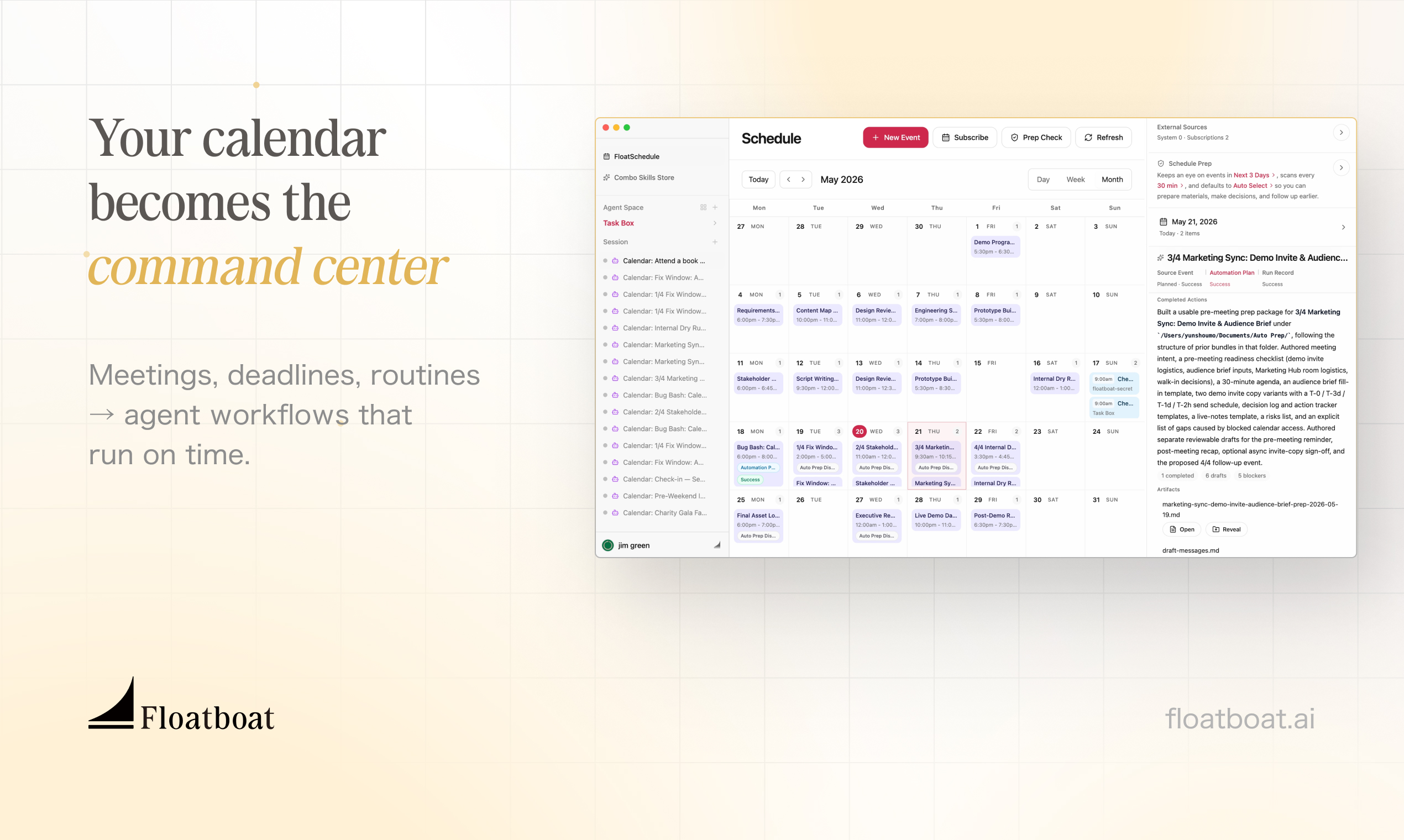
Calendar-Centered Automation serves as the foundation of Floatboat’s proactive intelligence. The system syncs multi-source calendars and uses schedule data as the primary signal for anticipating work needs. When a calendar event changes, the agents automatically adjust preparation workflows, gather relevant context from connected applications, and surface actionable insights before the user needs them.
Agent Workspace provides a centralized command center where professionals can monitor agent activity, review prepared materials, and approve or modify agent-generated outputs. The workspace is designed to give users full visibility into what agents are doing on their behalf, maintaining transparency and control without requiring constant oversight.
FloatIM is Floatboat’s built-in messaging layer — a chat interface where you talk to your AI agents the same way you message a colleague. You can bring multiple agents into one conversation to handle complex tasks together, and FloatIM remembers your full history, preferences, and prior decisions across every interaction — no need to repeat yourself or re-explain context.
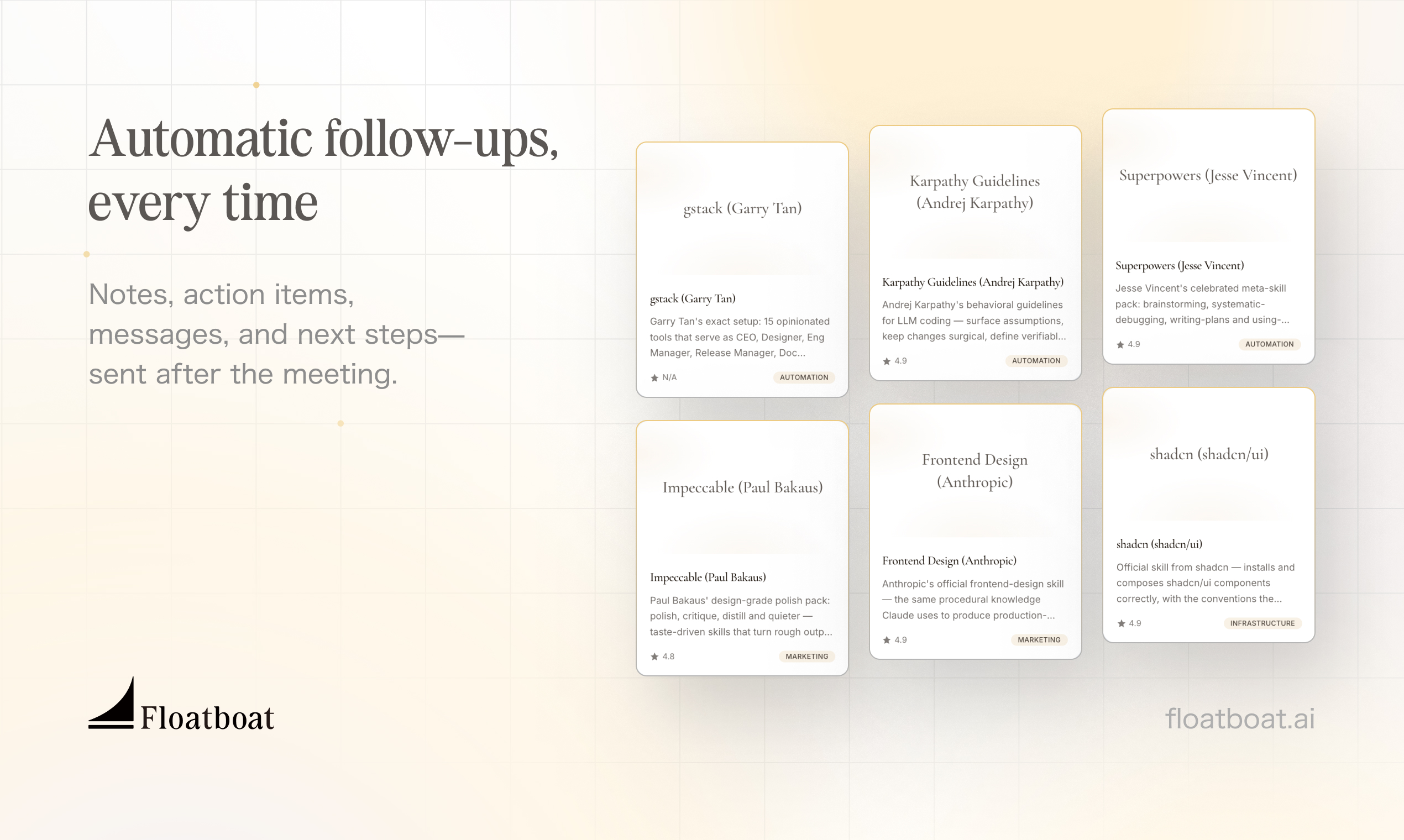
Combo Skills allow agents to chain multiple operations into sophisticated workflows. A single trigger — such as a new meeting appearing on the calendar — can initiate a sequence of actions: pulling relevant documents from Google Drive, summarizing recent Slack discussions with the meeting participants, checking GitHub for any open pull requests related to the agenda, and compiling everything into a pre-meeting briefing. These multi-step operations run autonomously, delivering completed work products rather than requiring users to orchestrate each step manually.
Multi-Model Support ensures that Floatboat is not locked into a single AI provider. The platform supports GPT, Claude, Gemini, DeepSeek, and Kimi, allowing users to leverage the strengths of different models for different tasks. This architectural decision reflects the company’s belief that the best agent OS should be model-agnostic, giving users flexibility as the AI landscape continues to evolve.
Local File Sync extends the platform’s contextual awareness beyond cloud applications. By maintaining synchronization with local file systems, Floatboat’s agents can reference documents, spreadsheets, presentations, and other materials stored on a user’s device, ensuring that no relevant context is lost simply because it exists outside of cloud-based tools.
Who Floatboat Is Built For
Floatboat is designed for any professional whose schedule drives their work. This includes managers juggling multiple direct reports and cross-functional projects, consultants managing client engagements across different organizations, students balancing coursework with extracurricular commitments and job searches, and individual contributors whose calendars dictate the rhythm of their productive output.
The platform is particularly well-suited for professionals who find themselves spending more time coordinating work than doing work — those who lose hours each week to meeting preparation, context gathering, follow-up tracking, and the administrative overhead that accumulates around a busy schedule. Floatboat’s proactive agents absorb this coordination burden, allowing users to focus their cognitive energy on high-value decision-making and creative work.
Use Case Scenarios
Consider a product manager with back-to-back meetings across three different projects. Before Floatboat, preparation meant manually checking Notion for project updates, scanning Slack channels for relevant discussions, reviewing GitHub for development progress, and compiling notes — often in the ten-minute gap between meetings. With Floatboat, the agents detect upcoming meetings from the calendar, automatically gather context from all connected tools, and deliver a comprehensive briefing that is ready for review when the user needs it.
For a consultant managing multiple client engagements, Floatboat’s agents track deliverable deadlines across different project management tools, surface relevant client communications from email and messaging platforms, and prepare status updates before scheduled check-ins. The consultant reviews and approves rather than researches and compiles.
A graduate student preparing for thesis committee meetings can rely on Floatboat to gather recent literature references from connected research tools, compile progress notes from various documents, and prepare presentation outlines based on the meeting agenda — all triggered automatically by the calendar event.
Availability and Access
Floatboat is available immediately as a desktop application for both macOS and Windows. The platform is free to try at floatboat.ai, with the global public launch today. Floatboat connects through Slack, Telegram, WeChat (Clawbot), and Feishu. The company invites professionals across all industries and roles to experience proactive agent technology and provide feedback that will shape the platform’s continued development.
See how Floatboat works: https://youtu.be/SWMIbUBfhJY
Looking Ahead: More Agents on the OS
The Calendar product represents the beginning of Floatboat’s vision for a comprehensive proactive agent OS. The company has announced plans to release additional agents focused on project execution, client management, and team coordination in the coming months. Each new agent will build upon the same foundational principles — proactive operation, integration with existing tools, and human-in-the-loop approval rather than continuous prompting.
“Calendar is where work begins for most professionals — it’s the natural starting point for a proactive agent OS,” said Judy Gao, Co-founder of Floatboat. “But the vision extends far beyond scheduling. Every aspect of professional coordination that currently requires manual effort is an opportunity for proactive agents to add value. The OS architecture is designed to support an expanding ecosystem of specialized agents that work together seamlessly.”
As professional workflows become more complex and the number of tools in the average technology stack continues to grow, Floatboat’s approach — embedding intelligence inside existing workflows rather than creating new ones — positions the company to address a fundamental and growing need in the modern workplace. By handling preparation, context gathering, and routine follow-through, Floatboat helps professionals reclaim time for higher-value decisions and execution.
Experience the future of calendar-driven work. Try Floatboat for free at floatboat.ai.
About Floatboat
Floatboat is a proactive agent OS for calendar-driven work. Founded in 2025 and headquartered in San Francisco, Floatboat is backed by Sequoia and Welight Capital.
For more information, please visit floatboat.ai or follow Floatboat on social media:
• X (Twitter)
• LinkedIn
• YouTube
Media Contact
Floatboat Team
Email: [email protected]
Website: floatboat.ai
Photos accompanying this announcement are available at
https://www.globenewswire.com/NewsRoom/AttachmentNg/da23665c-2391-418f-b751-dcac61cefc78
https://www.globenewswire.com/NewsRoom/AttachmentNg/8dbd8250-1512-4e4f-950d-eb52db3b0b28
https://www.globenewswire.com/NewsRoom/AttachmentNg/c58a32ee-bb12-4bd1-8da1-0021d0c276b0
