
DIVEVOLK SeaLink equipment arranged beside the vivo S60 production pool. Production still supplied by DIVEVOLK.
ZHUHAI, China, July 22, 2026 (GLOBE NEWSWIRE) — DIVEVOLK today shared a behind-the-scenes production case from vivo S60’s Starlight Luggage, where director Li Zitao and the underwater camera team used the DIVEVOLK SeaLink system to carry real-time instructions between the surface and the underwater crew.
In a post-shoot interview, Li described the communication workflow as a major change from traditional underwater production. Without it, the crew would have needed to move repeatedly between the pool and the deck to review instructions. The production used a separate on-set monitor for the underwater picture; SeaLink did not provide that monitor feed. Its role was to carry Li’s spoken adjustments across the waterline while the team remained in position.
A Short Breath-Hold Window, a Complex Shot
The underwater performance placed tight limits on every take. According to Li, the performer could generally remain underwater for one to two minutes at a time. Within that window, the team had to coordinate body movement, camera position, camera travel, and the timing of individual gestures.
“Without real-time communication, the camera operator and performer would largely have to rely on feel,” Li said. “For special shots that need dynamic adjustment – the timing of a turn, the camera path, or a precise action at a specific moment – communication is essential.”
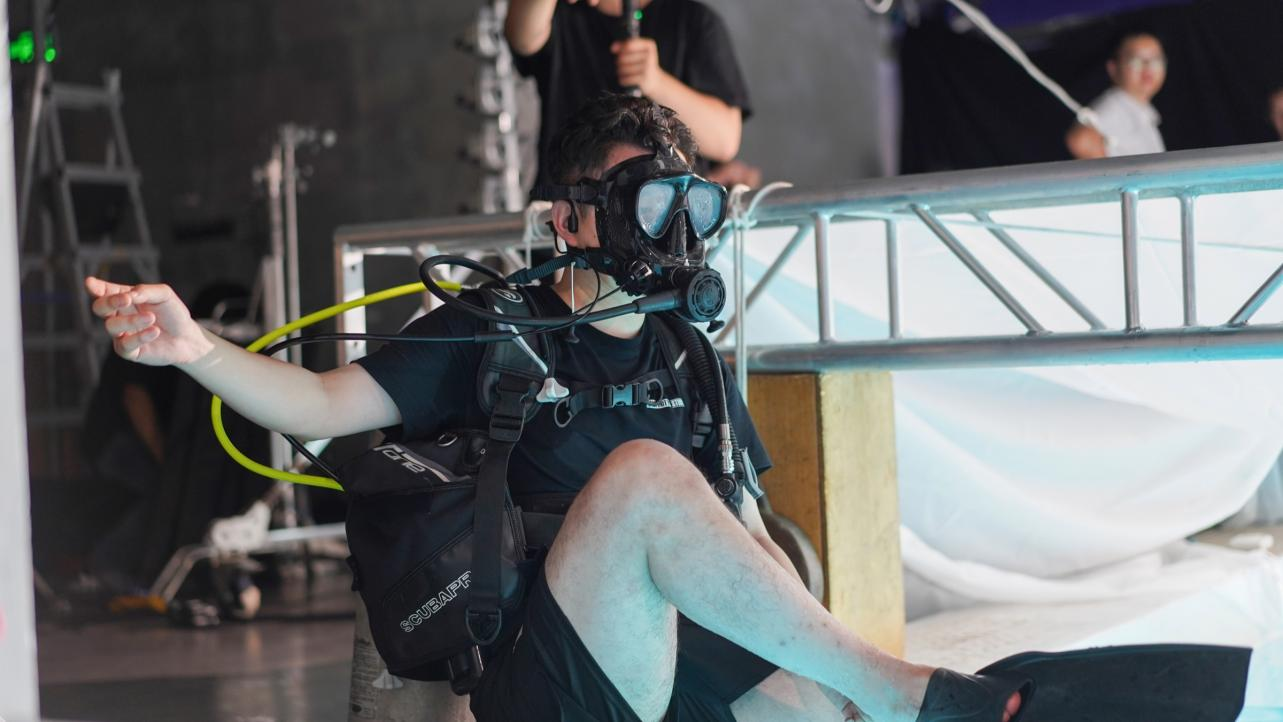
An underwater camera operator prepares beside the pool during the Starlight Luggage production. Production still supplied by DIVEVOLK.
Traditional hand signals remain useful for standard underwater instructions, but they cannot carry the full vocabulary of film direction. SeaLink gave the production a channel for more specific cues while the team was still in position.
From Four or Five Attempts to One or Two
Li said a shot using a conventional stop-and-brief workflow could require four or five attempts. During this production, the SeaLink-assisted workflow often allowed the team to reach the intended result in one or two.
“This was more than doubling efficiency,” Li said. “It made the whole creative process controllable and predictable.”
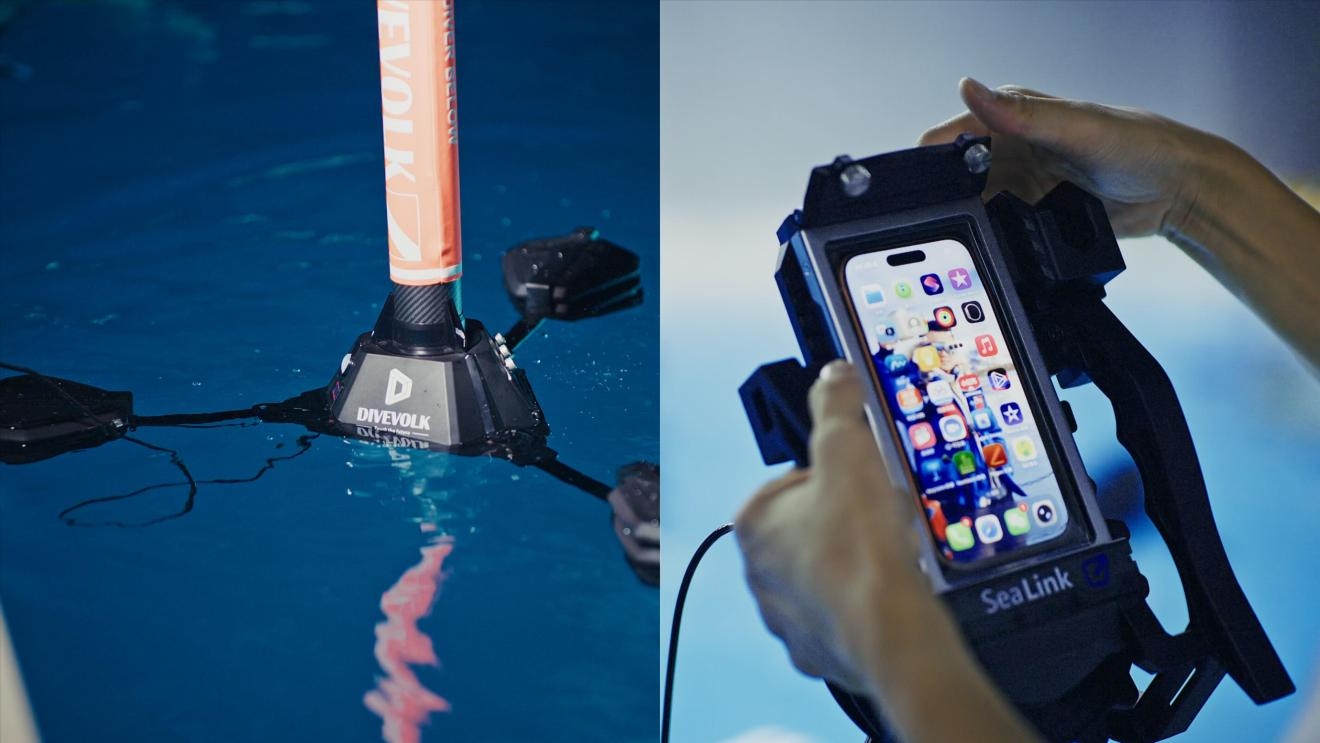
The reduction in repeated attempts also helped the crew manage physical effort. Underwater performers and camera operators spend energy on every reset, even before the camera starts rolling. Clearer direction allowed the production to use that energy on refinement rather than unnecessary repetition.
From a Separate Monitor to an Immediate Underwater Direction
The production’s separate monitor allowed Li to see the underwater image, while SeaLink provided the communication path for acting on what he saw. The two functions were distinct: SeaLink was used for cross-waterline communication, not picture monitoring.
While performer movement was largely designed in advance, Li continued to adjust camera position and motion after seeing the image on the production monitor.
At one moment, he recalled giving an immediate instruction: “Push in, circle from a low angle.” The team could act on the idea without surfacing for a new briefing or trying to translate a complex movement into hand signals.

A production monitor shows the underwater performance while the crew adjusts the camera workflow. Production still supplied by DIVEVOLK.
“It became a process of seeing, thinking, and speaking immediately,” Li said. “That kind of creative rhythm and freedom was almost impossible in my previous underwater shoots.”
A Communication Layer for Professional Underwater Work
SeaLink did not replace production planning, trained underwater operators, performer preparation, water-safety supervision, or the production’s separate monitoring system. In this shoot, its function was limited to real-time communication between the surface and the underwater team.
For commercial production teams, that distinction is central. The value of a connected underwater workflow is not simply that a signal reaches the surface. It is that the director, camera operator, performer, and deck crew can remain part of the same decision cycle while time, breath-hold capacity, lighting, and set position are limited.
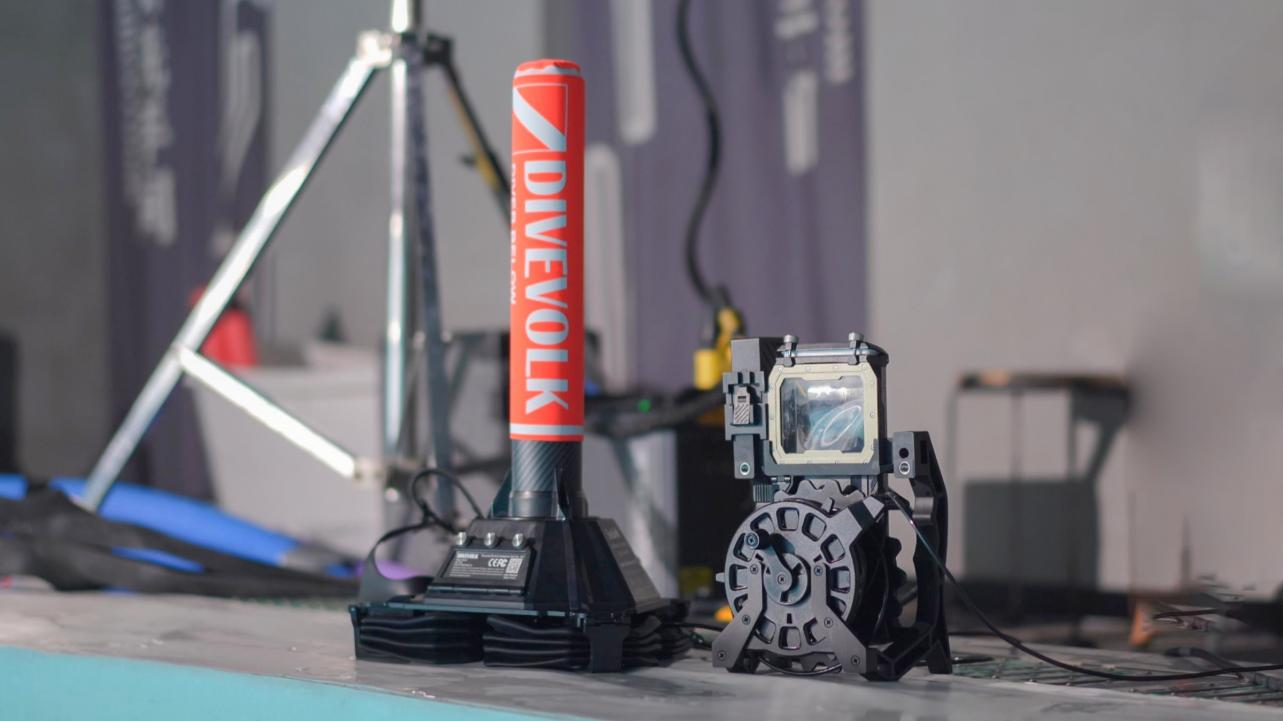
The SeaLink surface buoy and underwater terminal stand ready on the pool deck. Production still supplied by DIVEVOLK.
Quote from DIVEVOLK
“The Starlight Luggage production shows what real-time underwater communication can change: not the director’s vision, but the time between seeing an idea and putting it into action. SeaLink helps keep underwater work connected to the wider production instead of isolating it below the surface.”
After the shoot, Li said he would prioritize a real-time communication system for future underwater productions. He also described smartphone-based monitoring or shooting as a possible option for future projects, not as a picture-monitoring function used by SeaLink during this production.
“This system has shown me new possibilities for underwater creation,” he said. “Whenever conditions allow, I will include it in the standard setup.”
Pairing vivo S60 With DIVEVOLK SeaTouch Underwater Housings
Separate from SeaLink’s communication role on this production, the standard vivo S60 can be paired with DIVEVOLK’s SeaTouch housing line for underwater smartphone photography and video. DIVEVOLK’s compatibility materials list the vivo S60 for use with SeaTouch 4 Max, SeaTouch 4 Max Plus, and SeaTouch 4 Max Platinum.
The vivo S60 source materials describe a 50MP Sony main camera with gimbal-level optical stabilization, a 50MP Sony periscope telephoto camera with OIS, a 110-degree ultra-wide camera, and video recording up to 4K. Inside a SeaTouch housing, users retain access to the phone’s touchscreen camera interface, allowing them to change modes and framing underwater instead of treating the phone as a fixed-action camera.
Although the vivo S60 series carries IP68 and IP69 durability ratings, those ratings are not a substitute for a dedicated dive housing. A SeaTouch housing provides the physical protection and underwater control interface required for repeated snorkeling, pool, and dive use. This compatibility note describes a separate smartphone imaging setup; it does not mean SeaLink supplied the picture-monitoring feed during the Starlight Luggage shoot.

Production crew reviews underwater footage beside the pool set during vivo S60’s Starlight Luggage shoot. Production still supplied by DIVEVOLK.
About “Starlight Luggage” and Director Li Zitao
Starlight Luggage is a vivo S60 visual production featuring a breath-hold pool performance directed by Li Zitao and insfinity studio. Li is a director with experience working across multiple underwater shooting scenarios. In the supplied interview, he noted that he is not a full-time professional underwater cinematographer, but that his previous underwater production experience had made him familiar with the time and physical effort lost when a team must repeatedly surface to communicate.
On Starlight Luggage, Li’s direction covered performer movement, camera position, camera travel, and the timing of actions within short underwater takes. This release focuses on the workflow documented in his July 2026 interview and in supplied behind-the-scenes materials. The English title is a descriptive translation of the original Chinese title.
About DIVEVOLK
DIVEVOLK, headquartered in Zhuhai, China, is a global technology company specializing in underwater smartphone housings and diving accessories. The company designs and manufactures the SeaTouch 4 Max series of underwater smartphone housings and related accessories for diving, snorkeling, and underwater imaging.
The revolutionary SeaLink Underwater Smartphone Data Transmitter enables phones to receive signals at depths of up to 30 meters underwater, supporting features such as live streaming and video communication across multiple platforms. DIVEVOLK was honored as ScubaLab’s Best Buy in 2024 and twice won the German dive award for Innovation, in 2024 and 2026.
DIVEVOLK products are sold worldwide through https://divevolkdiving.com/ and authorized retailers. The company is committed to making underwater image creation affordable and accessible to every diver, marine researcher, and ocean communicator, and to advancing the technology that enables it.
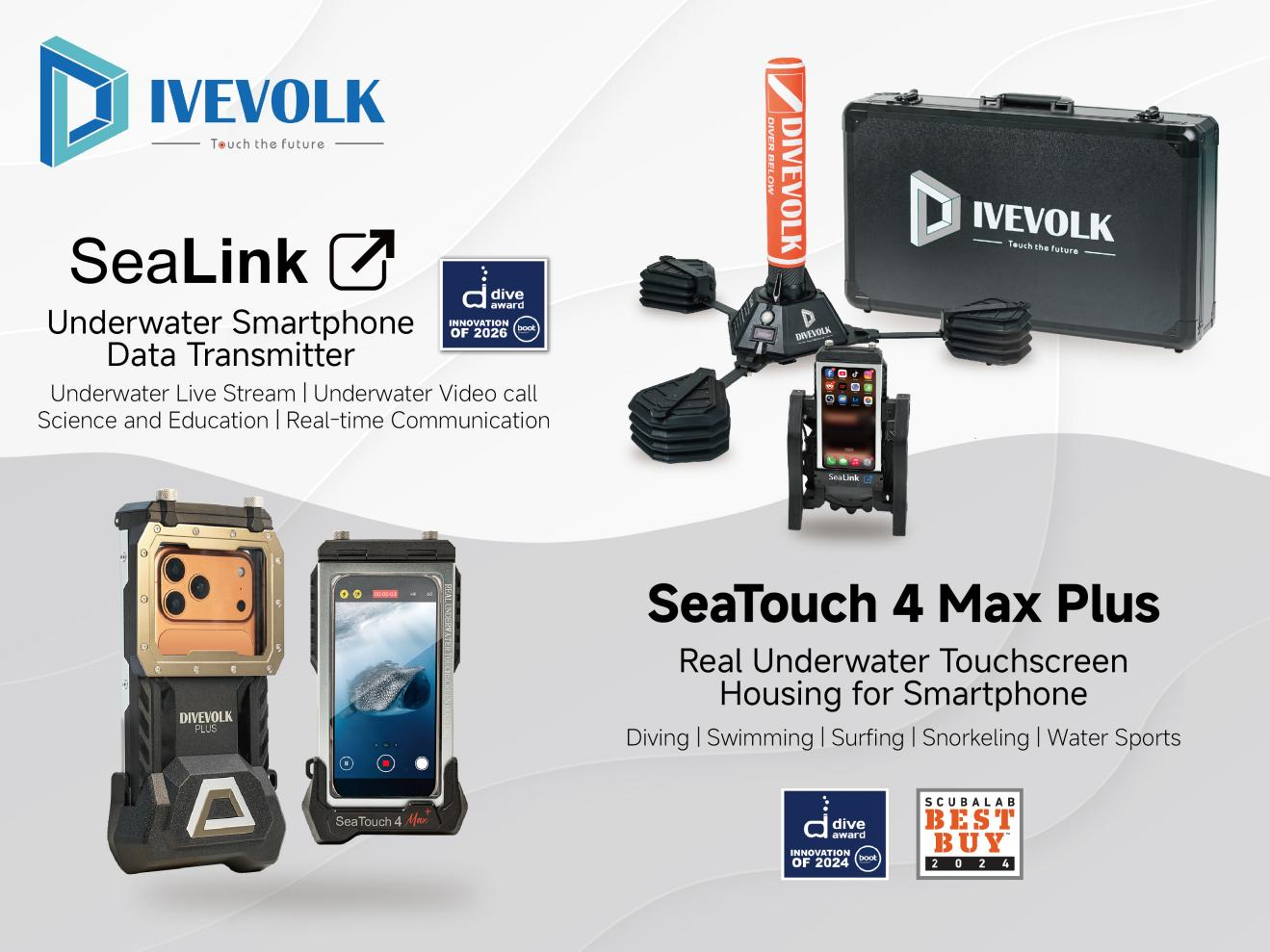
DIVEVOLK SeaLink Underwater Smartphone Data Transmitter and SeaTouch 4 Max Plus underwater smartphone housing. Product image courtesy of DIVEVOLK.
Editor’s Notes
- High-resolution behind-the-scenes production stills are available with this release.
- Quotes from Li Zitao were translated from the supplied Chinese interview for international media use.
- The phone visible inside the SeaLink terminal in the supplied stills is not identified in this release.
- SeaLink was used for cross-waterline real-time communication in this production; it did not provide the production’s picture-monitoring feed.
Media Contact
DIVEVOLK Marketing & Communications
Email: [email protected]
Website: https://divevolkdiving.com/
Photos accompanying this announcement are available at https://www.globenewswire.com/NewsRoom/AttachmentNg/c346f553-e27e-40aa-b6fc-f847f48ef869
https://www.globenewswire.com/NewsRoom/AttachmentNg/ba9a4ae2-213c-4b35-9776-0e31a7623fe6
https://www.globenewswire.com/NewsRoom/AttachmentNg/4ac9bf3d-a19c-42b4-afb0-ff410bb2d64b
https://www.globenewswire.com/NewsRoom/AttachmentNg/ee316884-7b96-459a-b195-699592f55240
https://www.globenewswire.com/NewsRoom/AttachmentNg/4b266e78-b3e1-4870-8781-4a5f59297a56
https://www.globenewswire.com/NewsRoom/AttachmentNg/ac4cc401-b24d-42eb-b1a4-e17e3204dbe4
https://www.globenewswire.com/NewsRoom/AttachmentNg/ede79d14-14a8-4229-9ca7-a4f3a91f6b1f
