
Plastic Restrictions and Foodservice Demand Push Bamboo Fiber Tableware Mainstream, Unlocking Opportunities in Compostable Takeaway Products, Sustainable Design and Retail Expansion
Bamboo Fiber Tableware and Kitchenware Market
Dublin, Aug. 25, 2026 (GLOBE NEWSWIRE) — The “Bamboo Fiber Tableware and Kitchenware Market Opportunity, Growth Drivers, Industry Trend Analysis, and Forecast 2025-2035” has been added to ResearchAndMarkets.com’s offering.
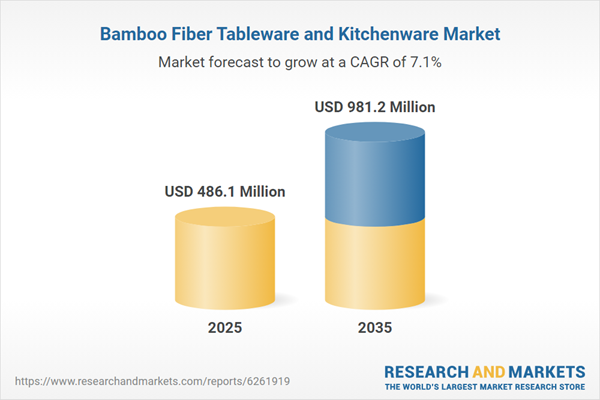
The global bamboo fiber tableware and kitchenware market was valued at USD 486.1 million in 2025 and is estimated to grow at a CAGR of 7.1% to reach USD 981.2 million by 2035.
The market is gaining momentum as governments, businesses, and consumers increasingly prioritize sustainable alternatives to conventional plastic-based products. The implementation of stricter plastic reduction policies and expanding restrictions on single-use plastics are accelerating demand for compostable and plant-based materials. Hospitality companies, foodservice operators, and catering businesses are increasingly adopting bamboo fiber products to meet changing environmental standards and consumer expectations. The growing preference for eco-friendly household products is also transforming purchasing behavior, with consumers showing greater willingness to choose products that support sustainable lifestyles. Bamboo fiber tableware and kitchenware benefit from their renewable material profile, practical performance, and suitability as alternatives to traditional disposable products. This combination of regulatory support, institutional adoption, and rising environmental awareness is positioning bamboo-based kitchen products as a mainstream category rather than a niche sustainable option.
The increasing focus on environmental responsibility is encouraging businesses and households to shift toward bio-based kitchenware solutions. Bamboo fiber products are gaining acceptance because they offer a balance of sustainability, functionality, and visual appeal. Consumer attitudes toward everyday household goods are evolving as environmental awareness continues to influence purchasing decisions. More buyers are considering the ecological impact of products and are willing to invest in alternatives that support sustainable consumption patterns. This transition is helping bamboo fiber tableware and kitchenware achieve broader adoption across different consumer groups.
The tableware segment generated USD 305.2 million in 2025 and is expected to reach USD 590.7 million by 2035. This segment represents a significant share of the market due to the regular replacement needs associated with plates, bowls, cups, and other serving products. Unlike durable kitchen equipment that is replaced less frequently, tableware experiences continuous use and higher replacement rates, creating a consistent purchasing cycle for manufacturers. Demand for sustainable disposable plates and takeaway food containers is also increasing as foodservice businesses seek alternatives that reduce environmental impact and support waste reduction initiatives.
The offline distribution segment held a 58.9% share in 2025. Physical retail continues to maintain a strong position because customers often prefer to evaluate kitchen products directly before purchase. Consumers typically want to examine important product characteristics, including material quality, weight, texture, durability, and overall construction, to ensure the product meets their expectations. The ability to physically assess products continues to support the importance of offline sales channels in this market.
The United States bamboo fiber tableware and kitchenware market captured an 81.7% share in 2025. Growth in the North American market is primarily supported by increasing consumer awareness of sustainability and the shift away from traditional single-use plastic products. Government initiatives, environmental regulations, and growing demand from foodservice operators are encouraging greater adoption of biodegradable alternatives such as bamboo-based tableware. The rising availability of sustainable household products and changing consumer preferences are further supporting market expansion across the region.
Major players operating in the global bamboo fiber tableware and kitchenware industry include Bamboozle Home, bamboo bamboo, Better Earth Eco Products, Bamboo Studio, Ekobo, Bambu Home, EcoSouLife, LEKOCH, Natural Home Brands, ChongBamboo, Fujian Huayun Bamboo & Wood Co., Ltd., Mann Bamboo Fiber Ware Co., Ltd., Oceans Republic Company Limited, Panabam Green Home Co., Ltd., Shaoneng Group Guangdong Luzhou Eco Technology, Suncha Technology Co., Ltd., The Bamboo Co, Totally Bamboo, Xenia Taler, Xiamen Homex Houseware Co., Ltd., and ZUPERZOZIAL. Companies operating in the market are focusing on product innovation, sustainable manufacturing, brand development, and distribution expansion to strengthen their presence. Manufacturers are investing in improved product designs, enhanced durability, and diversified product portfolios to address evolving consumer needs. Businesses are also expanding through online and offline retail partnerships, increasing sustainability-focused marketing efforts, and developing customized solutions for commercial and residential applications. Strategic collaborations, eco-certification efforts, and investments in efficient production processes are helping companies improve brand visibility, attract environmentally conscious customers, and build stronger positions in the competitive sustainable tableware market.
Comprehensive Market Analysis and Forecast
Industry trends, key growth drivers, challenges, future opportunities, and regulatory landscape
Competitive landscape with Porter’s Five Forces and PESTEL analysis
Market size, segmentation, and regional forecasts
In-depth company profiles, business strategies, financial insights, and SWOT analysis
Key Attributes:
| Report Attribute | Details |
| No. of Pages | 220 |
| Forecast Period | 2025 – 2035 |
| Estimated Market Value (USD) in 2025 | $486.1 Million |
| Forecasted Market Value (USD) by 2035 | $981.2 Million |
| Compound Annual Growth Rate | 7.1% |
| Regions Covered | Global |
Key Topics Covered:
Chapter 1 Methodology & Scope
1.1 Research approach
1.2 Quality Commitments
1.2.1 GMI AI policy & data integrity commitment
1.2.1.1 Source consistency protocol
1.3 Research Trail & Confidence Scoring
1.3.1 Research Trail Components
1.3.2 Scoring Components
1.4 Data Collection
1.4.1 Partial list of primary sources
1.5 Data mining sources
1.5.1 Paid sources
1.5.1.1 Sources, by region
1.6 Base estimates and calculations
1.6.1 Base year calculation for any one approach
1.7 Forecast model
1.7.1 Quantified market impact analysis
1.7.1.1 Mathematical impact of growth parameters on forecast
1.8 Research transparency addendum
1.8.1 Source attribution framework
1.8.2 Quality assurance metrics
1.8.3 Our commitment to trust
Chapter 2 Executive Summary
2.1 Industry 360 synopsis
2.2 Key market trends
2.2.1 Regional
2.2.2 Product Type
2.2.3 Usage
2.2.4 End Use
2.2.5 Distribution Channel
Chapter 3 Industry Insights
3.1 Industry ecosystem analysis
3.1.1 Supplier landscape
3.1.2 Profit margin
3.1.3 Value addition at each stage
3.1.4 Factor affecting the value chain
3.2 Industry impact forces
3.2.1 Growth drivers
3.2.1.1 Rising consumer demand for eco-friendly, biodegradable & sustainable products
3.2.1.2 Regulatory bans & restrictions on single-use plastics accelerating adoption
3.2.1.3 Growing e-commerce accessibility & online retail penetration
3.2.2 Industry pitfalls & challenges
3.2.2.1 Regulatory complexity around bamboo-melamine composite labeling
3.2.2.2 Supply chain concentration & raw material dependence on China & India
3.2.3 Opportunities
3.2.3.1 Expanding commercial food service sector in Asia-Pacific
3.2.3.2 Rising premiumization & gift market for sustainable tableware sets
3.3 Growth potential analysis
3.4 Regulatory framework
3.5 Major market trends and disruptions
3.6 Technology/innovation landscape
3.6.1 Current trends
3.6.2 Emerging trends
3.7 Pricing Analysis (driven by primary research)
3.7.1 Historical price trend analysis (driven by primary research)
3.7.2 Pricing strategy by player type (premium / value / cost-plus) (driven by primary research)
3.8 Future market trends
3.9 Trade data analysis (driven by paid database) (HS Code- 4419)
3.9.1 Import/export volume & value trends (driven by primary research)
3.9.2 Key trade corridors & tariff impact (driven by primary research)
3.10 Impact of AI & Generative AI on the Market
3.10.1 AI-driven disruption of existing business models
3.10.2 Gen-AI use cases & adoption roadmap by segment
3.10.3 Risks, limitations & regulatory considerations
3.11 Porter’s analysis
3.12 PESTEL analysis
3.13 Distribution infrastructure & channel penetration landscape (driven by primary research)
3.13.1 Channel coverage by region & format (modern vs. traditional trade) (driven by primary research)
3.13.2 Last-mile infrastructure gaps & emerging channel shifts (driven by primary Research).
3.14 Consumer behavior analysis
3.14.1 Purchasing patterns
3.14.2 Preference analysis
3.14.3 Regional variations in consumer behavior
3.14.4 Impact of e-commerce on buying decisions
Chapter 4 Competitive landscape, 2025
4.1 Introduction
4.2 Company market share analysis
4.2.1 by region
4.2.1.1 North America
4.2.1.2 Europe
4.2.1.3 Asia-Pacific
4.2.1.4 Latin America
4.2.1.5 Middle East and Africa
4.3 Company matrix analysis
4.4 Competitive analysis of major market players
4.5 Competitive positioning matrix
4.6 Key developments
4.6.1 Mergers & acquisitions
4.6.2 Partnerships & collaborations
4.6.3 New product launches
4.6.4 Expansion plans
Chapter 5 Market Estimates & Forecast, by Product Type, 2022-2035 (USD Million, Thousand Units)
5.1 Key trends
5.2 Tableware
5.2.1 Plates
5.2.2 Bowls
5.2.3 Cups & mugs
5.2.4 Trays
5.2.5 Others (cutlery, chopsticks, etc.)
5.3 Kitchenware
5.3.1 Cooking utensils
5.3.2 Storage containers
5.3.3 Cutting boards
5.3.4 Others (mixing bowls, etc.)
Chapter 6 Market Estimates & Forecast, by Usage Type, 2022-2035 (USD Million, Thousand Units)
6.1 Key trends
6.2 Reusable
6.3 Disposable
Chapter 7 Market Estimates & Forecast, by End Use, 2022-2035 (USD Million, Thousand Units)
7.1 Key trends
7.2 Residential
7.3 Commercial
7.3.1 Hotels & restaurants
7.3.2 Cafes
7.3.3 Catering services
7.3.4 Others (event services, institutional use, etc.)
Chapter 8 Market Estimates & Forecast, by Distribution Channel, 2022-2035 (USD Million, Thousand Units)
8.1 Key trends
8.2 Online
8.2.1 E-Commerce
8.2.2 Company website
8.3 Offline
8.3.1 Supermarkets/Hypermarkets
8.3.2 Specialty Stores
8.3.3 Others (Individual stores, Departmental stores, etc.)
Chapter 9 Market Estimates & Forecast, by Region, 2022-2035 (USD Million, Thousand Units)
9.1 Key trends
9.2 North America
9.2.1 U.S.
9.2.2 Canada
9.3 Europe
9.3.1 Germany
9.3.2 UK
9.3.3 France
9.3.4 Spain
9.3.5 Italy
9.4 Asia-Pacific
9.4.1 China
9.4.2 Japan
9.4.3 India
9.4.4 Australia
9.4.5 South Korea
9.5 Latin America
9.5.1 Brazil
9.5.2 Mexico
9.5.3 Argentina
9.6 MEA
9.6.1 South Africa
9.6.2 Saudi Arabia
9.6.3 UAE
Chapter 10 Company Profiles
10.1 Global Companies
10.1.1 Bambu Home
10.1.1.1 Business Overview
10.1.1.2 Financial Data
10.1.1.3 Product Landscape
10.1.1.4 Strategic Outlook
10.1.1.5 SWOT Analysis
10.1.2 EcoSouLife
10.1.3 Ekobo
10.1.4 Suncha Technology Co., Ltd.
10.1.5 Totally Bamboo
10.1.6 ZUPERZOZIAL
10.2 Regional Companies
10.2.1 Better Earth Eco Products
10.2.2 Bamboo Studio
10.2.3 Fujian Huayun Bamboo & Wood Co., Ltd.
10.2.4 LEKOCH
10.2.5 Mann Bamboo Fiber Ware Co., Ltd.
10.2.6 Natural Home Brands
10.2.7 Oceans Republic Company Limited
10.2.8 Shaoneng Group Guangdong Luzhou Eco Technology
10.2.9 Xiamen Homex Houseware Co., Ltd.
10.3 Emerging Companies
10.3.1 Bamboozle Home
10.3.2 bamboo bamboo
10.3.3 ChongBamboo
10.3.4 Panabam Green Home Co., Ltd.
10.3.5 The Bamboo Co
10.3.6 Xenia Taler
For more information about this report visit https://www.researchandmarkets.com/r/5fnlzl
About ResearchAndMarkets.com
ResearchAndMarkets.com is the world’s leading source for international market research reports and market data. We provide you with the latest data on international and regional markets, key industries, the top companies, new products and the latest trends.
Attachment
- Bamboo Fiber Tableware and Kitchenware Market
CONTACT:
CONTACT: ResearchAndMarkets.com
         Laura Wood,Senior Press Manager
         [email protected]
         For E.S.T Office Hours Call 1-917-300-0470
         For U.S./ CAN Toll Free Call 1-800-526-8630
         For GMT Office Hours Call +353-1-416-8900
