
The global onshore wind market is forecast to grow from USD 132.47 billion in 2026 to USD 321.14 billion by 2035, registering a 10.3% CAGR. Growth is driven by renewable energy targets, decarbonization policies, energy security concerns and advances in high-capacity turbines, AI-based maintenance, digital twins and battery storage. The report analyzes components, turbine ratings and regions, highlighting electrical infrastructure, 2–3 MW turbines and Europe. It also profiles leading onshore wind companies, including Vestas, Siemens Energy, Goldwind, Mingyang Smart Energy and GE Vernova.
Onshore Wind Market
Dublin, Aug. 31, 2026 (GLOBE NEWSWIRE) — The “Onshore Wind Market by Component, By Turbine Rating and Region – Global Forecast to 2035” has been added to ResearchAndMarkets.com’s offering.
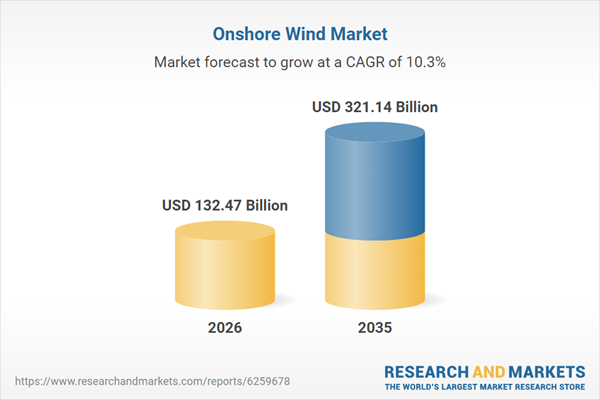
The global onshore wind market is projected to expand from an estimated USD 132.47 billion in 2026 to USD 321.14 billion by 2035, registering a compound annual growth rate of 10.3% during the forecast period. Growth is supported by accelerating renewable energy generation, energy security concerns, global decarbonization targets, and government policies promoting clean power deployment.
Onshore wind remains one of the most cost-competitive and scalable renewable energy technologies, benefiting from mature equipment, competitive generation costs, and shorter project development timelines compared with many alternative power sources. Governments and utilities are increasing investment as countries transition toward low-carbon energy systems and seek to reduce dependence on imported fossil fuels.
Technology Advancements Strengthen Onshore Wind Project Performance
Product innovation is improving energy output, operating efficiency, and long-term project economics. Manufacturers are introducing next-generation onshore wind turbines exceeding 5 MW, supported by larger rotor diameters, taller hub heights, longer lightweight composite blades, and advanced drivetrain technologies. These systems can maximize power generation across a wider range of wind conditions.
Digitalization is also reshaping wind farm operations. AI-enabled predictive maintenance, digital twins, condition-monitoring systems, real-time asset monitoring, and performance analytics help operators reduce downtime, optimize output, extend turbine life, and lower operating costs. These capabilities are particularly important for utility-scale wind farms and repowering projects.
Repowering aging wind farms and integrating battery energy storage systems are creating additional opportunities by increasing project productivity and improving grid reliability. However, lengthy permitting procedures, land acquisition complexities, high capital expenditure, transmission infrastructure gaps, grid integration constraints, and local community opposition may delay project execution and increase development costs.
Electrical Infrastructure to Hold the Second-Largest Component Share
By component, electrical infrastructure is expected to represent the second-largest segment of the onshore wind market during the forecast period. Expanding wind capacity is increasing demand for substations, transformers, switchgear, cables, high-voltage transmission networks, and reliable grid interconnection systems.
Grid modernization programs and smart grid deployment are further supporting this segment. High-capacity turbines and utility-scale wind farms require robust electrical infrastructure to manage larger volumes of renewable electricity, maintain stable power delivery, and support long-term operational efficiency.
2-3 MW Turbine Segment to Record the Third-Fastest Growth
By turbine rating, the 2-3 MW segment is projected to register the third-fastest growth through 2035. These turbines offer a strong balance of performance, cost, and deployment flexibility, making them suitable for moderate wind resources and projects where land availability or grid capacity limits the installation of larger turbines.
The 2-3 MW category is widely adopted in emerging markets, distributed utility-scale installations, and projects led by medium-sized developers. Lower upfront investment requirements, attractive returns, and continued upgrades of older wind farms are expected to support steady segment expansion.
Europe Positioned as the Second-Largest Regional Market
Europe is estimated to account for the second-largest share of the global onshore wind market during the forecast period. Germany, Spain, the UK, France, Sweden, and Italy continue to invest in capacity expansion through competitive auctions, energy transition programs, and supportive renewable power policies.
The region benefits from an established ecosystem of turbine manufacturers, project developers, grid companies, and engineering service providers. Deployment of high-capacity turbines, repowering of existing wind farms, battery energy storage, digital platforms, smart grids, and expanded transmission infrastructure will strengthen regional market growth.
The European Green Deal, REPowerEU program, and country-level renewable energy objectives are expected to stimulate additional investment in onshore wind farm development while supporting energy security and carbon emissions reduction.
Competitive Landscape
Major onshore wind market participants include Siemens Energy, Ming Yang Smart Energy Group Co., Ltd., Vestas, Goldwind Science & Technology Co., Ltd., and GE Vernova. The competitive assessment also covers SANY Renewable Energy Co., Ltd., Suzlon Energy Ltd., Doosan Enerbility, Dongfang Electric Wind Power Co. Ltd., Envision Energy, Windey Energy Technology Group Co., Ltd., Nordex SE, Shanghai Electric Wind Power Group, CRRC Shandong Wind Power, Hitachi Energy Ltd., ABB, Prysmian Group, Schneider Electric, Inox Wind, Senvion India, ENERCON Global GmbH, and Vayona Energy Pvt. Ltd.
The study evaluates company profiles, market shares, service offerings, growth strategies, product launches, and recent industry developments. Competitive activity is increasingly focused on high-capacity turbine platforms, advanced grid technologies, digital asset management, repowering services, and solutions that improve energy yield while reducing lifecycle costs.
Research Coverage and Methodology
The report defines, analyzes, and forecasts the global onshore wind market by component, turbine rating, and region. It provides qualitative and quantitative analysis of market value, competitive conditions, future trends, growth drivers, restraints, opportunities, and challenges. Coverage also includes product and service innovation, untapped geographies, market diversification, and regional development opportunities.
Primary research included in-depth interviews with key industry participants, subject-matter experts, C-level executives, directors, consultants, sales managers, engineers, and regional managers. Interview distribution was as follows:
- By company type: Tier 1, 45%; Tier 2, 30%; and Tier 3, 25%.
- By designation: C-level executives, 35%; directors, 25%; and other industry professionals, 40%.
- By region: Asia Pacific, 35%; Europe, 30%; North America, 17%; South America, 10%; and the Middle East & Africa, 8%.
Company tiers were classified using 2025 revenue: Tier 1 companies generated more than USD 1 billion, Tier 2 companies generated USD 500 million to USD 1 billion, and Tier 3 companies generated less than USD 500 million.
Key Report Benefits
- Analysis of renewable energy targets, government incentives, decarbonization policies, grid constraints, capital requirements, permitting barriers, and transmission infrastructure gaps.
- Assessment of opportunities arising from digitalization, advanced turbine technologies, repowering, battery storage, and smart grid integration.
- Detailed information on regional markets, new products and services, untapped geographies, recent developments, and product launches.
- Competitive analysis of leading turbine manufacturers, electrical infrastructure providers, technology companies, and onshore wind project participants.
Key Attributes:
| Report Attribute | Details |
| No. of Pages | 256 |
| Forecast Period | 2026 – 2035 |
| Estimated Market Value (USD) in 2026 | $132.47 Billion |
| Forecasted Market Value (USD) by 2035 | $321.14 Billion |
| Compound Annual Growth Rate | 10.3% |
| Regions Covered | Global |
Key Topics Covered:
Market Dynamics
- Drivers
- Increasing renewable energy deployment targets
- Rising implementation of financial incentives to support decarbonization
- Challenges
- Restraints
- Grid connection delays, curtailment risks, and rising project costs
- High capital expenditure and lengthy project development cycles
- Insufficient onshore wind energy transmission infrastructure
- Restraints
- Case Studies
- Industry Trends
- Opportunities
- Strong focus on repowering aging onshore wind farms
- Rising adoption of digital technologies and advanced turbine designs
Company Profiles
- VESTAS
- GOLDWIND SCIENCE & TECHNOLOGY CO., LTD.
- MING YANG SMART ENERGY GROUP CO., LTD.
- SIEMENS ENERGY
- GE VERNOVA
- ENVISION GROUP
- WINDEY ENERGY TECHNOLOGY GROUP CO., LTD.
- DOOSAN CORPORATION
- ABB
- PRYSMIAN GROUP
- NORDEX SE
- SCHNEIDER ELECTRIC
- DONGFANG ELECTRIC WIND POWER CO., LTD.
- SANY RENEWABLE ENERGY CO., LTD.
- SUZLON ENERGY LTD.
- HITACHI ENERGY LTD
- CRRC SHANDONG WIND POWER CO., LTD.
- SHANGHAI ELECTRIC POWER CO., LTD.
- INOX WIND LIMITED
- SENVION INDIA PRIVATE LIMITED
- ENERCON GLOBAL GMBH
- VAYONA ENERGY PVT. LTD.
- SINOVEL WIND GROUP CO., LTD.
- LEITWIND
- EWT
For more information about this report visit https://www.researchandmarkets.com/r/xwfopi
About ResearchAndMarkets.com
ResearchAndMarkets.com is the world’s leading source for international market research reports and market data. We provide you with the latest data on international and regional markets, key industries, the top companies, new products and the latest trends.
Attachment
- Onshore Wind Market
CONTACT:
CONTACT: ResearchAndMarkets.com
         Laura Wood,Senior Press Manager
         [email protected]
         For E.S.T Office Hours Call 1-917-300-0470
         For U.S./ CAN Toll Free Call 1-800-526-8630
         For GMT Office Hours Call +353-1-416-8900
