
Offshore Wind market to Reach USD 208.33 Billion by 2035, Driven by High-Capacity Turbines and Global Decarbonization. Market projected to register a 15.4% CAGR as floating wind, turbines above 15 MW, digital asset management, and offshore transmission investments accelerate.
Offshore Wind Market
Dublin, Aug. 17, 2026 (GLOBE NEWSWIRE) — The “Offshore Wind Market by Component, Water Depth, Foundation Type, Turbine Rating, and Region – Global Forecast to 2035” has been added to ResearchAndMarkets.com’s offering.
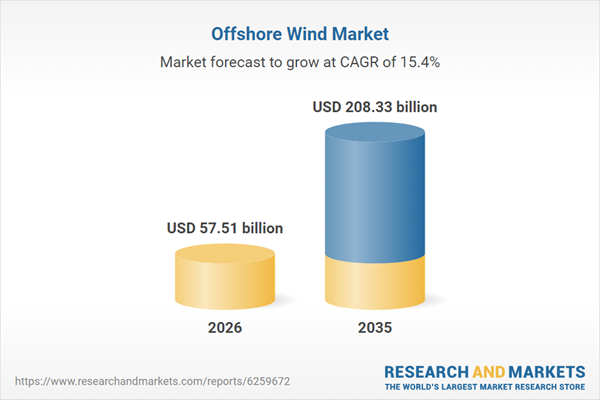
The global offshore wind market is estimated to grow from USD 57.51 billion in 2026 to USD 208.33 billion by 2035, registering a compound annual growth rate of 15.4% during the forecast period. Expanding renewable energy generation, energy security concerns, ambitious decarbonization targets, and rising investment in offshore renewable infrastructure are driving offshore wind project development worldwide.
Offshore wind is becoming an increasingly important source of utility-scale renewable electricity as governments and energy companies pursue low-carbon energy systems. Market growth is supported by advancements in turbine design, foundation engineering, offshore transmission, subsea cable networks, and digital asset management. Modern offshore wind farms are deploying turbine platforms exceeding 15 MW, advanced monopile and jacket foundations, floating wind systems, and high-voltage direct current transmission technology to improve energy production and project economics.
Developers and utilities are also adopting digital twins, AI-enabled predictive maintenance, autonomous inspection drones, condition-monitoring systems, and real-time performance analytics. These technologies support turbine performance monitoring, structural integrity assessment, weather analysis, maintenance planning, energy-yield optimization, and lifecycle extension while reducing operational downtime and maintenance expenditure.
Turbines Expected to Remain the Largest Component Segment
The turbines segment is expected to account for the largest share of the offshore wind market during the forecast period. Turbines represent the primary power-generating component of offshore wind farms and a substantial proportion of total project capital expenditure. Developers are investing in platforms above 10 MW and 15 MW to increase annual energy production, improve capacity factors, and reduce the levelized cost of electricity.
Next-generation turbines incorporate larger rotor diameters, advanced composite blade materials, enhanced blade aerodynamics, direct-drive generators, improved drivetrain systems, power electronics, and intelligent controls. Higher-capacity platforms allow projects to generate more electricity with fewer installations, lowering associated foundation, cabling, installation, and maintenance requirements. Integration of digital twins, predictive maintenance, condition monitoring, and real-time analytics is further improving turbine reliability and operational lifespan.
Above 15 MW Turbines Projected to Record the Fastest Growth
By turbine rating, the above 15 MW segment is projected to register the fastest growth through 2035. Adoption is being driven by demand for greater energy output, stronger project economics, fewer turbines per development, and lower balance-of-plant costs. Manufacturers are investing in larger rotors, advanced blades, and high-capacity generators designed for demanding offshore environments.
Deployment of turbines above 15 MW is gaining momentum in Europe, China, Taiwan, South Korea, and emerging offshore wind markets. Growth is supported by expanding project pipelines, government auction programs, offshore transmission investment, and national decarbonization commitments. These platforms are expected to increase capacity factors, reduce lifecycle costs, and strengthen the competitiveness of utility-scale offshore wind projects.
Europe to Hold the Second-Largest Regional Market Share
Europe is estimated to represent the second-largest offshore wind market during the forecast period. The UK, Germany, the Netherlands, Norway, Denmark, France, and Belgium continue to advance offshore wind deployment through long-term energy transition strategies, competitive auctions, supportive regulation, and renewable infrastructure investment.
The region benefits from an established ecosystem of developers, turbine manufacturers, foundation suppliers, transmission operators, engineering companies, and service providers. The European Green Deal, REPowerEU, and national offshore wind expansion targets are supporting investment in utility-scale wind farms, floating offshore wind, offshore substations, HVDC transmission, subsea cable networks, and port modernization. Green hydrogen production, offshore energy hubs, and cross-border electricity interconnections are creating additional opportunities.
Innovation Expands Offshore Wind Market Opportunities
Floating offshore wind is opening development opportunities in deep-water locations through semi-submersible platforms, spar-buoy structures, and tension-leg platforms. Product innovation is also focused on turbines exceeding 15 MW, larger rotor diameters, advanced composite blades, enhanced drivetrain systems, and digital platforms that improve output while lowering operating costs.
These solutions are increasingly being applied across utility-scale offshore wind farms, hybrid renewable energy projects, offshore energy hubs, and green hydrogen production facilities. Key market opportunities include floating wind commercialization and offshore wind expansion in emerging markets. Principal growth restraints include high capital expenditure and project development costs, while environmental and marine ecosystem concerns remain important project-development challenges.
Competitive Landscape
Major offshore wind market participants include Siemens Energy, Mingyang Smart Energy Group Co., Ltd., Vestas, Goldwind, and Envision Group. The competitive assessment also covers Ocean Winds, Prysmian, GE Vernova, Nexans, Sif Group, EEW Group, Schneider Electric, Dongfang Electric Wind Power Co., Ltd., Doosan, Hitachi Energy, Orsted, Northland Power Inc., CRRC Shandong Power Co., Ltd., Principle Power, Shanghai Electric Wind Power Group, SSE Renewables, EDF, Aker Solutions, Vattenfall, and Equinor ASA.
The report evaluates company profiles, market shares, service offerings, recent developments, product launches, growth strategies, and technology initiatives. Geographic representation includes Goldwind, Envision Group, Mingyang Smart Energy Group Co., Ltd., Dongfang Electric Wind Power Co., Ltd., CRRC Shandong Power Co., Ltd., and Shanghai Electric Wind Power Group in China; Vestas and Orsted in Denmark; Siemens Energy and EEW Group in Germany; Prysmian in Italy; GE Vernova and Principle Power in the US; Nexans and EDF in France; Sif Group in the Netherlands; Schneider Electric in France; Doosan in South Korea; Hitachi Energy in Switzerland; Northland Power Inc. and Ocean Winds in Canada; SSE Renewables in the UK; Aker Solutions and Equinor ASA in Norway; and Vattenfall in Sweden.
Research Coverage and Methodology
The study defines, analyzes, and forecasts the offshore wind market by component, turbine rating, water depth, foundation type, and region. It provides qualitative and quantitative analysis of market drivers, restraints, opportunities, challenges, competitive conditions, value estimates, and future trends. Coverage includes market development opportunities across regions, untapped geographies, new products and services, recent industry developments, and product innovation.
Primary research included interviews with industry participants, subject-matter experts, C-level executives, and consultants. By company type, respondents comprised Tier 1 companies at 45%, Tier 2 at 30%, and Tier 3 at 25%. By designation, the distribution was C-level executives at 35%, directors at 25%, and other respondents-including sales managers, engineers, and regional managers-at 40%. By region, participants were based in Asia Pacific at 51%, Europe at 39%, and North America at 10%.
Company tiers were classified using 2025 total revenue: Tier 1 companies generated more than USD 1 billion, Tier 2 companies generated USD 500 million to USD 1 billion, and Tier 3 companies generated less than USD 500 million.
Key Report Benefits
- Analysis of offshore wind capacity additions, renewable energy investment, electricity demand, and decarbonization initiatives.
- Assessment of high capital expenditure, project development costs, and environmental and marine ecosystem concerns.
- Evaluation of floating offshore wind technology and growth opportunities in emerging markets.
- Regional market analysis, competitive benchmarking, market estimates, and future industry trends.
- Coverage of turbines above 15 MW, floating foundations, HVDC systems, digital twins, AI-enabled maintenance, and real-time asset analytics.
Key Attributes:
| Report Attribute | Details |
| No. of Pages | 275 |
| Forecast Period | 2026 – 2035 |
| Estimated Market Value (USD) in 2026 | $57.51 billion |
| Forecasted Market Value (USD) by 2035 | $208.33 billion |
| Compound Annual Growth Rate | 15.4% |
| Regions Covered | Global |
Key Topics Covered:
Market Dynamics
- Drivers
- Increasing implementation of renewable energy policies to support decarbonization
- Growing electricity demand amid rapid urbanization and industrial expansion
- Challenges
- High capital expenditure and project development costs
- Environmental and marine ecosystem concerns in offshore project development
- Case Studies
- ORSTED AND SIEMENS GAMESA DEPLOY HORNSEA 2 USING HIGH-CAPACITY TURBINES TO IMPROVE RENEWABLE ENERGY GENERATION
- EQUINOR DEPLOYS HYWIND SCOTLAND TO COMMERCIALIZE FLOATING OFFSHORE WIND
- DOGGER BANK OFFSHORE WIND FARM UTILIZES GE VERNOVA’S HALIADE-X TURBINES TO GENERATE LARGE-SCALE CLEAN ENERGY
- Industry Trends
- TRENDS IN GLOBAL RENEWABLE ENERGY INDUSTRY
- TRENDS IN GLOBAL ELECTRICAL EQUIPMENT INDUSTRY
- TRENDS/DISRUPTIONS IMPACTING CUSTOMER BUSINESS
- INVESTMENT AND FUNDING SCENARIO
- Opportunities
- Emergence of floating offshore wind technology
- High emphasis on diversifying energy sources and strengthening energy security
Company Profiles
- SIEMENS ENERGY
- MING YANG SMART ENERGY GROUP CO., LTD.
- VESTAS
- GOLDWIND
- ENVISION GROUP
- PRYSMIAN
- GE VERNOVA
- NEXANS
- SIF GROUP
- SCHNEIDER ELECTRIC
- DONGFANG ELECTRIC WIND POWER CO., LTD.
- DOOSAN CORPORATION
- HITACHI ENERGY LTD
- ORSTED
- NORTHLAND POWER INC.
- SHANGHAI SMEC ENTERPRISE CO., LTD.
- AKER SOLUTIONS
- EQUINOR ASA
- OCEANWINDS
- EEW GROUP
- CRRC SHANDONG WIND POWER CO., LTD.
- PRINCIPLE POWER
- SSE PLC
- EDF
- VATTENFALL
For more information about this report visit https://www.researchandmarkets.com/r/9ojfsu
About ResearchAndMarkets.com
ResearchAndMarkets.com is the world’s leading source for international market research reports and market data. We provide you with the latest data on international and regional markets, key industries, the top companies, new products and the latest trends.
Attachment
- Offshore Wind Market
CONTACT:
CONTACT: ResearchAndMarkets.com
         Laura Wood,Senior Press Manager
         [email protected]
         For E.S.T Office Hours Call 1-917-300-0470
         For U.S./ CAN Toll Free Call 1-800-526-8630
         For GMT Office Hours Call +353-1-416-8900
