
Opportunities span AI-ready hyperscale campuses, GPU cloud platforms, liquid cooling, high-speed networking, power management and renewable energy integration. Multi-cloud and sovereign AI also enable regional expansion and strategic partnerships.
Hyperscale Data Center Market
Dublin, Aug. 11, 2026 (GLOBE NEWSWIRE) — The “Hyperscale Data Center Market, Till 2040: Distribution by Type of Component, Type of Deployment, Data Center Size, End User, Type of Workload, Cooling Technology, Geographical Regions, and Leading Players: Industry Trends and Global Forecasts” has been added to ResearchAndMarkets.com’s offering.
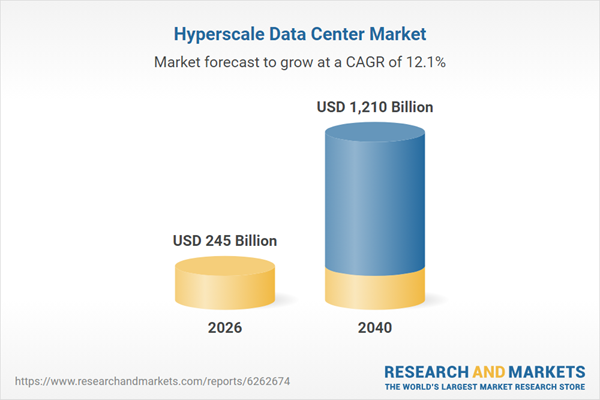
Global Hyperscale Data Center Market Projected to Reach USD 1.21 Trillion by 2040 as AI Infrastructure Investment Accelerates
The global hyperscale data center market is projected to increase from USD 245.0 billion in 2026 to USD 1.21 trillion by 2040, expanding at a compound annual growth rate of 12.1%. Market growth is being driven by artificial intelligence workloads, hyperscale cloud expansion, high-density GPU deployments, data sovereignty requirements and rising demand for energy-efficient digital infrastructure.
Infrastructure priorities are shifting from traditional cloud capacity optimization toward power-intensive AI computing clusters. This transition is increasing demand for direct-to-chip liquid cooling, immersion cooling, high-speed networking, advanced power management and gigawatt-scale data center campuses. Major cloud service providers and infrastructure operators are also integrating renewable energy procurement into development strategies as sustainability regulations and grid constraints influence site selection.
Recent transactions demonstrate the strategic importance of hyperscale infrastructure. Alphabet’s acquisition of renewable energy developer Intersect in December 2025 reflected the growing convergence of clean energy and data center development. Industry confidence was further illustrated by the USD 40 billion acquisition of Aligned Data Centers by a consortium comprising BlackRock, Microsoft, NVIDIA and xAI.
Key Hyperscale Data Center Market Findings
- IT infrastructure is projected to represent 34.0% of the global market in 2026, while liquid cooling systems are expected to record the fastest growth through 2040.
- Cloud deployment is anticipated to account for 46.0% of the market in 2026. Multi-cloud deployment is forecast to expand at a CAGR of 14.7% through 2040.
- Massive hyperscale facilities are estimated to capture 49.0% of the market in 2026 as operators prioritize centralized, high-capacity infrastructure.
- Cloud computing workloads are expected to hold a 31.0% market share in 2026, supported by enterprise migration and digital service growth.
- North America is projected to lead with a 41.0% share in 2026. Asia-Pacific is expected to be the fastest-growing region, registering a CAGR of 14.5% through 2040.
Competitive Landscape and Investment Outlook
The hyperscale data center industry is increasingly characterized by vertically integrated cloud and AI infrastructure ecosystems. Leading operators maintain extensive control over computing resources, networking, AI accelerators, software platforms and energy procurement. Competitive differentiation is becoming closely tied to access to power, deployment speed, thermal management, GPU availability and regional cloud coverage.
Amazon, Alphabet, Microsoft, Meta and Oracle are expected to invest a combined USD 660 billion to USD 690 billion in capital expenditure during 2026. Amazon has projected approximately USD 200 billion in 2026 capital spending, compared with approximately USD 125 billion in the previous year. Microsoft allocated USD 80 billion during 2025 to AI-optimized data centers and Azure infrastructure. Alphabet committed approximately USD 75 billion in 2025 and is expected to raise capital expenditure to between USD 175 billion and USD 185 billion in 2026.
Startup and growth-stage investment is also accelerating. Approximately 70% of data center-focused companies that raised more than USD 500 million completed their latest equity financing rounds during 2024 or 2025. CoreWeave has expanded its AI cloud infrastructure footprint to 32 data center facilities and approximately 250,000 GPUs as of 2025. Vantage Data Centers secured more than USD 2 billion in Series C financing in January 2026 after receiving an additional USD 1.6 billion equity investment in November 2025. Emerald AI is developing intelligent energy management capabilities that coordinate AI workloads with real-time grid availability.
Growth Opportunities in AI, Multi-Cloud and Sovereign Infrastructure
Multi-cloud adoption and sovereign AI initiatives are creating opportunities for hyperscale development, specialized AI-ready facilities and strategic infrastructure partnerships. Enterprises are distributing workloads across multiple platforms to improve resilience, regulatory compliance, performance and risk management. Regional cloud deployments announced or advanced by AWS, Microsoft and Google across Asia-Pacific and Europe during 2025 are expected to support demand for networking equipment, cooling systems, power infrastructure and data center construction services.
Thermal management will remain a central investment priority as rack densities increase. Direct-to-chip liquid cooling, immersion cooling and hybrid cooling systems are expected to gain adoption across AI and high-performance computing environments. Power availability will also shape future development, encouraging collaboration among hyperscale operators, utilities, renewable energy developers, semiconductor manufacturers and infrastructure investors.
Market Segmentation Covered in the Report
The hyperscale data center market report evaluates opportunities by component, deployment model, facility size, end user, workload, cooling technology and geography.
- Components: IT infrastructure, servers, storage systems, networking equipment, power infrastructure, cooling infrastructure, construction, security and monitoring solutions.
- Deployment models: Cloud, colocation, on-premises, hybrid and multi-cloud.
- Facility sizes: Small and medium facilities, large facilities and massive hyperscale facilities.
- End users: Cloud and colocation providers, enterprises, government agencies, telecommunications companies, digital platforms, financial institutions, healthcare organizations and retailers.
- Workloads: AI and machine learning, big data analytics, cloud computing, content delivery, enterprise applications, high-performance computing, IoT and edge processing.
- Cooling technologies: Air cooling, direct-to-chip liquid cooling, immersion cooling, hybrid cooling and free cooling systems.
- Regions: North America, Europe, Asia-Pacific, Latin America, the Middle East and North Africa, and the rest of the world.
Strategic Value for Decision-Makers
The report supports infrastructure investment, market entry, technology planning and regional expansion decisions across the hyperscale data center ecosystem. It identifies market gaps in liquid cooling, power availability, sovereign AI capacity and high-density networking while examining funding activity involving cloud providers, AI infrastructure companies, cooling technology developers and renewable energy-linked projects.
Decision-makers can use the analysis to benchmark competitive positioning, assess acquisition opportunities, evaluate infrastructure financing and identify potential partnerships. The report also reviews direct-to-chip cooling, immersion cooling, AI accelerators, multi-cloud orchestration and advanced thermal management technologies.
Additional modules include market sizing and opportunity analysis, company profiles, competitive benchmarking, megatrend assessment, patent analysis, recent industry developments, Porter’s Five Forces analysis and SWOT analysis. Forecasts extend through 2040 and cover revenue opportunities across deployment models, components, workloads, cooling technologies, end users and geographic markets.
The report addresses the current and future hyperscale data center market size, leading companies, principal growth drivers, partnership and funding trends, regional growth prospects and the distribution of opportunities across major market segments. Purchasers also receive dynamic Excel dashboards, up to 15% complimentary content customization, an interactive report walkthrough and qualifying report updates.
Key Attributes:
| Report Attribute | Details |
| No. of Pages | 201 |
| Forecast Period | 2026 – 2040 |
| Estimated Market Value (USD) in 2026 | $245 Billion |
| Forecasted Market Value (USD) by 2040 | $1210 Billion |
| Compound Annual Growth Rate | 12.1% |
| Regions Covered | Global |
Key Topics Covered:
1. PROJECT OVERVIEW
1.1. Context
1.2. Project Objectives
2. RESEARCH METHODOLOGY
2.1. Chapter Overview
2.2. Research Assumptions
2.3. Database Building
2.3.1. Data Collection
2.3.2. Data Validation
2.3.3. Data Analysis
2.4. Project Methodology
2.4.1. Secondary Research
2.4.1.1. Annual Reports
2.4.1.2. Academic Research Papers
2.4.1.3. Company Websites
2.4.1.4. Investor Presentations
2.4.1.5. Regulatory Filings
2.4.1.6. White Papers
2.4.1.7. Industry Publications
2.4.1.8. Conferences and Seminars
2.4.1.9. Government Portals
2.4.1.10. Media and Press Releases
2.4.1.11. Newsletters
2.4.1.12. Industry Databases
2.4.1.13. Roots Proprietary Databases
2.4.1.14. Paid Databases and Sources
2.4.1.15. Social Media Portals
2.4.1.16. Other Secondary Sources
2.4.2. Primary Research
2.4.2.1. Introduction
2.4.2.2. Types
2.4.2.2.1. Qualitative
2.4.2.2.2. Quantitative
2.4.2.3. Advantages
2.4.2.4. Techniques
2.4.2.4.1. Interviews
2.4.2.4.2. Surveys
2.4.2.4.3. Focus Groups
2.4.2.4.4. Observational Research
2.4.2.4.5. Social Media Interactions
2.4.2.5. Stakeholders
2.4.2.5.1. Company Executives (CXOs)
2.4.2.5.2. Board of Directors
2.4.2.5.3. Company Presidents and Vice Presidents
2.4.2.5.4. Key Opinion Leaders
2.4.2.5.5. Research and Development Heads
2.4.2.5.6. Technical Experts
2.4.2.5.7. Subject Matter Experts
2.4.2.5.8. Scientists
2.4.2.5.9. Doctors and Other Healthcare Providers
2.4.2.6. Ethics and Integrity
2.4.2.6.1. Research Ethics
2.4.2.6.2. Data Integrity
2.4.3. Analytical Tools and Databases
3. MARKET DYNAMICS
3.1. Forecast Methodology
3.1.1. Top-Down Approach
3.1.2. Bottom-Up Approach
3.1.3. Hybrid Approach
3.2. Market Assessment Framework
3.2.1. Total Addressable Market (TAM)
3.2.2. Serviceable Addressable Market (SAM)
3.2.3. Serviceable Obtainable Market (SOM)
3.2.4. Currently Acquired Market (CAM)
3.3. Forecasting Tools and Techniques
3.3.1. Qualitative Forecasting
3.3.2. Correlation
3.3.3. Regression
3.3.4. Time Series Analysis
3.3.5. Extrapolation
3.3.6. Convergence
3.3.7. Forecast Error Analysis
3.3.8. Data Visualization
3.3.9. Scenario Planning
3.3.10. Sensitivity Analysis
3.4. Key Considerations
3.4.1. Demographics
3.4.2. Market Access
3.4.3. Reimbursement Scenarios
3.4.4. Industry Consolidation
3.5. Robust Quality Control
3.6. Key Market Segmentations
3.7. Limitations
4. MACRO-ECONOMIC INDICATORS
4.1. Chapter Overview
4.2. Market Dynamics
4.2.1. Time Period
4.2.1.1. Historical Trends
4.2.1.2. Current and Forecasted Estimates
4.2.2. Currency Coverage
4.2.2.1. Overview of Major Currencies Affecting the Market
4.2.2.2. Impact of Currency Fluctuations on the Industry
4.2.3. Foreign Exchange Impact
4.2.3.1. Evaluation of Foreign Exchange Rates and Their Impact on Market
4.2.3.2. Strategies for Mitigating Foreign Exchange Risk
4.2.4. Recession
4.2.4.1. Historical Analysis of Past Recessions and Lessons Learnt
4.2.4.2. Assessment of Current Economic Conditions and Potential Impact on the Market
4.2.5. Inflation
4.2.5.1. Measurement and Analysis of Inflationary Pressures in the Economy
4.2.5.2. Potential Impact of Inflation on the Market Evolution
4.2.6. Interest Rates
4.2.6.1. Overview of Interest Rates and Their Impact on the Market
4.2.6.2. Strategies for Managing Interest Rate Risk
4.2.7. Commodity Flow Analysis
4.2.7.1. Type of Commodity
4.2.7.2. Origins and Destinations
4.2.7.3. Values and Weights
4.2.7.4. Modes of Transportation
4.2.8. Global Trade Dynamics
4.2.8.1. Import Scenario
4.2.8.2. Export Scenario
4.2.9. War Impact Analysis
4.2.9.1. Russian-Ukraine War
4.2.9.2. Israel-Hamas War
4.2.10. COVID Impact / Related Factors
4.2.10.1. Global Economic Impact
4.2.10.2. Industry-specific Impact
4.2.10.3. Government Response and Stimulus Measures
4.2.10.4. Future Outlook and Adaptation Strategies
4.2.11. Other Indicators
4.2.11.1. Fiscal Policy
4.2.11.2. Consumer Spending
4.2.11.3. Gross Domestic Product (GDP)
4.2.11.4. Employment
4.2.11.5. Taxes
4.2.11.6. R&D Innovation
4.2.11.7. Stock Market Performance
4.2.11.8. Supply Chain
4.2.11.9. Cross-Border Dynamics
4.3. Concluding Remarks
5. EXECUTIVE SUMMARY
6. INTRODUCTION
6.1. Chapter Overview
6.2. Overview of Hyperscale Data Center
6.2.1. Type of Component
6.2.2. Type of Deployment
6.2.3. Type of Data Center Size
6.2.4. End User Industry
6.2.5. Type of Workload
6.2.6. Type of Cooling Technology
6.3. Future Perspective
7. REGULATORY SCENARIO
8. COMPREHENSIVE DATABASE OF LEADING PLAYERS
9. COMPETITIVE LANDSCAPE
9.1. Chapter Overview
9.2. Hyperscale Data Center Market: Overall Landscape
9.2.1. Analysis by Year of Establishment
9.2.2. Analysis by Company Size
9.2.3. Analysis by Location of Headquarters
9.2.4. Analysis by Type of Company
9.3. Key Findings
10. WHITE SPACE ANALYSIS
11. COMPANY COMPETITIVENESS ANALYSIS
12. STARTUP ECOSYSTEM ANALYSIS
12.1. Hyperscale Data Center Market: Startup Ecosystem Analysis
12.1.1. Analysis by Year of Establishment
12.1.2. Analysis by Company Size
12.1.3. Analysis by Location of Headquarters
12.1.4. Analysis by Ownership Type
12.2. Key Findings
13. COMPANY PROFILES
13.1. Chapter Overview
13.2. Amazon Web Services (AWS)
13.2.1. Company Overview
13.2.2. Company Mission
13.2.3. Company Footprint
13.2.4. Management Team
13.2.5. Contact Details
13.2.6. Financial Performance
13.2.7. Operating Business Segments
13.2.8. Service / Product Portfolio (project specific)
13.2.9. MOAT Analysis
13.2.10. Recent Developments and Future Outlook
* Similar details are presented for other companies mentioned below (based on information in the public domain)
13.3. AirTrunk
13.4. Alibaba Cloud
13.5. Apple
13.6. Baidu
13.7. CoreWeave
13.8. CyrusOne
13.9. Digital Realty
13.10. Equinix
13.11. Google Cloud Platform (GCP)
13.12. IBM Cloud
13.13. Iron Mountain
13.14. Meta
13.15. Microsoft (Azure)
13.16. NTT Global Data Centers
13.17. NVIDIA
13.18. Nxtra (by Bharti Airtel)
13.19. Oracle Cloud (OCI)
13.20. QTS (Quality Technology Services)
13.21. Tencent
14. MEGA TRENDS ANALYSIS
15. UNMET NEED ANALYSIS
16. PATENT ANALYSIS
17. RECENT DEVELOPMENTS
17.1. Chapter Overview
17.2. Recent Funding
17.3. Recent Partnerships
17.4. Other Recent Initiatives
18. GLOBAL HYPERSCALE DATA CENTER MARKET
18.1. Chapter Overview
18.2. Key Assumptions and Methodology
18.3. Trends Disruption Impacting Market
18.4. Demand Side Trends
18.5. Supply Side Trends
18.6. Global Hyperscale Data Center Market: Historical Trends (Since 2022) and Forecasted Estimates (Till 2040)
18.7. Multivariate Scenario Analysis
18.7.1. Conservative Scenario
18.7.2. Optimistic Scenario
18.8. Investment Feasibility Index
18.9. Key Market Segmentations
19. MARKET OPPORTUNITIES BASED ON TYPE OF COMPONENT
19.1. Chapter Overview
19.2. Key Assumptions and Methodology
19.3. Revenue Shift Analysis
19.4. Market Movement Analysis
19.5. Penetration-Growth (P-G) Matrix
19.6. Hyperscale Data Center Market for IT Infrastructure: Historical Trends (Since 2022) and Forecasted Estimates (Till 2040)
19.7. Hyperscale Data Center Market for Servers: Historical Trends (Since 2022) and Forecasted Estimates (Till 2040)
19.8. Hyperscale Data Center Market for Storage Systems: Historical Trends (Since 2022) and Forecasted Estimates (Till 2040)
19.9. Hyperscale Data Center Market for Network Equipment: Historical Trends (Since 2022) and Forecasted Estimates (Till 2040)
19.10. Hyperscale Data Center Market for Power Infrastructure: Historical Trends (Since 2022) and Forecasted Estimates (Till 2040)
19.11. Hyperscale Data Center Market for UPS Systems: Historical Trends (Since 2022) and Forecasted Estimates (Till 2040)
19.12. Hyperscale Data Center Market for PDUs: Historical Trends (Since 2022) and Forecasted Estimates (Till 2040)
19.13. Hyperscale Data Center Market for Generators: Historical Trends (Since 2022) and Forecasted Estimates (Till 2040)
19.14. Hyperscale Data Center Market for UPS Systems: Historical Trends (Since 2022) and Forecasted Estimates (Till 2040)
19.15. Hyperscale Data Center Market for Cooling Infrastructure: Historical Trends (Since 2022) and Forecasted Estimates (Till 2040)
19.16. Hyperscale Data Center Market for Liquid Cooling Systems: Historical Trends (Since 2022) and Forecasted Estimates (Till 2040)
19.17. Hyperscale Data Center Market for Air-Based Cooling Systems: Historical Trends (Since 2022) and Forecasted Estimates (Till 2040)
19.18. Hyperscale Data Center Market for Construction and Facility Infrastructure: Historical Trends (Since 2022) and Forecasted Estimates (Till 2040)
19.19. Hyperscale Data Center Market for Security and Monitoring Solutions: Historical Trends (Since 2022) and Forecasted Estimates (Till 2040)
19.20. Data Triangulation and Validation
19.20.1. Secondary Sources
19.20.2. Primary Sources
19.20.3. Statistical Modeling
20. MARKET OPPORTUNITIES BASED ON TYPE OF DEPLOYMENT
20.1. Chapter Overview
20.2. Key Assumptions and Methodology
20.3. Revenue Shift Analysis
20.4. Market Movement Analysis
20.5. Penetration-Growth (P-G) Matrix
20.6. Hyperscale Data Center Market for Cloud: Historical Trends (Since 2022) and Forecasted Estimates (Till 2040)
20.7. Hyperscale Data Center Market for Colocation: Historical Trends (Since 2022) and Forecasted Estimates (Till 2040)
20.8. Hyperscale Data Center Market for On-Premises: Historical Trends (Since 2022) and Forecasted Estimates (Till 2040)
20.9. Hyperscale Data Center Market for Hybrid: Historical Trends (Since 2022) and Forecasted Estimates (Till 2040)
20.10. Hyperscale Data Center Market for Multi-Cloud: Historical Trends (Since 2022) and Forecasted Estimates (Till 2040)
20.11. Data Triangulation and Validation
20.11.1. Secondary Sources
20.11.2. Primary Sources
20.11.3. Statistical Modeling
21. MARKET OPPORTUNITIES BASED ON DATA CENTER SIZE
21.1. Chapter Overview
21.2. Key Assumptions and Methodology
21.3. Revenue Shift Analysis
21.4. Market Movement Analysis
21.5. Penetration-Growth (P-G) Matrix
21.6. Hyperscale Data Center Market for Small and Medium Facilities: Historical Trends (Since 2022) and Forecasted Estimates (Till 2040)
21.7. Hyperscale Data Center Market for Large Facilities: Historical Trends (Since 2022) and Forecasted Estimates (Till 2040)
21.8. Hyperscale Data Center Market for Massive Hyperscale Facilities: Historical Trends (Since 2022) and Forecasted Estimates (Till 2040)
21.9. Data Triangulation and Validation
21.9.1. Secondary Sources
21.9.2. Primary Sources
21.9.3. Statistical Modeling
22. MARKET OPPORTUNITIES BASED ON END USER
22.1. Chapter Overview
22.2. Key Assumptions and Methodology
22.3. Revenue Shift Analysis
22.4. Market Movement Analysis
22.5. Penetration-Growth (P-G) Matrix
22.6. Hyperscale Data Center Market for Cloud Service Providers: Historical Trends (Since 2022) and Forecasted Estimates (Till 2040)
22.7. Hyperscale Data Center Market for Colocation Providers: Historical Trends (Since 2022) and Forecasted Estimates (Till 2040)
22.8. Hyperscale Data Center Market for Enterprises: Historical Trends (Since 2022) and Forecasted Estimates (Till 2040)
22.9. Hyperscale Data Center Market for Government and Public Sector: Historical Trends (Since 2022) and Forecasted Estimates (Till 2040)
22.10. Hyperscale Data Center Market for Telecommunication Providers: Historical Trends (Since 2022) and Forecasted Estimates (Till 2040)
22.11. Hyperscale Data Center Market for Social Media and Digital Platforms: Historical Trends (Since 2022) and Forecasted Estimates (Till 2040)
22.12. Hyperscale Data Center Market for BFSI: Historical Trends (Since 2022) and Forecasted Estimates (Till 2040)
22.13. Hyperscale Data Center Market for Healthcare and Life Sciences: Historical Trends (Since 2022) and Forecasted Estimates (Till 2040)
22.14. Hyperscale Data Center Market for Retail and E-Commerce: Historical Trends (Since 2022) and Forecasted Estimates (Till 2040)
22.15. Data Triangulation and Validation
22.15.1. Secondary Sources
22.15.2. Primary Sources
22.15.3. Statistical Modeling
23. MARKET OPPORTUNITIES BASED ON TYPE OF WORKLOAD
23.1. Chapter Overview
23.2. Key Assumptions and Methodology
23.3. Revenue Shift Analysis
23.4. Market Movement Analysis
23.5. Penetration-Growth (P-G) Matrix
23.6. Hyperscale Data Center Market for AI and Machine Learning: Historical Trends (Since 2022) and Forecasted Estimates (Till 2040)
23.7. Hyperscale Data Center Market for Big Data Analytics: Historical Trends (Since 2022) and Forecasted Estimates (Till 2040)
23.8. Hyperscale Data Center Market for Cloud Computing: Historical Trends (Since 2022) and Forecasted Estimates (Till 2040)
23.9. Hyperscale Data Center Market for Content Delivery and Streaming: Historical Trends (Since 2022) and Forecasted Estimates (Till 2040)
23.10. Hyperscale Data Center Market for Enterprise Applications: Historical Trends (Since 2022) and Forecasted Estimates (Till 2040)
23.11. Hyperscale Data Center Market for High-Performance Computing: Historical Trends (Since 2022) and Forecasted Estimates (Till 2040)
23.12. Hyperscale Data Center Market for IoT and Edge Processing: Historical Trends (Since 2022) and Forecasted Estimates (Till 2040)
23.13. Data Triangulation and Validation
23.13.1. Secondary Sources
23.13.2. Primary Sources
23.13.3. Statistical Modeling
24. MARKET OPPORTUNITIES BASED ON COOLING TECHNOLOGY
24.1. Chapter Overview
24.2. Key Assumptions and Methodology
24.3. Revenue Shift Analysis
24.4. Market Movement Analysis
24.5. Penetration-Growth (P-G) Matrix
24.6. Hyperscale Data Center Market for Air Cooling: Historical Trends (Since 2022) and Forecasted Estimates (Till 2040)
24.7. Hyperscale Data Center Market for Direct-to-Chip Liquid Cooling: Historical Trends (Since 2022) and Forecasted Estimates (Till 2040)
24.8. Hyperscale Data Center Market for Immersion Cooling: Historical Trends (Since 2022) and Forecasted Estimates (Till 2040)
24.9. Hyperscale Data Center Market for Hybrid Cooling: Historical Trends (Since 2022) and Forecasted Estimates (Till 2040)
24.10. Hyperscale Data Center Market for Free Cooling Systems: Historical Trends (Since 2022) and Forecasted Estimates (Till 2040)
24.11. Data Triangulation and Validation
24.11.1. Secondary Sources
24.11.2. Primary Sources
24.11.3. Statistical Modeling
25. MARKET OPPORTUNITIES FOR HYPERSCALE DATA CENTER IN NORTH AMERICA
25.1. Chapter Overview
25.2. Key Assumptions and Methodology
25.3. Revenue Shift Analysis
25.4. Market Movement Analysis
25.5. Penetration-Growth (P-G) Matrix
25.6. Hyperscale Data Center Market in North America: Historical Trends (Since 2022) and Forecasted Estimates (Till 2040)
25.6.1. Hyperscale Data Center Market in the US: Historical Trends (Since 2022) and Forecasted Estimates (Till 2040)
25.6.2. Hyperscale Data Center Market in Canada: Historical Trends (Since 2022) and Forecasted Estimates (Till 2040)
25.6.3. Hyperscale Data Center Market in Mexico: Historical Trends (Since 2022) and Forecasted Estimates (Till 2040)
25.6.4. Hyperscale Data Center Market in Other North American Countries: Historical Trends (Since 2022) and Forecasted Estimates (Till 2040)
25.7. Data Triangulation and Validation
26. MARKET OPPORTUNITIES FOR HYPERSCALE DATA CENTER IN EUROPE
26.1. Chapter Overview
26.2. Key Assumptions and Methodology
26.3. Revenue Shift Analysis
26.4. Market Movement Analysis
26.5. Penetration-Growth (P-G) Matrix
26.6. Hyperscale Data Center Market in Europe: Historical Trends (Since 2022) and Forecasted Estimates (Till 2040)
26.6.1. Hyperscale Data Center Market in Austria: Historical Trends (Since 2022) and Forecasted Estimates (Till 2040)
26.6.2. Hyperscale Data Center Market in Belgium: Historical Trends (Since 2022) and Forecasted Estimates (Till 2040)
26.6.3. Hyperscale Data Center Market in Denmark: Historical Trends (Since 2022) and Forecasted Estimates (Till 2040)
26.6.4. Hyperscale Data Center Market in France: Historical Trends (Since 2022) and Forecasted Estimates (Till 2040)
26.6.5. Hyperscale Data Center Market in Germany: Historical Trends (Since 2022) and Forecasted Estimates (Till 2040)
26.6.6. Hyperscale Data Center Market in Ireland: Historical Trends (Since 2022) and Forecasted Estimates (Till 2040)
26.6.7. Hyperscale Data Center Market in Italy: Historical Trends (Since 2022) and Forecasted Estimates (Till 2040)
26.6.8. Hyperscale Data Center Market in the Netherlands: Historical Trends (Since 2022) and Forecasted Estimates (Till 2040)
26.6.9. Hyperscale Data Center Market in Norway: Historical Trends (Since 2022) and Forecasted Estimates (Till 2040)
26.6.10. Hyperscale Data Center Market in Russia: Historical Trends (Since 2022) and Forecasted Estimates (Till 2040)
26.6.11. Hyperscale Data Center Market in Spain: Historical Trends (Since 2022) and Forecasted Estimates (Till 2040)
26.6.12. Hyperscale Data Center Market in Sweden: Historical Trends (Since 2022) and Forecasted Estimates (Till 2040)
26.6.13. Hyperscale Data Center Market in Switzerland: Historical Trends (Since 2022) and Forecasted Estimates (Till 2040)
26.6.14. Hyperscale Data Center Market in the UK: Historical Trends (Since 2022) and Forecasted Estimates (Till 2040)
26.6.15. Hyperscale Data Center Market in Other European Countries: Historical Trends (Since 2022) and Forecasted Estimates (Till 2040)
26.7. Data Triangulation and Validation
27. MARKET OPPORTUNITIES FOR HYPERSCALE DATA CENTER IN ASIA-PACIFIC
27.1. Chapter Overview
27.2. Key Assumptions and Methodology
27.3. Revenue Shift Analysis
27.4. Market Movement Analysis
27.5. Penetration-Growth (P-G) Matrix
27.6. Hyperscale Data Center Market in Asia-Pacific: Historical Trends (Since 2022) and Forecasted Estimates (Till 2040)
27.6.1. Hyperscale Data Center Market in China: Historical Trends (Since 2022) and Forecasted Estimates (Till 2040)
27.6.2. Hyperscale Data Center Market in India: Historical Trends (Since 2022) and Forecasted Estimates (Till 2040)
27.6.3. Hyperscale Data Center Market in Japan: Historical Trends (Since 2022) and Forecasted Estimates (Till 2040)
27.6.4. Hyperscale Data Center Market in Singapore: Historical Trends (Since 2022) and Forecasted Estimates (Till 2040)
27.6.5. Hyperscale Data Center Market in South Korea: Historical Trends (Since 2022) and Forecasted Estimates (Till 2040)
27.6.6. Hyperscale Data Center Market in Other Asian Countries: Historical Trends (Since 2022) and Forecasted Estimates (Till 2040)
27.7. Data Triangulation and Validation
28. MARKET OPPORTUNITIES FOR HYPERSCALE DATA CENTER IN LATIN AMERICA
28.1. Chapter Overview
28.2. Key Assumptions and Methodology
28.3. Revenue Shift Analysis
28.4. Market Movement Analysis
28.5. Penetration-Growth (P-G) Matrix
28.6. Hyperscale Data Center Market in Latin America: Historical Trends (Since 2022) and Forecasted Estimates (Till 2040)
28.6.1. Hyperscale Data Center Market in Argentina: Historical Trends (Since 2022) and Forecasted Estimates (Till 2040)
28.6.2. Hyperscale Data Center Market in Brazil: Historical Trends (Since 2022) and Forecasted Estimates (Till 2040)
28.6.3. Hyperscale Data Center Market in Chile: Historical Trends (Since 2022) and Forecasted Estimates (Till 2040)
28.6.4. Hyperscale Data Center Market in Colombia Historical Trends (Since 2022) and Forecasted Estimates (Till 2040)
28.6.5. Hyperscale Data Center Market in Venezuela: Historical Trends (Since 2022) and Forecasted Estimates (Till 2040)
28.6.6. Hyperscale Data Center Market in Other Latin American Countries: Historical Trends (Since 2022) and Forecasted Estimates (Till 2040)
28.7. Data Triangulation and Validation
29. MARKET OPPORTUNITIES FOR HYPERSCALE DATA CENTER IN MIDDLE EAST AND AFRICA (MEA)
29.1. Chapter Overview
29.2. Key Assumptions and Methodology
29.3. Revenue Shift Analysis
29.4. Market Movement Analysis
29.5. Penetration-Growth (P-G) Matrix
29.6. Hyperscale Data Center Market in Middle East and Africa (MEA): Historical Trends (Since 2022) and Forecasted Estimates (Till 2040)
29.6.1. Hyperscale Data Center Market in Egypt: Historical Trends (Since 2022) and Forecasted Estimates (Till 2040)
29.6.2. Hyperscale Data Center Market in Iran: Historical Trends (Since 2022) and Forecasted Estimates (Till 2040)
29.6.3. Hyperscale Data Center Market in Iraq: Historical Trends (Since 2022) and Forecasted Estimates (Till 2040)
29.6.4. Hyperscale Data Center Market in Israel: Historical Trends (Since 2022) and Forecasted Estimates (Till 2040)
29.6.5. Hyperscale Data Center Market in Kuwait: Historical Trends (Since 2022) and Forecasted Estimates (Till 2040)
29.6.6. Hyperscale Data Center Market in Saudi Arabia: Historical Trends (Since 2022) and Forecasted Estimates (Till 2040)
29.6.7. Hyperscale Data Center Market in United Arab Emirates (UAE): Historical Trends (Since 2022) and Forecasted Estimates (Till 2040)
29.6.8. Hyperscale Data Center Market in Other MEA Countries: Historical Trends (Since 2022) and Forecasted Estimates (Till 2040)
29.7. Data Triangulation and Validation
30. MARKET OPPORTUNITIES FOR HYPERSCALE DATA CENTER IN REST OF THE WORLD
31. MARKET CONCENTRATION ANALYSIS: DISTRIBUTION BY LEADING PLAYERS
31.1. Leading Player 1
31.2. Leading Player 2
31.3. Leading Player 3
31.4. Leading Player 4
31.5. Leading Player 5
31.6. Leading Player 6
32. ADJACENT MARKET ANALYSIS
33. KEY WINNING STRATEGIES
34. PORTER’S FIVE FORCES ANALYSIS
35. SWOT ANALYSIS
36. VALUE CHAIN ANALYSIS
37. STRATEGIC RECOMMENDATIONS
37.1. Chapter Overview
37.2. Key Business-related Strategies
37.2.1. Research & Development
37.2.2. Product Manufacturing
37.2.3. Commercialization / Go-to-Market
37.2.4. Sales and Marketing
37.3. Key Operations-related Strategies
37.3.1. Risk Management
37.3.2. Workforce
37.3.3. Finance
37.3.4. Others
38. INSIGHTS FROM PRIMARY RESEARCH
39. REPORT CONCLUSION
40. TABULATED DATA
41. LIST OF COMPANIES AND ORGANIZATIONS
A selection of companies mentioned in this report includes, but is not limited to:
- Amazon Web Services (AWS)
- Microsoft Azure
- Google Cloud
- Oracle Cloud Infrastructure (OCI)
- IBM Cloud
- Alibaba Cloud
- Equinix
- Digital Realty
- NTT Global Data Centers
- CyrusOne
For more information about this report visit https://www.researchandmarkets.com/r/4gju85
About ResearchAndMarkets.com
ResearchAndMarkets.com is the world’s leading source for international market research reports and market data. We provide you with the latest data on international and regional markets, key industries, the top companies, new products and the latest trends.
Attachment
- Hyperscale Data Center Market
CONTACT:
CONTACT: ResearchAndMarkets.com
         Laura Wood,Senior Press Manager
         [email protected]
         For E.S.T Office Hours Call 1-917-300-0470
         For U.S./ CAN Toll Free Call 1-800-526-8630
         For GMT Office Hours Call +353-1-416-8900
