
Calgarians will once again pay more on their property tax bills this year, however, the increase is mostly due to another provincial request for an increased share of property taxes from Calgary homeowners.
Calgary city council finalized the property tax increase Tuesday, which included an 8.1 per cent overall residential property tax increase, a combination of both the municipal and provincial portions.
The jump comes after city council whittled down the proposed property tax increase to 1.2 per cent for both residential and non-residential properties during budget deliberations last year.
However, the provincial portion of property taxes is increasing by 19.8 per cent for residential properties this year, and 8.8 per cent for non-residential properties.
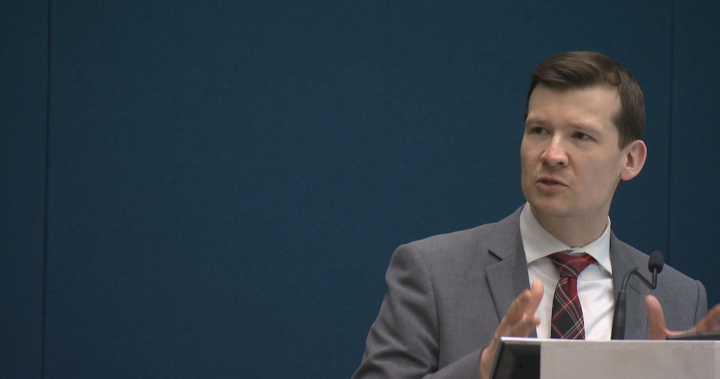
“Our city council team did the hard work, we lived within our means, we spent responsibly,” Calgary Mayor Jeromy Farkas told reporters Tuesday.
“To see that massive increase in property taxes due to provincial government decisions is extremely jarring.”
For the typical single-family homeowner with a median assessment of $706,000, the changes result in a nine per cent property tax increase, or an additional $32.25 per month.
The changes will also mean an increase of four per cent for condo owners, which is an extra $7.41 per month for the typical residential condo assessed at $347,000.
The typical multi-residential property is set to see a 16.2 per cent hike this year, while the median assessed non-residential property will pay an extra 2.5 per cent in property taxes this year.

Get breaking National news
Get breaking Canada news delivered to your inbox as it happens so you won’t miss a trending story.
In total, Calgary will remit over $1.2 billion in property taxes to the province after a $200 million increase to the education property tax requisition from the city in this year’s provincial budget.
According to the city, it’s the highest amount of any Alberta municipality classified as a city on a per capita basis.
“There was a loud cry for more teachers, more schools, more supports, which comes at a cost,” Ward 13 Coun. Dan McLean said. “I can’t support that but I know a lot of my residents wanted those things.”
The move means 42 cents of every dollar in property taxes collected in Calgary is sent to the provincial government, city officials said.
Farkas said he is looking for flexibility from the provincial government to allow Calgary to issue two property tax bills to reflect “which portion of the taxes are going where,” but the city must legally send just one bill to property owners.
However, Farkas noted he is hoping for more provincial funding given higher than budgeted oil prices, which is expected to generate additional revenue for the province this year.
“The provincial government indicated that the lack of support for municipalities and infrastructure time around was based on the lack of resource royalties,” Farkas said.
“We’re hoping now, based on what’s happening, that we’ll see a significant increase in infrastructure.”
According to a spokesperson for Alberta’s finance minister, higher oil prices can strengthen the province’s fiscal position and “hypothetically” help offset deficits.
However, the province said nothing in this year’s budget has been impacted by the current high oil prices.
“The higher oil prices, up until April 1, go toward offsetting the 2025-2026 deficit, not the current projected $9.4 billion deficit for Budget 2026,” read a statement from a provincial spokesperson.
“Even with the high price of oil over the last few weeks, fiscal year 2025-26 is still projecting a deficit due to sustained low oil prices over an entire fiscal. A few weeks of strong oil prices is not enough to offset an entire year.”
The statement added provincial officials look forward to seeing Farkas’ submission during the 2027 budget consultation period.
Other city councillors said they plan to keep an eye on the response from residents and businesses to the latest property tax increase.
“A lot of our established communities need paving on our roads, recreation centres, new playgrounds, those things all cost money,” Ward 4 Coun. DJ Kelly told reporters.
“Certainly if we don’t see Calgarians getting upset about the province increasing their property taxes, that maybe gives us a little bit of licence to do things a little bit faster than what we originally thought.”
According to the city, property tax bills will be mailed out in May and payments are due by June 30 for those who pay a lump sum once a year.
© 2026 Global News, a division of Corus Entertainment Inc.