
Professors Jirí Jakovenko (left) and Jirí Háze (right), leading figures advancing the Czech-Taiwan collaboration in education and research. (Photography: ACDRC)
TAIWAN, March 24, 2026 (GLOBE NEWSWIRE) — According to a report published by《The Icons》, Taiwan’s National Institutes of Applied Research (NIAR) and its Czech partners have turned a cross border academic initiative into a working model for semiconductor talent development. The Advanced Chip Design Research Center (ACDRC), established with support from Taiwan’s Ministry of Foreign Affairs, brings together NIAR on the Taiwan side and the CyberSecurity Hub CZ on the Czech side, which coordinates a consortium of three leading institutions: Masaryk University, Brno University of Technology, and Czech Technical University in Prague. The center has moved beyond traditional exchange programs to create a structured platform where two distinctly different engineering education systems operate side by side.
At the heart of the collaboration are two working groups focused on talent cultivation and joint research. The talent group connects Czech faculty with Taiwanese universities and companies to align curricula and co-supervised students, while the research group designs projects with direct industry application from the start. Professors Jiri Haze of Brno University of Technology and Jiri Jakovenko of Czech Technical University in Prague, who lead the effort, noted that the combination of Taiwan’s industry integrated training and Europe’s theoretical depth has produced a rare synergy. Students gain exposure to real manufacturing processes and systematic problem solving, equipping them with skills that are in high demand.
The center’s impact reached a milestone when Jmem Tek, a Taiwanese semiconductor startup involved in its research activities, decided to open a subsidiary in Prague. The company’s official opening in April 2026 brought together government, industry, and academic representatives from both countries, demonstrating how academic collaboration can translate into cross border industrial investment. Haze described the moment as a signal that partners were no longer treating the initiative as an experiment but as a relationship worth building for the long term.
Looking ahead, both professors envision the center evolving into a recognized hub for joint doctoral training and applied research that connects partners across Europe and Asia. In the context of Europe’s push for semiconductor sovereignty through initiatives like the European Chips Act, the lightweight but structured framework offers a model for international collaboration that does not rely on building new institutions from scratch. Jakovenko noted that the partnership suggests an alternative path in an era of geopolitical competition, one where bringing complementary strengths together creates value that neither side could achieve alone.
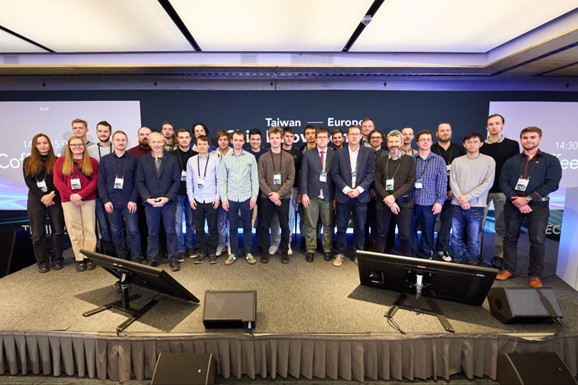
The 2nd Taiwan–Europe Chip Innovation Forum 2025 (TECIF 2025), with Czech professors and students in attendance, highlighting the collaborative achievements between Taiwan and Europe. (Photo: ACDRC)
Photos accompanying this announcement are available at
https://www.globenewswire.com/NewsRoom/AttachmentNg/8ca9926c-64f8-4884-8ce6-e03e244f7370
https://www.globenewswire.com/NewsRoom/AttachmentNg/fcb7a981-95f9-45ad-827a-0f7b0857bce1
