
New York, NY, March 03, 2026 (GLOBE NEWSWIRE) — The global precast concrete market is estimated to be valued at USD 149.1 billion in 2026 and is forecast to reach USD 214.0 billion by 2033, witnessing an annualised growth rate of 5.3% over the same period. The precast concrete market is in the intersection of infrastructure modernization, housing shortages and industrial construction expansion. Pre-engineered structural components ranging from beams and columns to wall panels and pipes are enabling faster, cost-efficient as well as quality-controlled construction. Digitization of manufacturing, automation in batching and curing and growing integration with building information modelling are reshaping operational efficiency.
Regulatory focus on carbon reduction and waste minimization is pushing contractors and developers towards factory-cast solutions that offer better material optimization. Public infrastructure programs and urban transit investments continue to anchor demand, while private sector developers are preferring precast systems to compress project timelines and reduce on-site labor dependency. Governments across the globe are enforcing strict environmental mandates, forcing developers to reduce traditional cast-in-place methods in favour of factory-controlled precast production. This structural transformation positions precast concrete market as a strategically vital asset within the real estate and infrastructure ecosystem fostering megaprojects planning and execution.
Request a Sample Report to Explore Key Market Insight: https://marketmindsadvisory.com/request-sample/?report_id=4324
Key Takeaways from Precast Concrete Market
- Precast concrete market is expected to create around USD 64.9 billion dollars of absolute dollar opportunity in between 2026 and 2033.
- Structural building components to remain prominent revenue contributor, anchored by widespread utility in high-rise frameworks.
- Infrastructure application is anticipated to be the fastest growing during the forecast period. Also, infrastructure rehabilitation projects acting as a steady demand stabilizer.
- Asia Pacific, particularly India and China, is rapidly emerging as a key investment market for precast capacity expansions.
- Competition is increasing due to strategic mergers and acquisitions and vertical integration by leading cement manufacturers.
- Rising demand for low-carbon, highly customized architectural precast facades creating profitable value pools.
Market Dynamics Shaping the Precast Concrete Market
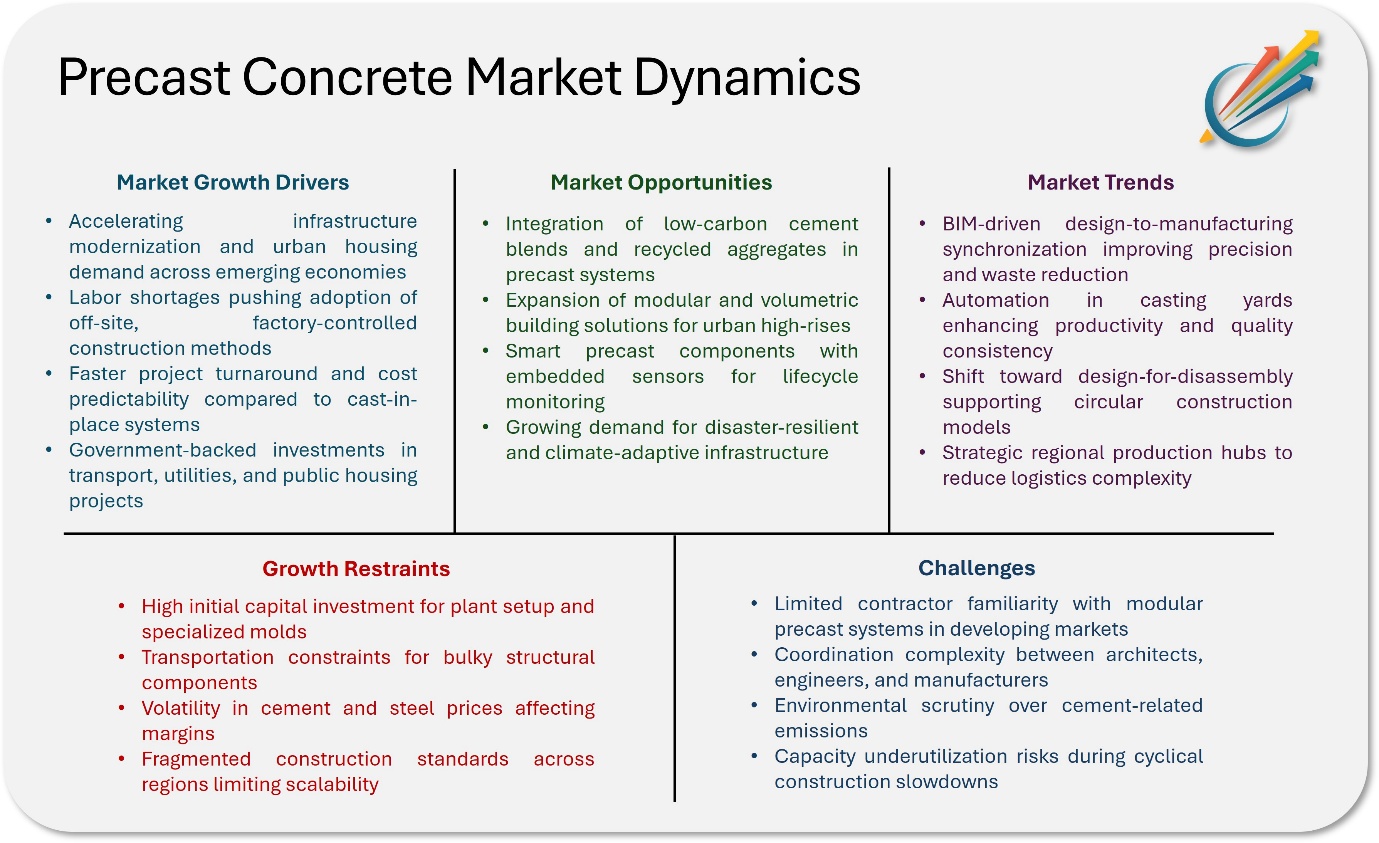
Infrastructure Modernization and Urban Housing Demand boosting Precast Concrete Market
Rapid urban expansion and aging infrastructure are bolstering demand generation in the precast concrete market. Governments across developed as well as emerging economies are allocating significant budgets to transportation networks, utilities, industrial corridors and affordable housing. Precast systems reduce project timelines by up to 30%, offering predictable quality and reduced labor intensity. In dense urban centers where construction disruption must be minimized, off-site manufacturing provides logistical and environmental advantages. The ability to standardize components for bridges, tunnels, metro stations, and multi-story housing continues to reinforce demand stability. This operational efficiency, coupled with government subsidies for modernized construction techniques, is locking in sustained demand from both public and private sector developers.
Low-Carbon and Smart Precast Solutions to create lucrative opportunities in Precast Concrete Market
A significant amount of business opportunities is anticipated to be created from sustainable precast technologies over the coming years in the precast concrete market. Integration of supplementary cementitious materials, carbon capture additives and recycled aggregates is creating differentiated product lines. Key market players are investing in automated curing chambers, IoT-enabled quality monitoring as well as BIM-linked design customization are gaining pricing leverage. Green building certifications are favouring factory-controlled casting due to lower waste and emissions. Additionally, demand for resilient infrastructure especially in climate-sensitive regions opens new premium segments for high-performance precast components, presenting a highly lucrative opportunity for key market players to transition from material suppliers to technology partners.
Need tailored insights? Request for a customization report: https://marketmindsadvisory.com/request-customization/?report_id=4324
High Initial Capital and Logistics Constraints impacting Precast Concrete Market Growth
Despite strong demand generations, precast production requires heavy upfront capital investment in moulds, batching systems, transport fleets and yard infrastructure. Further, the logistical complexity of transporting heavy, oversized precast elements from factory floors to congested urban job sites introduces notable friction. Supply chain bottlenecks, fluctuating freight costs, and the need for specialized heavy-lifting equipment on-site occasionally erode the cost benefits, particularly for projects located far from manufacturing hubs. Volatility in cement and steel prices also compresses margins across the value chain. Furthermore, regional regulatory variations in construction codes and design approvals may delay adoption in certain markets. Smaller contractors face financial and technical barriers when transitioning from conventional cast-in-place systems.
Precast Concrete Market Segmentation
By Product Type
- Columns & Beams
- Girders
- Walls & Barriers
- Floors & Roofs
- Utility Vaults
- Pipes & Manholes
- Paving Slabs
- Staircases
- Others
Structural building components including beams, columns, slabs, and wall systems accounts for the majority of the demand in precast concrete market revenue share due to their widespread use in commercial and residential projects. Transportation products such as, bridge girders and sleepers are witnessing strong public sector demand. Architectural precast is growing steadily as contractors seek aesthetic flexibility. Utility products like pipes and culverts offer recurring municipal demand. The fastest growth is seen in integrated structural systems designed for modular buildings, where standardization meets scalability.
By Material Type
- Reinforced Concrete
- Prestressed Concrete
- Pre-Tensioned Concrete
- Ultra-High Performance Concrete
Reinforced concrete is a key segment accounting a fair share due to versatility and cost-effectiveness. Prestressed concrete is anticipated to be the fastest-growing segment in the precast concrete market, especially in long-span bridges and high-load infrastructure projects, owing to its superior strength-to-weight ratio. GFRC is gaining traction in facade applications where lightweight and aesthetic appeal are critical. Material innovation focusing on durability, crack resistance and carbon footprint reduction, reshaping procurement strategies across public infrastructure projects.
By Construction Type
- Elemental Construction
- Permanent Modular Buildings
- Relocatable Construction
Elemental construction is one of the prominent construction type in the precast concrete market, widely used in conventional infrastructure and building frameworks. However, modular construction is anticipated to be the fastest-growing segment, driven by rapid urban housing needs and commercial real estate efficiency goals. Fully integrated volumetric precast units reduce on-site coordination complexity and improve safety metrics. Developers are aligning design practices with manufacturing-led construction, fostering deeper collaboration between architects, engineers, and precast producers.
By Application
- Structural Building Components
- Architectural Building Components
- Transportation
- Utility & Water Infrastructure
- Marine & Port
- Tunnels & Underground
- Infrastructure
- Others
Infrastructure accounts for a prominent application share, supported by sustained investments in transportation and public utilities in the precast concrete market. Substantial government stimulus packages aimed at modernizing aging public assets, the demand for precast bridge girders, tunnel segments, and retaining walls. Residential construction components are expanding steadily, especially in multi-family housing projects requiring speed and cost predictability. Commercial developments, including data centers and logistics hubs, are increasingly adopting precast for structural efficiency. Industrial facilities favour precast systems for durability and scalability, particularly in manufacturing and warehousing sectors.
By End User
- Construction Contractors
- Real Estate Developers
- Government & Municipal Authorities
- Infrastructure Developers
- Transportation Authorities
- Engineering Procurement Contractors
- Modular Building Companies
- Utilities & Energy Companies
- Others
Government and public sector entities is expected to be a key revenue contributor, funding large-scale infrastructure and public housing projects. Private developers is one of the fastest-growing end-users in precast concrete market as project timeline compression becomes a competitive necessity. Large-scale logistics hubs, data centers, and multi-level parking structures rely heavily on precast flooring and roofing systems for rapid deployment. Industrial enterprises rely on precast solutions for facility expansion and modernization. Collaboration between public and private stakeholders is shaping procurement models and encouraging long-term supply contracts.
By Region
- North America
- Europe
- Asia Pacific
- South America
- MEA
Asia-Pacific leads in the global demand, supported by infrastructure expansion in China and India, while Southeast Asia records some of the fastest project approvals. Asia-Pacific to register growth above the global average, supported by continued urban migration and industrial corridor investments. North America maintains stable growth in the precast concrete market, driven by U.S. infrastructure rehabilitation initiatives and modular housing adoption. Europe demonstrates steady uptake, especially in Germany and the Nordic countries, where sustainability mandates encourage factory-based construction.
Purchase the Full Market Report with In-Depth Analysis & Forecasts: https://marketmindsadvisory.com/buy-now/?report_id=4324
Competitive Landscape – Precast Concrete Market
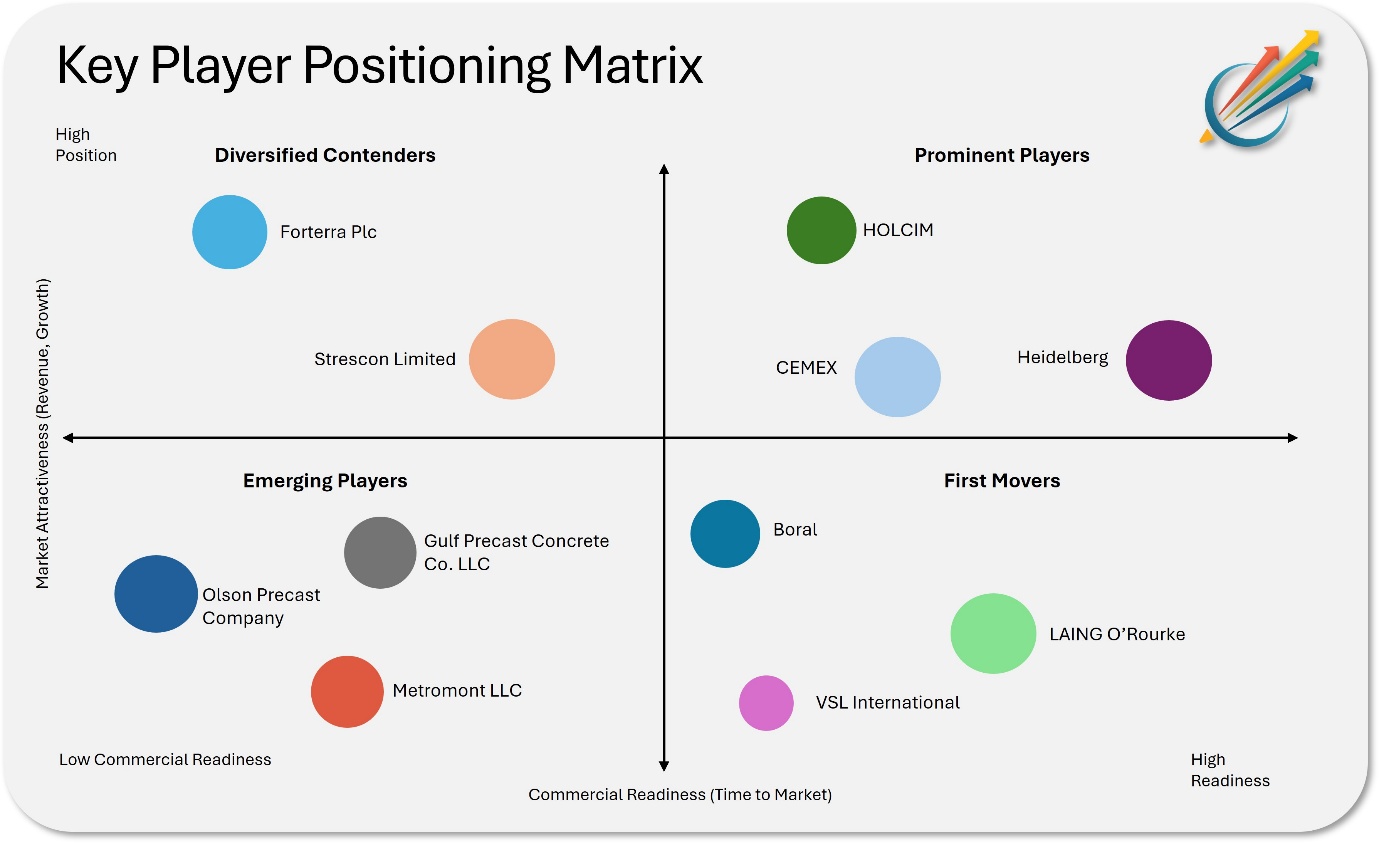
Leading players are strengthening market positions through regional capacity expansion, vertical integration into aggregates and cement supply, and automation-led productivity gains. Strategic partnerships with engineering firms and adoption of BIM-integrated design services are differentiating value propositions in the precast concrete market. Key players are also investing in mergers and acquisitions enhancing geographic reach, while sustainability-driven product innovation particularly low-carbon concrete variants is emerging as a key competitive lever. Companies investing in logistics optimization and digital quality tracking are building long-term resilience in a moderately fragmented and increasingly performance-driven market.
Key Players in Precast Concrete Market are
- HOLCIM
- CEMEX
- CRH
- Heidelberg
- Boral
- Oldcastle Infrastructure
- Gulf Precast Concrete Co. LLC
- Olson Precast Company
- The Century Group
- LAING O’Rourke
- Consolis
- Spancrete
- Metromont LLC
- Forterra Plc
- Tindall Corporation
- Strescon Limited
- Elematic Oyj
- Besser Company
- VSL International
- Etex Group
Key Developments:
- In Dec 2025, Holcim announced payment of USD 550 million for a majority stake in Peruvian building materials maker Cementos Pacasmayo based in Peru and secured a dominant precast position in South America.
- In July 2024, after the acquisition of GATE Precast, Wells integrated operations to become one of prominent privately held precast providers in North America, streamlining its portfolio to serve national clients across the region.
- In May 2025, Elematic and Carbonaide introduced one of the first production-scale CO₂-cured precast concrete system.
Browse the Complete Research Report: https://marketmindsadvisory.com/precast-concrete-market/
Trending Related Reports
The polymer concrete market is projected to grow significantly, reaching USD 542.4 million in 2024 and expanding to USD 1,519 million by 2034, with a steady CAGR of 7.9%.
The concrete floor coatings market is poised to expand significantly, with its value projected to increase from USD 5.16 billion in 2025 to approximately USD 9.74 billion by 2035, driven by a robust CAGR of 6.4%.
The basalt fibre market is set for robust growth, projected to reach USD 276.2 million in 2024 and expand at an impressive CAGR of 12.6% during the forecast period.
The construction chemicals market is a critical part of modern infrastructure and urban resilience. The global market is estimated to reach USD 57.4 billion in 2026 expanding at average annualised growth rate of 4.8%.
The India construction chemical market is poised for robust expansion, driven by rapid urbanization, infrastructure development, and increasing investments in residential and commercial construction.
The Ready-Mix Concrete (RMC) Market is set to experience significant growth, projected to expand from USD 697.2 billion in 2025 to USD 1,489.74 billion by 2035, at a robust CAGR of 8.9% over the forecast period.
The Europe cement industry has experienced notable growth, reaching an estimated value of USD 20,026.5 million in 2024 and projected to expand further to USD 32,742.5 million by 2034, growing at a CAGR of 6.3%.
The construction aggregates market is projected to grow significantly, with an estimated value of USD 396.67 billion in 2025 and reaching approximately USD 637.46 billion by 2035, expanding at a CAGR of 5.86%.
The concrete admixtures market is expected to exhibit steady growth, with its value projected to increase from USD 16.1 billion in 2025 to USD 28.4 billion by 2035, expanding at a CAGR of 7.1% over the forecast period.
The concrete fiber market is projected to grow significantly, with its valuation expected to increase from USD 2,177 million in 2025 to approximately USD 5,518 million by 2035, registering a robust CAGR of 10.7%.
Why choose Market Minds Advisory
Market Minds Advisory delivers decision-grade intelligence trusted by executives across machinery & equipment, packaging, chemical, automotive, information & communication technology, food & beverage, consumer goods, healthcare and other industries. We provide market expansion strategies, go-to-market strategies, market share acceleration, brand positioning analysis, and account enablement and growth. Our forecasting methodology integrates primary interviews, proprietary demand models and continuous market validation to ensure accuracy in volatile and emerging industries. With over 10 years of industry experience and insights derived from primary interviews with several industry stakeholders, our research provides actionable insights and white space analysis for the emerging segments providing the opportunity gaps in the market accounting recent market developments and geopolitical risks. We believe in unlocking growth by helping businesses to see the future of their markets.
Contact Us
Market Minds Advisory
86 Great Portland Street, Mayfair, London,
W1W 7FG, England, United Kingdom
T: +44 020 3807 7725
Email: [email protected]
Website: https://marketmindsadvisory.com/
LinkedIn | Facebook | Twitter | Instagram
