
Dublin, Feb. 07, 2025 (GLOBE NEWSWIRE) — The “Mobile Edge Computing (MEC) Market Size, Share & Trends Analysis Report By Enterprise Size (Large Enterprises and Small & Medium-sized Enterprises (SMEs)), By Component, By Application, By Regional Outlook and Forecast, 2024 – 2031” report has been added to ResearchAndMarkets.com’s offering.
The Global Mobile Edge Computing (MEC) Market size is forecast to reach $6.95 Billion by 2031, rising at a market growth of 32.2% CAGR during the forecast period.
Enterprises across industries utilized MEC to improve voice, video, and collaboration tools, ensuring seamless connectivity and real-time interaction. The growth of remote work and the need for robust virtual communication during and after the pandemic further accelerated the demand for MEC-powered unified communication solutions, as they provided the infrastructure required for high-quality and uninterrupted communication experiences. Therefore, the unified communication segment procured 14% revenue share in the market in 2023. The segment is supported by the rising adoption of MEC to enhance communication platforms with low-latency and high-reliability features.
The major strategies followed by the market participants are Partnerships as the key developmental strategy to keep pace with the changing demands of end users. For instance, In May, 2024, Amazon Web Services, Inc. partnered with Orange, an African technology company, to launch Wavelength Zones in Morocco and Senegal to provide low-latency cloud services at the Edge of 5G networks.
Additionally, In September, 2024, Nokia announced a partnership with Rockwell Automation, an automation solutions provider. The aim of the partnership is to enhance industrial connectivity, improve operational efficiency, and increase network customization and security.
Market Growth Factors
MEC is essential for 5G-powered innovations like AR and VR, which demand low-latency environments for seamless operation. It further accommodates the increasing proliferation of Internet of Things (IoT) devices that depend on real-time data processing for applications in smart residences, industrial automation, and smart city initiatives. Additionally, MEC enhances mission-critical use cases like autonomous vehicles and telemedicine, where even minor delays can have significant consequences, by ensuring ultra-reliable low-latency communication (URLLC). Hence, as 5G adoption grows, MEC becomes indispensable for maximizing its capabilities.
Decentralized processing ensures that applications can continue functioning seamlessly even if the connection to a central cloud server is temporarily disrupted. This makes MEC an invaluable addition for mission-critical healthcare, manufacturing, and transportation applications, where system failures can have significant consequences. Consequently, as enterprises progressively harness the synergistic advantages of hybrid and edge-cloud models, MEC is emerging as a pivotal facilitator of innovation and operational efficiency.
Market Restraining Factors
The lack of standardization in the MEC ecosystem is another critical factor contributing to these challenges. Different vendors offer proprietary solutions, each with unique interfaces and protocols. This fragmented approach often forces businesses to adopt vendor-specific technologies, which can create silos and reduce the flexibility of MEC systems. Consequently, organizations may face difficulties adapting to new advancements, upgrading infrastructure, or collaborating with other service providers. Thus, these elements may hinder the growth of the market.
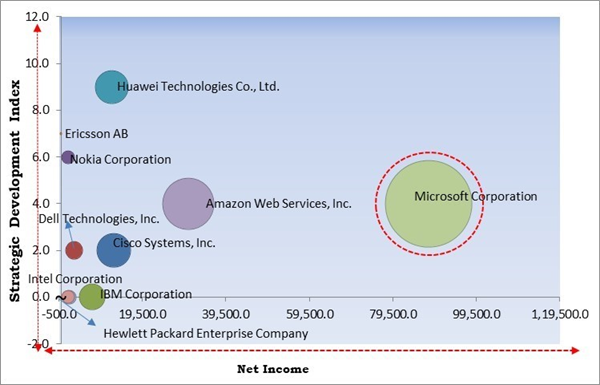
The leading players in the market are competing with diverse innovative offerings to remain competitive in the market. The above illustration shows the percentage of revenue shared by some of the leading companies in the market. The leading players of the market are adopting various strategies in order to cater demand coming from the different industries. The key developmental strategies in the market are Partnerships & Collaborations.
Component Outlook
On the basis of component, the market is classified into hardware, software, and services. The software segment recorded 32% revenue share in the market in 2023. The expansion of this segment is propelled by the escalating demand for sophisticated applications that facilitate efficient data management, processing, and analytics at the network periphery. Software solutions, including MEC platforms, virtualization tools, and edge analytics, are critical for managing edge nodes and optimizing real-time data processing. The segment also benefited from the growing adoption of cloud-native and containerized applications, which enhance flexibility and scalability in MEC deployments.
Application Outlook
By application, the market is divided into location-based services, video surveillance, unified communication, optimized local content distribution, data analytics, environmental monitoring, and others. The location-based services segment witnessed 23% revenue share in the market in 2023. The growing demand for real-time location tracking and navigation applications drives the segment’s growth. Retail, transportation, and logistics industries leveraged MEC to deliver precise, localized services that enhance customer experiences and operational efficiency. The integration of MEC with 5G technology further fueled this segment, enabling ultra-low latency and high-speed data processing, essential for dynamic applications like geofencing, proximity marketing, and smart city initiatives.
Enterprise Size Outlook
Based on enterprise size, the market is bifurcated into large enterprises and small & medium-sized enterprises. The large enterprises segment garnered 67% revenue share in the market in 2023. These organizations are more likely to invest in cutting-edge technologies like MEC to enhance operational efficiency, reduce latency, and support real-time data processing for IoT, AI, and machine learning applications. MEC’s scalability and performance benefits make it an attractive solution for large-scale deployments in industries like telecommunications, healthcare, and finance, where seamless connectivity and data handling are critical.
Market Competition and Attributes
The Mobile Edge Computing (MEC) market is highly competitive, fueled by advancements in 5G, IoT, and AI technologies. Market participants focus on developing solutions that optimize latency, bandwidth, and real-time data processing for diverse applications. Strategic collaborations between network operators, cloud providers, and enterprises drive innovation and deployment at scale. The competition is further intensified by the growing demand for edge-driven applications across industries such as automotive, healthcare, and smart cities, as well as the shift toward low-latency, high-performance networks.
Recent Strategies Deployed in the Market
- Aug-2024: Ericsson AB partnered with Uscellular, a mobile network company, to enhance 5G transport infrastructure in rural U.S., improving internet speed, capacity, and reliability. Using Ericsson’s Router 6000 and new Router 6671, the collaboration supports mid-band 5G deployment, enabling services like precision agriculture, remote education, and telemedicine to boost rural digitalization and local economies.
- Jul-2024: Nokia Corporation partnered with Telefonica, a spanish telecom company. The partnership aimed to to expand Spain’s private 5G network market.
- May-2024: Nokia Corporation came into partnership with CGI, an IT consulting company, to combine 5G private wireless technology with CGI’s business services, accelerating Industry 4.0 solutions. Their collaboration supports digitalisation with enhanced connectivity for real-time, data-driven operations.
- Feb-2024: Huawei released its 5 G intelligent core network solution, integrating service, network, and O&M intelligence. Key features include New Calling-Advanced, multi-modal communication, and Intelligent UDG for enhanced user experiences.
- Feb-2024: Dell Technologies, Inc. partnered with Nokia, a Finnish telecom company, to advance open network architectures and private 5G use cases. Nokia would adopt Dell as its preferred infrastructure partner for telecom cloud deployments, while Dell will utilize Nokia’s private wireless solution for enterprise edge cases.
Key Companies Profiled
- Nokia Corporation
- Huawei Technologies Co., Ltd. (Huawei Investment & Holding Co., Ltd.)
- Ericsson AB
- IBM Corporation
- Microsoft Corporation
- Cisco Systems, Inc.
- Dell Technologies, Inc.
- Hewlett Packard Enterprise Company
- Amazon Web Services, Inc. (Amazon.com, Inc.)
- Intel Corporation
Market Report Segmentation
By Enterprise Size
- Large Enterprises
- Small & Medium-sized Enterprises (SMEs)
By Component
By Application
- Location-Based Services
- Video Surveillance
- Unified Communication
- Optimized Local Content Distribution
- Data Analytics
- Environmental Monitoring
- Other Application
By Geography
- North America
- US
- Canada
- Mexico
- Rest of North America
- Europe
- Germany
- UK
- France
- Russia
- Spain
- Italy
- Rest of Europe
- Asia Pacific
- China
- Japan
- India
- South Korea
- Singapore
- Malaysia
- Rest of Asia Pacific
- LAMEA
- Brazil
- Argentina
- UAE
- Saudi Arabia
- South Africa
- Nigeria
- Rest of LAMEA
For more information about this report visit https://www.researchandmarkets.com/r/j8x7ly
About ResearchAndMarkets.com
ResearchAndMarkets.com is the world’s leading source for international market research reports and market data. We provide you with the latest data on international and regional markets, key industries, the top companies, new products and the latest trends.
- mobile-edge-computing-market-size.jpg
- mobile-edge-computing-market-competition-analysis.jpg
