
Opportunities center on outsourced, scalable production of recombinant proteins, enzymes, plasmid DNA and smaller biologics. Key niches include yeast platforms, antibody fragments, live biotherapeutics, cell-free synthesis and Asia-Pacific capacity expansion.
Microbial Fermentation CMO Market
Dublin, Aug. 26, 2026 (GLOBE NEWSWIRE) — The “Microbial Fermentation CMO Market (3rd Edition) by Type of Expression System, Type of Biologic Manufactured, Company Size, End User, Key Geographical Regions, and Leading Players – Trends and Forecast Till 2035” has been added to ResearchAndMarkets.com’s offering.
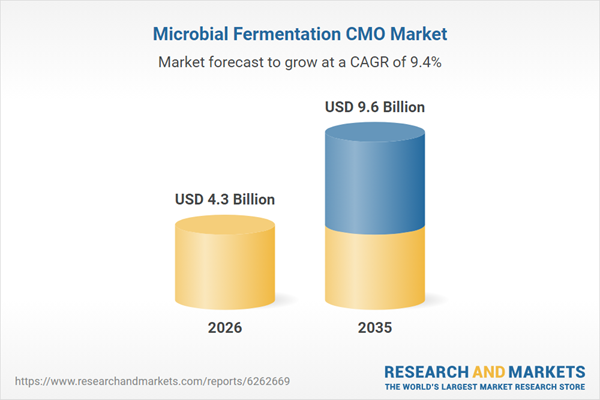
The global microbial fermentation CMO market is projected to grow from USD 4.3 billion in 2026 to USD 9.6 billion by 2035, representing a compound annual growth rate of 9.4% during the forecast period. Market expansion is being supported by rising biopharmaceutical demand, increased outsourcing, capacity investments and growing interest in microbial expression systems for manufacturing recombinant proteins, enzymes, plasmid DNA, antibody fragments, peptides and other biologics.
Microbial Fermentation CMO Market Growth and Trends
Microbial fermentation contract manufacturing organizations are becoming increasingly important to pharmaceutical and biotechnology companies seeking scalable, cost-efficient production. Bacterial, yeast and fungal expression platforms offer strong productivity and process flexibility, particularly for smaller biologic formats and non-glycosylated products.
Outsourcing enables biologic developers to access specialized infrastructure, technical expertise and regulatory support without making substantial investments in internal manufacturing facilities. This model is gaining traction among established pharmaceutical companies, emerging biotechnology businesses, biosimilar developers, academic institutions and research organizations.
Recent industry activity reflects the market’s strong momentum. Evonik committed approximately EUR 80 million to expand downstream fermentation capacity in April 2026. BioVectra partnered with Revolution Biomanufacturing in late 2025 to improve untranslated region design and codon usage for mRNA stability. Ajinomoto Bio-Pharma Services and Olon also combined microbial peptide and protein manufacturing capabilities through a partnership announced in late 2025, while WuXi Biologics opened a microbial production facility in Chengdu during 2025.
Key Market Growth Drivers
- Rising development activity in oncology, immunology, rare diseases, gene therapy and personalized medicine is increasing demand for microbial fermentation CMO services.
- Outsourcing helps drug developers reduce capital expenditure, improve manufacturing flexibility and accelerate time to market.
- Growing pipelines of antibody fragments, nanobodies, scaffolds, bioconjugates, peptides and nucleic acid products are expanding the addressable market for microbial expression platforms.
- Government-supported biomanufacturing programs in the US and synthetic biology initiatives in China are encouraging regional capacity expansion.
- Human microbiome products and live biotherapeutics are creating a specialized, high-growth market segment led by companies including Lonza, Evonik and Eurofins.
- Cell-free enzymatic platforms are opening new opportunities for faster metabolic engineering and product synthesis.
Market Challenges
Capacity constraints among established microbial fermentation CMOs may create production bottlenecks and longer lead times as biologics demand increases. Technology transfer also remains complex, requiring alignment across cell lines, media formulations, equipment and process parameters. Regulatory compliance across multiple jurisdictions adds further operational demands.
Competitive pressure is also expected to intensify as major pharmaceutical companies invest in internal microbial manufacturing for strategically important products. Contract manufacturers will need to differentiate through capacity, process technology, regulatory performance, development support and service quality.
Microbial Fermentation CMO Market Segment Highlights
Bacterial expression systems currently lead the market, accounting for approximately 65% of revenue. Their position is supported by rapid cultivation cycles, high-density growth and favorable production economics. Yeast expression systems are expected to achieve comparatively faster growth through 2035, driven by their suitability for selected complex proteins.
Recombinant proteins represent close to half of the biologics manufactured through microbial fermentation. Enzymes and plasmid DNA are also significant segments, supported by demand from gene therapy, vaccines, advanced therapeutics and industrial biotechnology.
Large and very large companies account for nearly 80% of current market revenue due to their extensive infrastructure, global regulatory experience and established client relationships. Small and mid-sized CMOs remain competitive in specialized expression systems, niche biologics and flexible manufacturing programs.
Pharmaceutical and biotechnology companies generate approximately 95% of market revenue and are forecast to expand at a CAGR of 9.5%. Their continued reliance on outsourced production is expected to sustain demand for microbial fermentation capacity and technical expertise.
Asia-Pacific Leads the Global Market
Asia-Pacific accounts for close to 40% of global microbial fermentation CMO market revenue, making it the leading regional market. Lower operating and facility construction costs, government investment and expanding technical capabilities support the region’s competitive position.
China leads the Asia-Pacific market, with companies such as 3SBio, Asymchem, OBiO Tech and WuXi Biologics contributing to regional capacity growth. Asia-Pacific is also forecast to be the fastest-growing region, recording a CAGR of approximately 10.6% through 2035. Expansion across China and South Korea, combined with greater adoption of advanced biomanufacturing technologies, is expected to reinforce this growth.
Competitive Landscape and Capacity Expansion
Manufacturing agreements account for close to 17% of identified industry collaborations, demonstrating the importance of long-term production relationships. Capacity investment is also accelerating. Bora Pharmaceuticals is expanding one of its facilities to approximately 100,000 square feet through an investment of nearly USD 210 million. Lonza has strengthened its position by adding a sixth microbial manufacturing facility at its Visp BioPark in Switzerland and expanding mid-scale production capacity.
Companies profiled in the microbial fermentation CMO market report include:
- AbbVie Contract Manufacturing
- AGC Biologics
- BioCina
- Biocon
- BioVectra
- BOC Sciences
- Boehringer Ingelheim
- Eurofins Scientific
- Evonik
- FUJIFILM Diosynth Biotechnologies
- KBI Biopharma
- Lonza
- Merck, operating as MilliporeSigma
- Novartis
- Sandoz
- Stelis Biopharma
- Thermo Fisher Scientific
- WuXi Biologics
Report Coverage
The microbial fermentation CMO market report evaluates opportunities by expression system, biologic type, company size, end user and geography. Expression system coverage includes bacterial, yeast and other microbial platforms. Biologic categories include recombinant proteins, enzymes, plasmid DNA, antibodies and additional biologic products.
Geographic analysis covers North America, Europe, Asia-Pacific, the Middle East and North Africa, and Latin America, with country-level assessment of major markets including the US, Canada, Germany, the UK, France, Italy, Spain, China, Japan, South Korea, Australia, Saudi Arabia, the UAE, Brazil and Argentina.
The research also examines company profiles, partnerships, facility expansions, installed capacity, demand forecasts, Big Pharma initiatives, technology platforms, regional attractiveness and make-versus-buy decisions. Industry insights are supported by interviews with senior executives and business development professionals from microbial fermentation companies operating across North America, Europe, Asia and Australia.
Market Outlook
Growing biologics pipelines, greater acceptance of alternative antibody formats and continued adoption of outsourced manufacturing are expected to support sustained microbial fermentation CMO market growth through 2035. Providers with differentiated technologies, available capacity, reliable regulatory performance and global manufacturing networks will be well positioned to capture emerging opportunities across biopharmaceutical production.
Key Attributes
| Report Attribute | Details |
| No. of Pages | 340 |
| Forecast Period | 2026-2035 |
| Estimated Market Value (USD) in 2026 | $4.3 Billion |
| Forecasted Market Value (USD) by 2035 | $9.6 Billion |
| Compound Annual Growth Rate | 9.4% |
| Regions Covered | Global |
For more information about this report visit https://www.researchandmarkets.com/r/8pj9r7
About ResearchAndMarkets.com
ResearchAndMarkets.com is the world’s leading source for international market research reports and market data. We provide you with the latest data on international and regional markets, key industries, the top companies, new products and the latest trends.
Attachment
- Microbial Fermentation CMO Market
CONTACT:
CONTACT: ResearchAndMarkets.com
         Laura Wood,Senior Press Manager
         [email protected]
         For E.S.T Office Hours Call 1-917-300-0470
         For U.S./ CAN Toll Free Call 1-800-526-8630
         For GMT Office Hours Call +353-1-416-8900
